Related

EU Omnibus Packages Part 5: Omnibus V – Simplifying EU Defense Regulation
EU Omnibus Packages Part 4: Omnibus IV — Product Regulation, Simplification, and Compliance

Athletes Disqualified at 2026 Winter Olympics Over PFAS

EU Omnibus Packages Part 3: Simplifying EU Agricultural Regulation
On 10 April 2024, Indiana Attorney General Todd Rokita launched a massive lawsuit against more than 20 manufacturers of per- and polyfluoroalkyl substances (PFAS), also known as “forever chemicals.” This is one of the latest lawsuits filed by state attorneys general since the issue of PFAS contamination attracted national attention. As reported by Safer States, 30 U.S. state attorneys general have initiated litigation against the manufacturers of PFAS chemicals as of April 2024 for contaminating water supplies and other natural resources.
This is just the start. The U.S. Environmental Protection Agency (EPA) designated perfluorooctanoic acid (PFOA) and per-fluorooctane sulfonate (PFOS) as hazardous substances under the Comprehensive Environmental Response, Compensation, and Liability Act (CERCLA) in a rule issued in May 2024, subjecting these substances to release reporting and notification requirements. CERCLA, also known as Superfund, makes it even more likely that states will initiate litigation for cleanup costs and damages related to PFAS.
Introduced in the late 1930s, PFAS chemicals have been widely used in many industrial and consumer products for decades. Oil repellent, heat and water resistant, and stable, these beneficial properties of many PFAS chemicals make them an indispensable part of the everyday life of regular consumers due to their use in many consumer products like food packaging materials and cookware, clothing, and textiles, to name a few.
Behind the benefits and convenience brought by these chemicals, though, a much steeper price was waiting to be paid in terms of human health and the environment: PFAS chemicals are long-lasting, and their components break down slowly in the environment over time. After decades of widespread use, the health and environmental risks of these chemicals has started to be revealed.
What makes matters more complex is the sheer number of PFAS chemicals in existence. Depending on the sources and definition used, there are a few thousand to tens of thousands of PFAS chemicals, which makes it very challenging to study and assess the potential risks to human health and the environment.
As the awareness of the potential risks associated with PFAS chemicals grows, we start to see more actions taken by all stakeholders. For instance, the EPA announced a drinking water standard for PFAS in April 2024 that aims to provide a new layer of safeguards for drinking water, reducing potential exposure to contamination for more than 100 million people.
Along with the final rule, EPA said it was allocating $1 billion in funding from the Bipartisan Infrastructure Law to help states and U.S. territories implement PFAS testing and treatment at public water systems and to help owners of private wells address PFAS contamination. The funding is in addition to a $9 billion investment in funding from the Bipartisan Infrastructure Law to help communities with drinking water impacted by PFAS and other emerging contaminants and $12 billion for general drinking water improvements.
In the meantime, state legislatures are not waiting for the federal government to take action and are making their own moves to regulate or ban PFAS. According to recent research from Safer States, at least 36 states will consider more than 450 bills on toxic chemical and plastics related policies. Safer States' analysis further determined that PFAS “will continue to dominate in 2024, with at least as many as 35 states introducing policies.”
“Because of pressure from firefighters, farmers, and families there is a tremendous amount of momentum to address these threats from petrochemicals like PFAS and toxic materials like fossil fuel-based plastics,” said Sarah Doll, national director of Safer States. “From state policy consideration to state AG action, states are continuing to lead efforts to protect public health with urgency and safer solutions.”
In this article, we'll examine the current law regulating PFAS in food packaging materials, including cookware, and cosmetics.
States Laws, Language Vary Greatly
In general, state-level PFAS laws consist of requirements for product notification and certificates of compliance for the manufacturers and distributors of products containing intentionally added PFAS. Bans on the sale and distribution of selected product categories, or all product categories in certain states, are also an essential part of the current legislative landscape for PFAS at the state level.
One issue that is hugely important for the compliance efforts of industry is the definitions of key terms used in these state laws. Other than the definition of PFAS, which is generally consistent among all states, a number of important definitions vary significantly between different states or even among legislation governing different product types within a single state.
For instance, the definition of “intentionally added PFAS” may require the PFAS added to have a functional or technical effect on the final product under some laws but not others. Similarly, PFAS chemicals that are breakdown products of an added chemical are not always considered intentionally added in all states. It is crucial to carefully review the specific laws of the states where the manufacturing, sales, and distribution activities will take place in order to accurately identify the applicable requirements for affected products.
A State-by-State Analysis
California
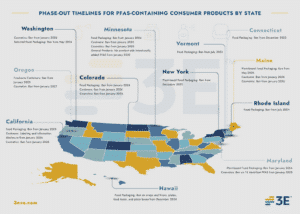
In California, food packaging materials were banned from containing regulated PFAS as of 1 January 2023. Under Chapter 15 to Part 3 of Division 104 of the Health and Safety Code, the state banned plant-based food packaging containing PFAS from being sold and distributed in the state as of 1 January 2023.
Additionally, as of 1 January 2024, cookware that contains one or more intentionally added chemicals in the handle or direct food contact surface has been subject to labeling and information disclosure requirements for these chemicals. Failure to comply with these requirements will result in a ban on the sales and distribution of the cookware.
Similarly, California will prohibit cosmetics that contain intentionally added PFAS from being manufactured, sold, delivered, held, or offered for sale in the state as of 1 January 2025. Cosmetic products that meet criteria set under the law may be exempt from this ban.
Colorado
In Colorado, the current requirements on products containing intentionally added PFAS were introduced under Bill HB 22-1345 in 2022. This bill establishes the legislative framework for regulating the sale and distribution of certain PFAS-containing products, such as plant-based direct food packaging and cosmetics. The state banned the sale and distribution of food packaging containing intentionally added PFAS as of 1 January 2024. A similar ban on cosmetics will become effective on 1 January 2025.
Additionally, food contact materials, including food packaging and cookware, are subject to specific labeling requirements that aim to clearly indicate the presence of PFAS in these products.
On 1 May 2024, Governor Jared Polis of Colorado signed Senate Bill 24-081 into law. This bill adds to the product types subject to the distribution and sales ban imposed under the act, such as cookware, and specifies the deadlines for phasing out these products. This ban will become effective for the newly identified products as soon as 1 January 2026.
Connecticut
Connecticut is another state that initiated legislation regulating PFAS. Bill SB 837, which became law in July 2021, prohibited the sale of direct food contact packaging that contains intentionally introduced PFAS in the state as of 31 December 2023. It also authorizes purchasers of food packaging materials and the state's Commissioner of Energy and Environmental Protection to request a certificate verifying compliance from the manufacturers of these products.
Hawaii
Hawaii's current legislation regulating PFAS in food packaging has a relatively narrow scope. Part XLVII of Chapter 321 of Hawaii Revised Statutes 2023 prohibits the manufacture, sale, and distribution of specific types of food packaging in the state as of 31 December 2024. This ban only applies to wraps and liners, plates, food boats, and pizza boxes.
Maine
As one of the bellwether states of PFAS regulations in the U.S., Maine established stringent requirements targeting PFAS ahead of many other states. The current law in Maine regulates PFAS through product notification requirements and bans on the sale and distribution of selected products containing intentionally added PFAS.
More specifically, manufacturer, supplier, or distributor may not offer for sale plant-based food packaging intended for direct food contact as of 25 May 2026, if PFAS have been intentionally introduced to this packaging in any amount greater than an incidental presence. Currently, this ban only applies to bags and sleeves, bowls, closed containers, flat service ware, food boats, open-top containers, pizza boxes, plates, and wraps and liners.
It's worth noting that since the introduction of its comprehensive PFAS legislation in 2021 under LD 1503, which establishes the framework product notification requirements and introduces a ban on certain PFAS-containing products, Maine has issued a number of amendments, such as LD 217 and LD 1537. Under LD 1537, cookware and cosmetics containing intentionally added PFAS will be banned in the state as of 1 January 2026.
Maryland
Maryland adopted its PFAS prohibitions and requirements in 2022. Under the George “Walter” Taylor Act, a manufacturer or distributor is prohibited from manufacturing, selling, or distributing plant-based food packaging intended for direct food contact in the state if PFAS has been intentionally added. The ban became effective on 1 January 2024.
In terms of cosmetics, Maryland passed HB0643 in 2021, which prohibits the use of harmful substances such as PFAS in cosmetic products. This ban will take effect as of 1 January 2025. This ban on PFAS as a cosmetic ingredient is only applicable to 13 identified PFAS and their salts.
Minnesota
Minnesota imposed a ban on food packaging containing intentionally added PFAS under Minn. Stat. § 325F.075 effective 1 January 2024.
Additionally, HF2310, which was signed into law in May 2023, requires information on products containing PFAS to be submitted to the Pollution Control Agency, starting in 2026. It will prohibit the sale of cookware and cosmetics with intentionally added PFAS starting 1 January 2025. By 1 January 2032, no product with intentionally added PFAS may be sold unless the use is determined to be unavoidable. Named after Amara Strande, a former student at Tartan High School in Oakdale, Minnesota, who developed a rare form of liver cancer at the age of 15 and died at age 20, this bill is titled “Amara’s Law.”
New York
New York prohibited the use of PFAS in direct food packaging in 2020. Senate Bill S8817, which was signed by the governor on 2 December 2020, banned the distribution and sale of food packaging containing intentionally added PFAS starting 31 December 2022. It's worth noting that the food packaging regulation is limited to plant-based packages or package components intended for direct food contact, such as direct food packaging made of paper and paperboard.
Oregon
Oregon enacted legislation regulating both food packaging materials and cosmetics. Under SB 543, which became effective on 1 January 2024, the sale and distribution of foodware containers incorporating intentionally added PFAS will be prohibited in the state as of 1 January 2025. Examples of foodware containers include bowls, plates, cups, lids, clamshells, or other containers or any other items used for serving or containing prepared food. The bill did not define the term “intentionally added.”
For cosmetics, SB 546 defines products covered by the term “cosmetic product” and imposes a ban on the sale and distribution of cosmetic products containing intentionally added PFAS above the practical quantification limit, which is defined as the lowest concentration of a chemical that can be reliably measured within specified limits of precision, accuracy, representativeness, completeness, and comparability during routine laboratory operating conditions. This ban will become effective on 1 January 2027.
Rhode Island
Rhode Island enacted its first legislation targeting PFAS in food packaging materials in 2022. The Toxic Packaging Reduction Act prohibits the sale of direct food packaging that contains intentionally introduced PFAS during manufacturing and distribution in any amount as of 31 July 2024. This phaseout date originally was set for 1 January 2024 but was pushed back to July.
Vermont
Vermont is another state that is active legislatively over PFAS contamination. The Green Mountain state enacted S.20, which targets food packaging intended for direct food contact, among others, in the state. A manufacturer, supplier, or distributor are prohibited from manufacturing, selling, and distributing food packaging to which PFAS have been intentionally added and are present in any amount. This bill also authorizes the state attorney general to request a certificate of compliance from food packaging manufacturers, verifying the compliance status of their products. These requirements became effective on 1 July 2023.
Washington
The current law in Washington state prohibits the sale and distribution of cosmetic products containing certain intentionally added chemicals, such as PFAS. This ban will become effective on 1 January 2025. A grace period is provided for in-state retailers, which may exhaust their existing stock through sales to the public until 1 January 2026 if they are in possession of these cosmetic products when the ban becomes effective.
Chapter 70A.222 of the Revised Code of Washington (RCW) prohibits the manufacture, sale, and distribution of this food packaging that contains intentionally added PFAS at any amount. The law requires the Department of Ecology to identify which safer alternatives are available and publish its findings before the ban becomes effective.
It also mandates a certificate confirming the compliance status of food packaging. Failure to provide this certificate may trigger a ban on the sale of that particular food packaging.
As of 1 May 2024, in the state of Washington, the manufacture, sale, and distribution for use of the selected types of food packaging that contain intentionally added PFAS are prohibited. Affected food packaging includes wraps, plates, food boats, pizza boxes, bags and sleeves, bowls, flat service ware, open-top containers, and closed containers.
—–
Editor's Note: 3E is expanding news coverage to provide customers with insights into topics that enable a safer, more sustainable world by protecting people, safeguarding products, and helping businesses grow. Deep Dive articles, produced by reporters, feature interviews with subject matter experts and influencers as well as exclusive analysis provided by 3E researchers and consultants


Insights straight to your inbox
Sign Up NowReporter
Xiaolu Wang
Xiaolu Wang is a Washington, D.C.-based reporter for 3E. She covers the latest developments in environmental, health, and safety (EHS) regulations and legislation at the U.S. state level and legal developments that impact enforcement and compliance of EHS regulations.

Related Resources
News
EU Omnibus Packages Part 5: Omnibus V – Simplifying EU Defense Regulation
News
EU Omnibus Packages Part 4: Omnibus IV — Product Regulation, Simplification, and Compliance
News
Athletes Disqualified at 2026 Winter Olympics Over PFAS
News
EU Omnibus Packages Part 3: Simplifying EU Agricultural Regulation