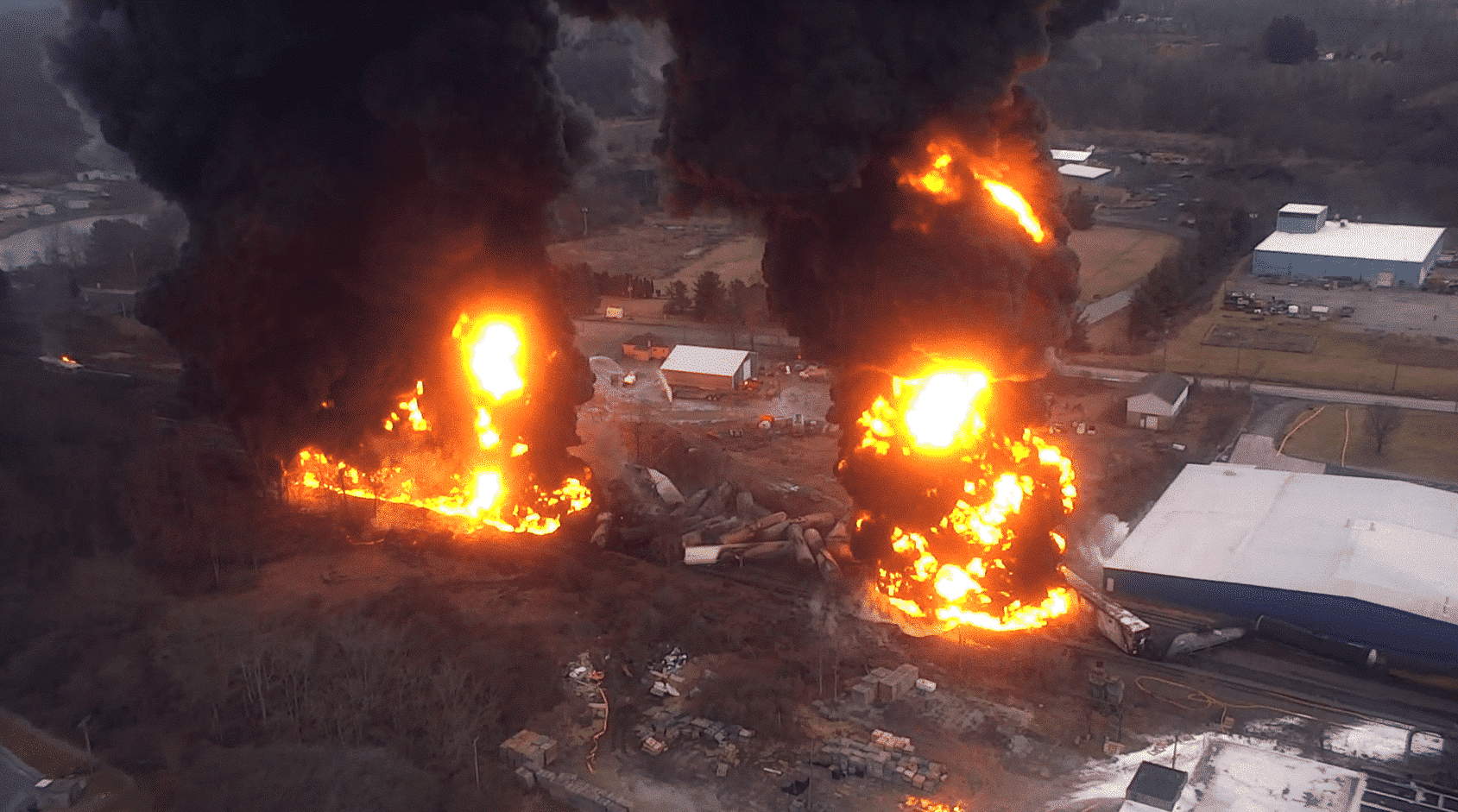
While the failure of a rail car wheel bearing caused the derailment of a Norfolk Southern Corporation train in East Palestine, Ohio, on 3 February 2023, subsequent actions that followed over the next few days made the situation worse, according to findings from investigators from the U.S. National Transportation Safety Board (NTSB).
Area residents, NTSB board members and investigators, and others gathered on 25 June 2024 at East Palestine High School to discuss the agency's investigation of the 2023 derailment of a Norfolk Southern Corporation train and subsequent venting and burning of rail cars containing vinyl chloride monomer (VCM). As a result of the derailment and venting, residents were forced to evacuate their homes; some say they will never live in East Palestine again.
“We are here to ensure that the lessons learned from this derailment will lead to meaningful change so no other community has to relive the challenges faced by the people of East Palestine,” NTSB board member Michael Graham told the audience who gathered in person and virtually to hear the findings.
At the meeting, NTSB announced “that the probable cause of the derailment involving Norfolk Southern Railway train 32N was the failure of the L1 bearing on the 23rd railcar in the consist that overheated and caused the axle to separate, derailing the train and leading to a post-derailment fire that likely began with the release of a Class 3 flammable liquid from a DOT-111 tank car that was punctured during the derailment.”
NTSB: Bearing Failed and Overheated
According to NTSB investigators, the derailment occurred when a bearing on a hopper car failed and overheated, leading to the fiery derailment in the center of this small Midwestern town.
Overheated wheel bearings are a common cause of rail accidents. Hot bearing detectors are part of a system intended to warn crews to stop the train before the hot bearing can cause a derailment. As reported on Trains.com, “Hotbox detectors failed to diagnose 124 severely defective bearings in the U.S. and Canada from 2010 to 2018, 117 of which resulted in derailments.”
Norfolk Southern had only one employee monitoring the east coast of the country. According to NTSB, he worked from home, and there was no one covering for him if he stepped away from the monitors. The crew did not receive a hot bearing warning until the train passed over a detector in East Palestine, at which point the overheated bearing was about to cause its axle to fail. The crew began to slow the train using dynamic braking, but it was too late; 38 rail cars derailed, including 11 rail tank cars carrying hazardous materials.
Prof. Constantine Tarawneh, who heads the University Transportation Center for Railways Safety at the University of Texas Rio Grande Valley, told CNN in February 2023 that temperature is not a good way to predict wheel bearing failure.
“By the time you're sensing a high temperature in a bearing, it's too late, the bearing is already in its final stages of failure,” Tarawneh told CNN, adding that more hot box detectors won't be enough to eliminate derailments caused by wheel bearing failures.
“I don't care how close you space them … it's not going to help,” Tarawneh told Trains.com.
NTSB investigators determined that the difficulty of accurately measuring temperature inside the bearing, combined with Norfolk Southern's standard operating procedures and the spacing between detectors, meant the crew did not receive adequate warning to stop the train before the derailment.
Vent and Burn is a “Last Resort”
According to the NTSB report, the continued use of DOT-111 tank cars to transport flammable liquids and other hazardous materials contributed to the severity of the hazardous materials release. The tank cars are being phased out of flammable liquids service due to their “long record of inadequate mechanical and thermal crashworthiness and propensity to release lading in a derailment,” according to NTSB. “This unacceptable safety record is why the NTSB is calling for an accelerated phaseout of DOT-111 tank cars in hazmat service.”
The NTSB reported that during the derailment, three DOT-111 tank cars were mechanically breached, releasing flammable and combustible liquids that ignited. The fire spread and exposed other tank cars to heat, leading to a decision to conduct vent and burn action on five tank cars carrying vinyl chloride monomer (VCM). The vent and burn resulted in a mushroom cloud that towered over the town and surrounding area.
The decision made by the local incident commander three days after the derailment to conduct a vent and burn was based on “incomplete and misleading information provided by Norfolk Southern officials and contractors,” investigators concluded. The vent and burn was not necessary to prevent a tank car failure.
According to the Federal Railroad Administration (FRA), a vent and burn procedure should be a last resort, used only when a tank car is about to fail. Norfolk Southern rejected three other removal methods and began planning for a vent and burn shortly after the derailment, investigators found.
Bad Information, Poor Communication Contributed to Severity
Ultimately, bad information and poor communication were the greatest contributors in making a bad situation much, much worse, said the NTSB in its report.
The NTSB specifically called out one source of information about polymerization consulted by Norfolk Southern and its contractor. According to NTSB, the Chlorine Institute's Pamphlet 171 includes “misleading information about signs of polymerization”.
When contacted for comment, the Chlorine Institute's President Frank Reiner noted his organization “takes the NTSB report very seriously, will review the report and recommendations with subject matter experts and identify any appropriate responsive actions.”
The organization sympathizes with the community and individuals that have been affected by the East Palestine derailment, Reiner said, adding that the Chlorine Institute shares the goals of the NTSB “in maximizing the safe transport of life essential chemicals including chlorine, caustic, hydrochloric acid, bleach, and VCM.”
He emphasized the chemicals are used to make critical products, such as packaging for IV-drip medicines in hospitals, disinfectants to provide clean drinking water, and piping for houses and buildings.
In addition, the NTSB stated that Norfolk Southern and its contractors “continued to describe polymerization as an imminent threat when expert opinions and available evidence should have led them to reconsider their course of action. [Norfolk Southern] compromised the integrity of the decision to vent and burn the tank cars by not communicating expertise and dissenting opinions to the incident commander making the final decision. This failure to communicate completely and accurately with the incident commander was unjustified.”
The NTSB report stated that the VCM in the derailed DOT 105 tank cars remained stable and did not undergo polymerization, a dangerous chemical reaction, until the cars were deliberately breached with explosives during the vent and burn procedure. On-scene temperature trends and post-accident examinations confirmed no polymerization reaction was occurring, making the vent and burn unnecessary to prevent an explosion. The high local and environmental impacts of this decision highlight the need for federal guidance on when to conduct a vent and burn, said the NTSB.
Norfolk Southern Responds
Norfolk Southern Corporation, not surprisingly, takes issue with some of the NTSB findings. In a statement, the company said, “Norfolk Southern and its expert contractors’ only motivation in recommending the vent and burn to the Unified Command was the health and safety of the community and first responders.”
Norfolk Southern emphasized that, after careful consideration of all options, it and its specialist contractors proposed a controlled vent and burn to the Unified Command as the sole measure to safeguard the community from a potential catastrophic explosion. This recommendation was formulated with input from two of the three specialized firms in the country certified by the Chlorine Institute to handle vinyl chloride emergencies.
According to Norfolk Southern, “several key factors indicated the strong possibility of a catastrophic, uncontrolled explosion,” including:
- The tank cars had been damaged in a high-speed derailment and were exposed to extensive pool fires.
- The pressure relief devices were not working. The behavior of the pressure relief devices on the affected tank cars indicated that dangerous pressure was building inside the tank cars without being properly released.
- The manufacturer’s safety guidance warned that vinyl chloride monomer may polymerize when exposed to the conditions present at the derailment.
“Other options for safely removing the vinyl chloride monomer cars from the derailment site (such as rerailing them) were not possible, due to damage sustained in the derailment and dangerous conditions on-site,” noted Norfolk Southern.
According to NTSB’s report Norfolk Southern Railway's delay in transmitting information about the train's consist to emergency responders and the state of Ohio's “insufficient training requirements” for volunteer firefighters contributed to the exposure of emergency responders and the public to post-derailment hazards.
The Village of East Palestine agrees “that improved and more complete communications from all experts to the incident command surrounding the vent and burn decision were needed to enable incident command to make a fully informed decision.”
In a statement, the village noted that neither the East Palestine fire chief nor Ohio Governor Mike DeWine were made aware of OxyVinyls’ recommendations during the vent and burn decision-making process, adding, “Incident command is unable to make fully informed decisions when information is withheld.”
Norfolk Southern and its contractors claim they received conflicting information from OxyVinyls’ personnel as to whether polymerization was or could be occurring. An affiliate of OxyChem, OxyVinyls is the largest VCM producer in the United States.
Norfolk Southern stated that OxyVinyls’ safety data sheet clearly indicated that polymerization was possible under the observed circumstances at the derailment. It disagreed with the conclusion that it withheld OxyVinyls’ views from the Unified Command, noting that OxyVinyls “had every opportunity to participate and were present on the scene where the Unified Command was operating. There was no obstacle to Oxy Vinyls making their views known to the ultimate decision-makers.”
OxyVinyls disputes Norfolk Southern's retelling of the events following the derailment. When contacted by 3E, OxyVinyls had this to say: “We were shocked to learn that OxyVinyls' technical assessment and the temperature data collected by Norfolk Southern were not provided to the decision-makers.”
According to OxyVinyls, it was Norfolk Southern's decision to direct the incident response communication flow and it was Norfolk Southern's choice not to inform the incident commander of “OxyVinyls' data-based view” that polymerization was not occurring.
“It's surprising to us that Norfolk Southern continues to challenge the results of a thorough government investigation led by the NTSB and supported by multiple federal agencies,” said OxyVinyls. “We want to express our thanks to the NTSB and its investigators for their professionalism and the thoroughness with which they approached their work.”
Unified Command was advised that a vent and burn procedure might be necessary approximately 20 hours before the final decision was made to proceed with the operation, according to Norfolk Southern, which added: “The vent and burn effectively avoided a potential uncontrolled explosion. There was no loss of life and contractors took steps to manage environmental impact.”
“Unfortunately, some have sought to minimize the wide-ranging impacts of this derailment, pointing to the fact that there were no fatalities or injuries. For this, we are certainly grateful, but the absence of a fatality or injury doesn't mean the presence of safety,” countered NTSB Chair Jennifer Homendy. “Our agency doesn't wait for death or injury to occur. Instead, we objectively analyze the facts and evidence to make recommendations that, if implemented, will ensure this never happens again. Thanks to the hard work of our world-class investigators, we now have a roadmap to do just that.”
New Safety Recommendations
As a result of the investigation, the NTSB issued new safety recommendations to the Secretary of Transportation, FRA, PHMSA, the state of Ohio, the Association of American Railroads, Columbiana County Emergency Management Agency, the Chlorine Institute, Norfolk Southern Railway, the International Association of Fire Chiefs, the International Association of Fire Fighters, the American Chemistry Council, Oxy Vinyls, LP, and the National Volunteer Fire Council. The recommendations address safety issues including:
- Failure of wayside monitoring systems to diagnose a hot wheel bearing in time for mitigation to prevent a derailment.
- Inadequate emergency response training for volunteer first responders.
- Hazardous materials placards that burned away, preventing emergency responders from immediately identifying hazards.
- A lack of accurate, timely, and comprehensive information passed to local incident commanders and state officials.
- The continued use of DOT-111 tank cars in hazmat service.
“As this derailment has further shown and as the NTSB found, volunteer firefighters respond to the same fires as career firefighters, but with a fraction of the training,” noted the statement from East Palestine. “All village volunteer firefighters have at least the state minimum training. And as the NTSB further found, each and every first responder at the derailment did the best they could under extraordinarily challenging circumstances.”
Stay tuned for Part Two of this story, DEEP DIVE: East Palestine: 'We Can't Move Forward' Following Train Derailment.
————
Editor's Note: 3E is expanding news coverage to provide customers with insights into topics that enable a safer, more sustainable world by protecting people, safeguarding products, and helping businesses grow. Deep Dive articles, produced by reporters, feature interviews with subject matter experts and influencers as well as exclusive analysis provided by 3E researchers and consultants.


Insights straight to your inbox
Sign Up NowIndustry Editor
Sandy Smith
Sandy Smith is an award-winning newspaper reporter and business-to-business journalist who has spent 20+ years researching and writing about EHS, regulatory compliance, and risk management and networking with EHS professionals. She is passionate about helping to build and maintain safe workplaces and promote workplace cultures that support EHS, and has been interviewed about workplace safety and risk management by The Wall Street Journal, CNN, and USA Today.

Related Resources

News
EU Omnibus Packages Part 5: Omnibus V – Simplifying EU Defense Regulation
News
EU Omnibus Packages Part 4: Omnibus IV — Product Regulation, Simplification, and Compliance

News
Athletes Disqualified at 2026 Winter Olympics Over PFAS

News
EU Omnibus Packages Part 3: Simplifying EU Agricultural Regulation