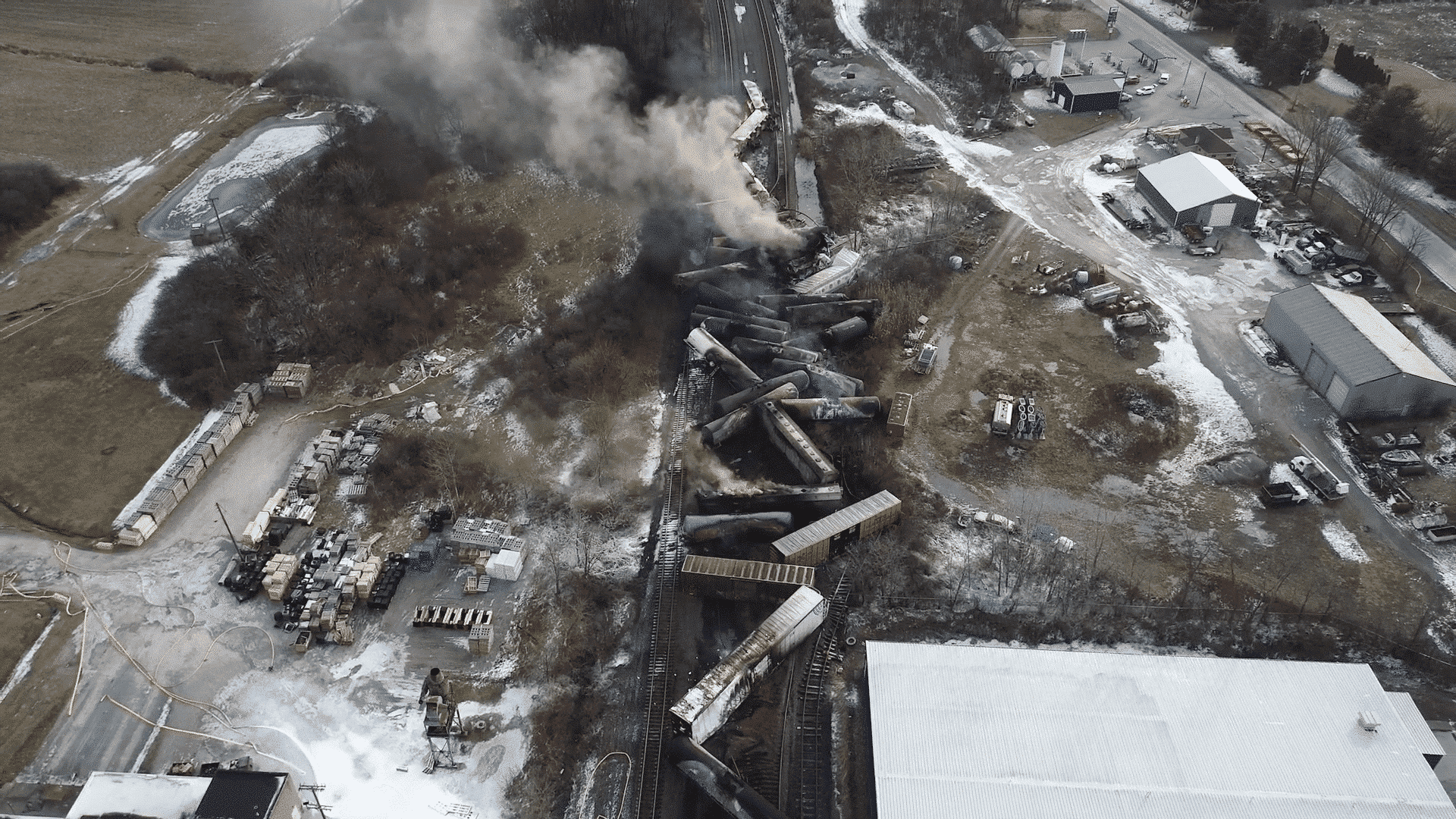
What were you doing at 8:55 p.m. on 3 February 2023? Maybe you were getting kids ready for bed, working second shift, watching television, walking the dog. It's hard to remember back that far.
However, it's highly likely that most, if not all, the residents of East Palestine, Ohio, can tell you exactly what they were doing at that time on that date. Because that was the time and the day that “normal” changed for them.
For the residents living in and around the village of East Palestine, the 3 February 2023 derailment of a Norfolk Southern Corporation train caused panic for many, financial devastation for some, and the loss of a sense of safety and community for most that they say can never be recovered.
The National Transportation Safety Board (NTSB) met with residents of East Palestine on 25 June 2024 to share the results of a comprehensive investigation into the cause of the derailment.
According to the transportation safety agency, a rail car's defective wheel bearing caused the fiery derailment and subsequent hazardous material release in the center of a small Ohio village. As bad as the derailment and fire were, subsequent actions magnified the danger, according to NTSB's report.
NTSB investigators, speaking at the day-long NTSB board meeting held at East Palestine High School, said the decision by the local incident commander three days after the derailment to conduct a vent and burn of the contents of the tank cars carrying vinyl chloride monomer (VCM) escalated the situation and potentially contributed to further contamination. Investigators noted his actions were based on incomplete and misleading information provided by Norfolk Southern officials and contractors. The vent and burn was not necessary to prevent a tank car failure, NTSB investigators found.
Residents continue to feel they are being kept in the dark about certain aspects of the derailment, cleanup, and potential lingering health hazards and impacts - not surprising given NTSB's findings that Norfolk Southern Railway and its contractors failed to communicate relevant expertise and dissenting opinions to the incident commander. Residents and first responders worry about long-term health effects from the derailment, fire, and subsequent and apparently unnecessary venting and burning of five rail cars containing VCM.
“My father worked for the railroad for years and he died six months before this happened and I'm glad he didn't live to see this,” long-time resident Vicki Hoffman told me. Hoffman and her husband, Doug Simpson, live just a few blocks from the site of the derailment, in a home that has been in Doug's family for more than a century.
“The truth just keeps trickling out,” Hoffman said. “We can't move forward until everyone's health is taken care of. It's the uncertainty and the lies. Once you're caught in a lie, then we don't believe anything you say after that.”
EPA, Justice Settle with Norfolk Southern
“Norfolk Southern's train derailment and massive chemical spill onto East Palestine's grounds and into its waterways jeopardized the safety and health of residents, damaging their homes, their lives and the environment,” said U.S. Attorney Rebecca C. Lutzko for the Northern District of Ohio, when a settlement was announced on 23 May 2024 between the U.S. and Norfolk Southern. “That is why the Department of Justice diligently worked to hold Norfolk Southern responsible for this disaster by quickly filing suit and negotiating a resolution that protects residents' interests.”
Under the settlement, Norfolk Southern has agreed to:
- Spend an estimated $235 million for all past and future cleanup costs, so that cleanup efforts can continue and the company, rather than taxpayers, covers the cost.
- Pay $25 million for a 20-year community health program that includes medical monitoring for qualified individuals, mental health services for individuals residing in affected counties as well as first responders who worked at the site and a community facilitation plan to assist community members in using the benefits of the program.
- Spend approximately $15 million to implement long-term monitoring of groundwater and surface water for a period of 10 years.
- Pay $15 million for a private drinking water monitoring fund that will continue the existing private drinking water well monitoring program for 10 years.
- Implement a “waterways remediation plan,” with an estimated budget of $6 million, for projects in Leslie Run and Sulphur Run that will prioritize addressing historical pollution, reducing non-point source pollution through infrastructure upgrades and stormwater management projects, and restoring aquatic and riparian habitat.
- Pay a $15 million civil penalty to resolve the alleged violations of the Clean Water Act.
- Pay $175,000 for natural resource damages, to be used by the United States to restore, rehabilitate, replace, or acquire the equivalent of the natural resources injured as a result of the derailment.
In addition, the consent decree requires Norfolk Southern to undertake projects to improve the safety of transporting hazardous materials by rail. These projects will include the installation of additional devices to detect overheated wheel bearings early enough to prevent derailments like the one that happened in East Palestine. Norfolk Southern has estimated that its costs dating from the derailment will exceed $200 million in rail safety enhancements alone.
The Human Cost of the East Palestine Disaster
“The human cost from the Norfolk Southern train derailment disaster was high and continues today,” said Assistant Attorney General Todd Kim of the Justice Department's Environment and Natural Resources Division. “That is why we worked to include funding in this agreement for a community health program. Notably, this settlement also secures significant resources to complete cleanup in and around East Palestine as well as measures to detect and address potential rail safety risks.”
From what Hoffman has seen, the “community health program” includes group therapy sessions as well as yoga and tai chi classes. “Feel good stuff,” said Hoffman.
So, what does a community health program mean to her? “In an ideal world, I would like Norfolk Southern to pay for the medical care of everybody in town or in our zip code for the rest of our lives. Anyone who lives in town and has been smelling this day to day, I think we're all going to get cancer,” said Hoffman.
Months ago, Hoffman told me the Environmental Protection Agency (EPA) came to the village and offered to test homes for various chemicals and hazards. More than 600 residents signed up, Hoffman and Simpson among them. The experience left a sour taste in Hoffman's mouth, no pun intended.
“We don't really trust the EPA anymore. Turns out they didn't have their machines calibrated [properly] to test for dioxides,” said Hoffman.
What residents didn't know then but do know now is that the EPA also didn't test the majority of their homes for butyl acrylate, one of the main chemicals that contaminated their town following the derailment and likely one of the main culprits for the widespread complaints about irritation of the eyes, nose, throat, and lungs. Two of the cars that derailed contained approximately 386,000 pounds of acrylates - butyl acrylate and ethylhexyl acrylate - which are used in the manufacture of paints, coatings, and sealants.
“I would say this is one of the most significant errors associated with the response,” Dr. Andrew Whelton, a professor of Civil Engineering and Environmental and Ecological Engineering at Purdue University who also conducted testing in East Palestine, told CNN.
A community health assessment conducted by the National Center for Environmental Health of the Agency for Toxic Substances and Disease Registry shortly after the derailment found that out of 702 responses, approximately 90% of respondents complained of symptoms ranging from headaches and stuffy noses to breathlessness and dizziness. More than two-thirds of respondents (70%) reported new or worsening mental health symptoms.
Perhaps more alarmingly, the majority of first responders who took a similar survey reported they were not wearing respirators during their response activities. Nearly 40% of the responders, the majority of whom are volunteers, who said they had received any chemical safety training at some point during their time as a first responder admitted they had not taken any in the past year.
As noted in the recent CNN article, case studies of previous exposures to butyl acrylate spills have raised questions about long-term health effects.
Settlements Won't Restore Sense of Community
Of her home for the past 50 years, Hoffman now says, “We don't feel the same about it. Now it's just a house; it's not a home.” Shortly after the derailment, Hoffman and Simpson moved to a trailer about 10 miles away from East Palestine. They divide their time between their house and the trailer, with Simpson generally spending more time in town because of meetings and other commitments. Hoffman said she spends much less time there, citing her fear of possible long-term health impacts.
“Our house is over 100 years old. I don't think we could ever get our house uncontaminated. I'd like them to buy our houses. It's just not the same,” she said.
Simpson agrees that life in East Palestine has changed. “It's a rural community. It was a tight-knit community. There have been a lot of divided feelings post-incident,” he admitted. As a member of the Village Council, Simpson has experienced first-hand how heated and divisive things have become.
In some instances, especially when it comes to participating in health studies to determine if there will be long-term health impacts from exposure to vinyl chloride or accepting a $600 million settlement offer from Norfolk Southern Corporation, it has become neighbor against neighbor in some cases, Hoffman and Simpson say. Their small Ohio community, and the way they view it, has been changed forever by the failure of a wheel bearing on a train car and the events that happened afterward.
What's Next for Rail Safety, East Palestine?
Norfolk Southern said it has taken steps to improve safety, and over the last 16 months has implemented many enhancements and technologies to “make our railroad even safer.”
Among the NTSB recommendations specific to Norfolk Southern, the company already has taken action to enable the immediate availability of train consist information to first responders and to encourage contractors to share information to make emergency response decisions. In addition, it has addressed the Federal Railroad Administration (FRA) recommendations from its 2023 Safety Culture Assessment.
“As a result of these actions and others, Norfolk Southern’s mainline accident rate declined 38% last year to industry leading levels,” noted a statement from the company. “We will move quickly to compare the NTSB’s recommendations to our current protocols and will implement those that advance our safety culture.” Saying it is a company that keeps its promises and that it promised to “clean the site safely, thoroughly, and with urgency,” it has completed the removal of impacted soil. In addition, it says, “robust” sampling programs, under EPA oversight, at the derailment site and in the community at large have consistently shown the air and water around the site are safe. Moreover, Norfolk Southern has invested more than $5 million to overhaul the municipal water system with state-of-the-art technology, including new engineering and carbon filtration systems.
“No community should have to experience the trauma inflicted upon the residents of East Palestine,” said EPA Administrator Michael S. Regan. “[EPA's] enforcement action … ensures the cleanup is paid for by the company and helps prevent another disaster like this from happening again. Because of this settlement, residents and first responders will have greater access to health services, trains will be safer, and waterways will be cleaner.”
“We take our responsibility to East Palestine and the surrounding community seriously,” stated Norfolk Southern. “Since day one we have followed through on our commitment to doing what’s right to ensure the area recovers and thrives. We continue to update our progress at NSMakingItRight.com.”
“They keep saying they're 'making it right.' They'll never make it right,” Hoffman countered.
(For more information about the National Transportation Safety Board investigation into the Norfolk Southern train derailment in East Palestine, see the article DEEP DIVE: U.S. NTSB: The Decision to Vent and Burn Norfolk Southern Rail Cars in East Palestine “Unnecessary.”)
——-
Editor's Note: 3E is expanding news coverage to provide customers with insights into topics that enable a safer, more sustainable world by protecting people, safeguarding products, and helping businesses grow. Deep Dive articles, produced by reporters, feature interviews with subject matter experts and influencers as well as exclusive analysis provided by 3E researchers and consultants.


Insights straight to your inbox
Sign Up NowRelated Resources

News
EU Omnibus Packages Part 5: Omnibus V – Simplifying EU Defense Regulation
News
EU Omnibus Packages Part 4: Omnibus IV — Product Regulation, Simplification, and Compliance

News
Athletes Disqualified at 2026 Winter Olympics Over PFAS

News
EU Omnibus Packages Part 3: Simplifying EU Agricultural Regulation