Related

EU Omnibus Packages Part 5: Omnibus V – Simplifying EU Defense Regulation

EU Omnibus Packages Part 4: Omnibus IV — Product Regulation, Simplification, and Compliance

Athletes Disqualified at 2026 Winter Olympics Over PFAS

EU Omnibus Packages Part 3: Simplifying EU Agricultural Regulation
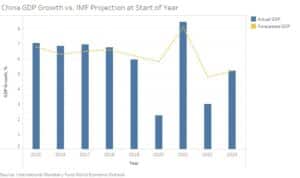
For the last few years, China's GDP growth and industrial activity has been moving at a slower pace than chemical producers predicted- and relied on. Increasing unemployment, slowed consumer spending, and a prolonged property crisis have all contributed to China's economy experiencing a slower-than anticipated recovery, and the global chemical industry is feeling the impacts.
“The situation in China certainly has an impact on the overall pricing situation in the world,” said Markus Kamieth, CEO of BASF in the company's Q2 earnings call. “There's no question about that because China is by far the largest chemical market in most of the chemical categories that we are looking at here.”
The most recent quarterly earnings reports from some of the biggest global chemical companies have one thing in common: a lower demand for products in Asia, resulting in lower prices for certain materials globally.
Low Demand Sets Low Prices for Industrial Materials
Kamieth said that over the last two years, China has grown slower than expected in GDP and in industrial activity.
“That meant that overcapacities have built up, also in the chemical markets,” he explained. “These products are looking for a home. Of course, that sets price pressure.”
Multiple companies reported a trend of decreasing prices on materials worldwide, including materials used to produce steel, polymers, and electronics. Mitsubishi Chemical Holdings (MCG), headquartered in Japan, is a producer of coke, a material used to create steel. According to MCG, the demand for steel in China has decreased enough for the company to continue reducing its production of coke, describing the demand for steel materials as “sluggish.”
“[There is] a slump in the overseas coke market, and the coke business environment is in a difficult situation,” the company stated in its first quarterly report for the 2025 fiscal year from 1 April 2024 to 20 June 2024.
The bust of the property boom in China has big contributing factor, since decreasing infrastructure growth means a decreasing demand for industrial materials like steel, according to Herbert Crowther, analyst for energy, climate, and resources at the Eurasia Group.
“Steel was always linked quite closely to the property sector,” he told 3E. “Today, the sort of newer growth drivers in China are much less steel intensive, but the production stock remains basically fully intact.”
Crowther said that in addition to the property slump, the newer growth drivers in China -products such as EVs and solar panels - are less coal-product dependent than traditional markets, driving overcapacity in heavy industry materials with increasingly less use for them.
Chemical Sales on the Decline
Dow Chemical reported year-over-year decreases in Packaging & Specialty Plastics, with net sales down 7% from 2023, according to the company's Q2 earnings report. The company attributed this to lower downstream polymer prices, primarily in Asia Pacific. Despite the year-over-year decline, the company did have slightly increased sales in Packaging & Specialty Plastics compared to the first quarter.
“The pace of the global macroeconomic recovery has been slower than expected,” said CEO James Fitterling in the company's most recent quarterly earnings call. “We remain focused on working capital, reducing costs, and matching our operating rates to current demand.”
Companies are also seeing lower demand in the electronics segment in the Asia-Pacific region, meaning less demand for the chemicals that go into electronics products, such as helium. Linde reported that even though the company is seeing positive pricing movement in some areas, it is being offset by low pricing on helium and rare gases.
China's deflation and the overcapacity issues have been setting price pressures for more than a year. Linde has a high consumer base in China and says it has been monitoring and responding to the situation for more than 18 months.
“It isn't new,” said CEO Sanjiv Lamba in the company's quarterly earnings call. “We have been undertaking this and using this as an opportunity to reset the cost base in China.”
Lamba said the cost actions the company is taking include continuing to develop cost-effective AI tools to comply with safety requirements for its facilities in China to offset some of the deflation-related production cost issues in the region. On pricing, Lamba said the company “is currently pushing to try and get pricing to continue to move up,” and said he feels good about the momentum so far.
Overcapacity Proves a Difficult Problem to Solve
Crowther said China has been working to expand its domestic production of chemicals as it moves away from traditional coal-based sectors, but the low domestic demand is creating an over-capacity dilemma in both the chemical and heavy industrial markets.
“The overcapacity issues, particularly in traditional sectors and heavy industrial sectors are very difficult to resolve from Beijing’s perspective,” he said. “Officials have for a while viewed the chemical sector as an area where they can reduce imports by expanding local production, particularly in more high value and niche chemicals where imports have historically been more prevalent.”
Crowther said one solution to the overcapacity issue could be increasing exports, but global competition remains high and demand, especially for heavy industrial materials, continues to decline. Plus, many countries, such as the U.S., continue to implement hefty tariffs on China. Recently, the Biden Administration announced its plan to increase tariff rates on steel and aluminum imports from China, as well as a plan to implement a 100% tariff rate on EVs.
Crowther said that for now, there isn't really a straightforward solution to solving China's overcapacity issues. But, the expansion of China's chemical industry, especially given the country's production capacity, will continue to have very material external effects.
“We don’t have clear answers yet,” he said. “It will require some very delicate balancing acts on the economic policy side.”
——
Editor's Note: 3E is expanding news coverage to provide customers with insights into topics that enable a safer, more sustainable world by protecting people, safeguarding products, and helping businesses grow. Deep Dive articles, produced by reporters, feature interviews with subject matter experts and influencers as well as exclusive analysis provided by 3E researchers and consultants.


Insights straight to your inbox
Sign Up NowReporter
Sheridan Wood
Sheridan Wood is 3E's Industry Reporter. She has reported on local, state, and national news for public radio stations KACU, The Texas Standard, and National Public Radio. She has won regional and national reporting awards from the Society of Professional Journalists.

Related Resources
News
EU Omnibus Packages Part 5: Omnibus V – Simplifying EU Defense Regulation
News
EU Omnibus Packages Part 4: Omnibus IV — Product Regulation, Simplification, and Compliance
News
Athletes Disqualified at 2026 Winter Olympics Over PFAS
News
EU Omnibus Packages Part 3: Simplifying EU Agricultural Regulation