Related

EU Omnibus Packages Part 5: Omnibus V – Simplifying EU Defense Regulation

EU Omnibus Packages Part 4: Omnibus IV — Product Regulation, Simplification, and Compliance

Athletes Disqualified at 2026 Winter Olympics Over PFAS

EU Omnibus Packages Part 3: Simplifying EU Agricultural Regulation
As the United States prepares for a change in administration come January 2025, President-elect Donald Trump is expected to make some major changes in the climate regulation space in the first 100 days of his second term in office. With the anticipated rollbacks of a number of Biden initiatives, it will ultimately be up to shareholders, global trade partners, or deliberate corporate choices to pressure companies to maintain climate initiatives and goals.
Post-Election Market Response
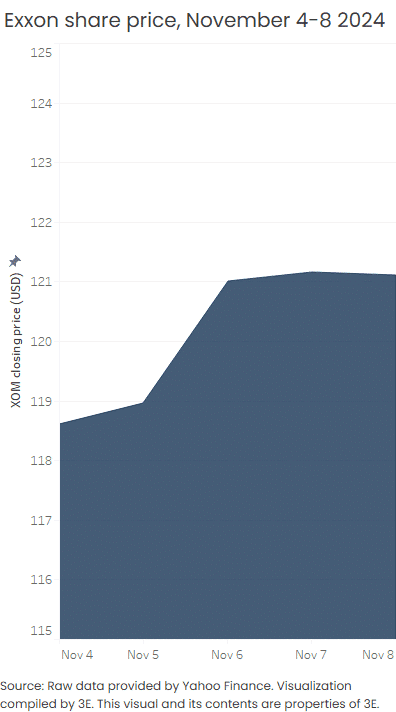
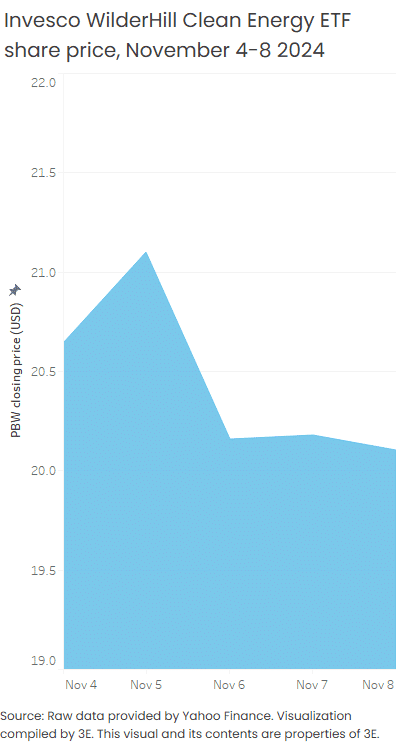
Despite the uncertainty of what exactly climate policy under a second Trump term may look like, the 6 November 2024 stock market likely revealed what the world expects from a second Trump administration. Nearly all markets, including oil and gas companies like ExxonMobil, saw an uptick in stock price. But renewables businesses, like Invesco WilderHill Clean Energy, saw the opposite, going down several points immediately following the election and it's been on the decline since.
“Markets are an immediate sort of animal spirit reflecting what we have right now,” said Ian Bremmer, president of the Eurasia Group, in a live interview with Foreign Policy.
Although the trends we're seeing in the stock market are likely a short-term response to Trump's election, it is indicative of which industries investors project Trump's administration will benefit - and it likely will not be renewables.
Anticipating a Deregulatory Environment
Glenn Schwartz, director of energy policy at Rapidan Energy Group, told 3E that Trump does not believe climate change is much of a problem. As a result, his climate policies operate on a cost-benefit analysis: If there is no problem to be solved, then any cost to address that problem is too high.
“He’s no big believer in regulations in general,” Schwartz said. “We expect to be in a deregulatory environment, and that’s really no surprise.”
Expected regulatory rollbacks will be overseen by Trump's appointee to lead the U.S. Environmental Protection Agency (EPA), Lee Zeldin, assuming he receives congressional confirmation. Zeldin noted in a Fox News interview that he will have an opportunity to “…roll back regulations that are forcing businesses to struggle” and pursue U.S. energy dominance.
“A lot of sectors feel like they will be more unrestrained with regulatory rollback,” Bremmer said.
Under President Joe Biden, the U.S. has already reached a record oil production of 13.5 million barrels of oil a day. Trump's “drill, baby, drill” mindset, coupled with the fact that Trump is a known friend of the oil and gas industry, means that number will only go up. This is likely to make carbon-based energy cheaper.
However, the energy landscape has changed in the four years since Trump last held office. For instance, Bremmer made a point to say that while Texas is the oil and gas capital of the U.S., it is also the post-carbon transition energy capital of the country. The clean energy market is expanding, and although Trump may rollback clean energy regulations, it does not mean that clean energy transition is going to be brought to a total halt under his administration.
“Trump is certainly going to put his thumb on the scale in favor of CEOs of oil and gas companies,” Bremmer said. “But he's not going to stop transition energy development. There are too many red state jobs that are reliant on it.”
Consequences of a Second Exit From the Paris Climate Accord
Many businesses set their corporate sustainability goals to stay in alignment with the objectives of the Paris Climate Accord. Trump pulled the U.S. from the Paris Accord during his first term as president and is expected to almost certainly do so again.
But this time around, companies are operating in a different energy environment. At COP 29, the United Nations Climate Change Conference in Baku, Azerbaijan, ExxonMobil CEO Darren Woods stated that pulling the U.S. from the Paris Climate Accord for a second time would be a bad idea. The oil and gas giant has, like many other companies, invested in increasing sustainability efforts, and the results are proving to be worth it.
“The fact is that post-carbon energy investment at scale is not only proven, but is proven at a very efficient level,” Bremmer said. “The cost of wind and solar have come down exponentially.”
Although there are no hard-and-fast consequences for nations falling short of their Paris Accord agreements, Woods told the New York Times that a global system for managing emissions is valuable, and the U.S. should be a part of it. While the administration would certainly face backlash from environmental groups and corporations alike should the U.S. leave the Paris Accord, a more severe threat is the potential for Trump to withdraw the U.S. from the United Nations Framework Convention on Climate Change (UNFCCC). The treaty is a more rigorous international effort involving the private sector to help combat climate change and would be more challenging to reenter at some future point, requiring a congressional vote.
Additionally, other countries that are U.S. trade partners have their own climate policies - and they may not make exceptions for imports from the U.S. that compromise the decarbonization of their supply chains. For example, the European Union is one of the biggest consumers of U.S. liquified natural gas (LNG) and has some of the strictest rules on imported methane emissions. Schwartz said between the EPA methane regulations and the Inflation Reduction Act (IRA) methane tax, the U.S. meets the definition of “equivalence” for the EU’s import regulations, allowing the U.S. to avoid price penalties down the line.
“If [Trump] and Congress repeal the methane fee, which I expect to happen, we would no longer really have a leg to stand on to argue that our gas is equivalent from a methane emission standpoint, and that could hurt us in LNG,” he said.
Schwartz said another area of concern is green hydrogen, of which the EU is also a big consumer. He expects Trump to expand green hydrogen rules so more businesses are eligible for tax cuts, but in a way that would likely fall out of scope with the EU's regulations and affect hydrogen trade down the line.
Tax Credits and the Inflation Reduction Act
While Trump may have an agenda to clean out a large portion of Biden-era climate policies, U.S. House Speaker Mike Johnson said the administration will need to take “a scalpel, not a sledgehammer,” to the incumbent's IRA. It is unclear exactly what elements of the IRA will stay and which will go, but Schwartz said the economic, labor, and investment benefits from the IRA have been disproportionately flowing to Republican districts, and getting rid of it would undermine some of those gains, but that does not mean the IRA is safe.
“One of the first things this Republican Congress is going to do is start a reconciliation bill to extend the Trump-era tax cuts, and that is going to be something like $5 trillion at a minimum in new debt,” he said. “They are looking for ways to pay for that, and their options are limited. There’s not a lot of places to look apart from the IRA.”
Schwartz said the unspent grants and funds from the act will likely be recouped, but it remains to be seen how much of the tax credits for clean energy initiatives will remain in place. If companies are benefiting from IRA tax credits, Schwartz said they would be wise to tread carefully as those specific credits are not guaranteed to stay in place under Trump.
Based on Trump's first term in office and projections for what he may do in his second, companies can expect to have little regulatory incentive to pursue decarbonization for the next four years. Rather, pressure, if any, is likely to come from international trade regulations, shareholders, or executive decisions to continue with sustainability efforts despite not being mandated to.
——-
Editor's Note: 3E is expanding news coverage to provide customers with insights into topics that enable a safer, more sustainable world by protecting people, safeguarding products, and helping businesses grow. Deep Dive articles, produced by reporters, feature interviews with subject matter experts and influencers as well as exclusive analysis provided by 3E researchers and consultants.
Contributor: Dolan Harrington, Data Journalist, 3E


Insights straight to your inbox
Sign Up NowReporter
Sheridan Wood
Sheridan Wood is 3E's Industry Reporter. She has reported on local, state, and national news for public radio stations KACU, The Texas Standard, and National Public Radio. She has won regional and national reporting awards from the Society of Professional Journalists.

Related Resources
News
EU Omnibus Packages Part 5: Omnibus V – Simplifying EU Defense Regulation
News
EU Omnibus Packages Part 4: Omnibus IV — Product Regulation, Simplification, and Compliance
News
Athletes Disqualified at 2026 Winter Olympics Over PFAS
News
EU Omnibus Packages Part 3: Simplifying EU Agricultural Regulation