
Related

EU Omnibus Packages Part 5: Omnibus V – Simplifying EU Defense Regulation
EU Omnibus Packages Part 4: Omnibus IV — Product Regulation, Simplification, and Compliance

Athletes Disqualified at 2026 Winter Olympics Over PFAS

EU Omnibus Packages Part 3: Simplifying EU Agricultural Regulation
Members of the American Chemistry Council (ACC) are three times safer than chemical companies that are not members and four times safer than manufacturing companies in general. To what do they owe that success? Two words: Responsible Care.
“When there’s an incident in the industry, whether they’re a member or not, that gives us a black eye,” said Chris Jahn, CEO of the ACC in an interview. “We have a tremendous incentive to continue to improve our performance overtime so that we continue to have our license to operate and grow here in the United States.”
Part of membership with the ACC is mandatory participation in the organization's Responsible Care program. The program provides training and resources for companies that promote safety and sustainability values businesses must adhere to - and prove that they are adhering to. More than 150 companies took part in Responsible Care in 2023, resulting in a decrease in certain emissions and in recordable employee injury and illness rates.
Responsible Care Practices
The goal of Responsible Care is to promote safety and sustainability performance in the U.S. chemical industry while promoting the industry's innovation and production. Jahn said the chemical industry is bringing solutions for some of the world's biggest challenges, including climate change, through things like alternative energy and the chemistry used for lightweighting electric vehicles.
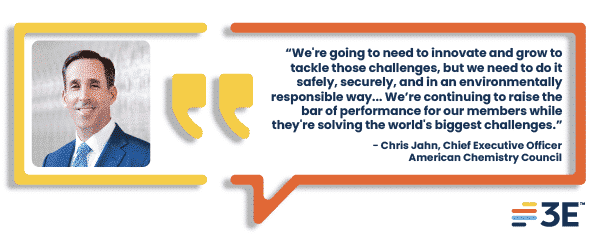
“We’re going to need to innovate and grow to tackle those challenges, but we need to do it safely, securely, and in an environmentally responsible way,” Jahn said. “We're continuing to raise the bar of performance for our members while they’re solving the world’s biggest challenges.”
Members are subject to third-party audits, which the ACC boasts is one of the tools that makes Responsible Care so effective.
“You can’t just say that you’re doing these things, these set of practices which make your operation as safe and clean as possible,” Jahn said. “You actually have to show, 'this is what we do, this is how we do it,' and you actually demonstrate that you do that and you're always looking to improve.”
Daryl Roberts, chief operations and engineering officer at DuPont and ACC Board Responsible Care committee chair, said that ACC members have a commitment to tracking and reporting performance against specific environmental, health, safety, and security metrics.
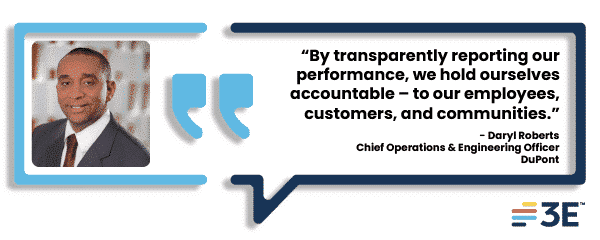
“By transparently reporting our performance, we hold ourselves accountable – to our employees, customers, and communities,” Roberts said in a separate interview.
DuPont is one of more than 150 ACC members and Responsible Care practitioners. Roberts highlighted the program's Enhancing Process Safety Initiative, as one of the tools DuPont has found useful. Through the initiative, members participate in annual incident information and practice sharing forums.
“The Process Safety Regional Networks meet quarterly at a local facility and are an opportunity for networking, education, and engagement for industry professionals responsible for process safety management,” Roberts told 3E.
Jahn said networking and peer-to-peer learning opportunities provide members with opportunities to learn from each other on their best practices - and their mistakes.
Roberts also said the ACC's Data Insights Program, newly launched in 2023, has been valuable for DuPont. The program provides companies with extensive analysis of environmental, health, and safety data from participating members as well as datasets from governing agencies such as the U.S. Occupational Safety and Health Administration (OSHA) and the U.S. Environmental Protection Agency (EPA). Roberts said large public datasets from governing agencies can be “unwieldy,” and the program assists companies in measuring their own performance.
“It gives companies the functionality to dynamically visualize metrics, supporting their performance improvement initiatives,” he said.
2023 Metrics
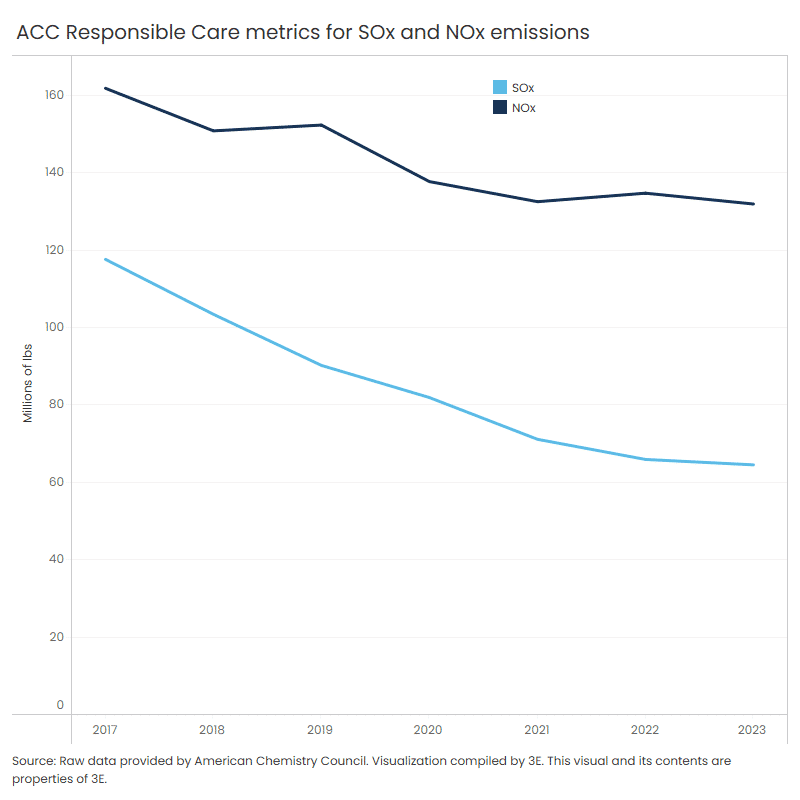
The ACC described 2023 as a “banner year” for the Responsible Care program, reporting the following metrics for 2023 compared to 2017 and 2022:
- 45% decrease of sulfur dioxide (SOx) emissions since 2017; 2% decrease since 2022
- 19% decrease of nitrogen dioxide (NOx) emissions since 2017; 2% decrease since 2022
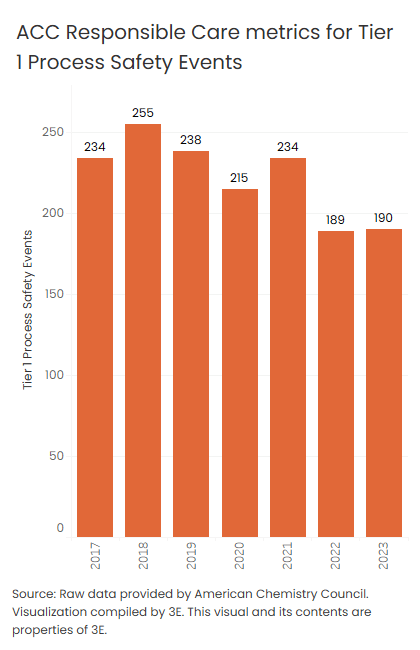
- 19% decrease in tier 1 process safety events since 2017; 0.5% increase since 2022
- ACC reported that nearly 90% of tier 1 process safety events were low severity, measured on the API Recommended Practice 754: Process Safety Performance Indicators for the Refining and Petrochemical Industries for classifying process safety events, where low severity scores are 0-3 on a scale of 135.
- 5% decrease in water usage since 2017; 11% decrease since 2022
- 14% decrease in greenhouse gas intensity since 2017; 2% decrease since 2022
- 17% decrease in total recordable injury and illness rates for employees since 2017; 16% decrease since 2022
Jahn said 2023 was his members' safest year yet, with a 0.64 total recordable injury rate for employees, down from 0.74 the previous year with zero fatalities for both employees and contractors and zero high severity events. Jahn attributed 2023's successful results to the evolution of the program over the years and the extensive training and resources ACC provides to members. (2023 is the most recent year for which results are available.)
Noting the results are the culmination of over 35 years of Responsible Care, Jahn told 3E that the tools and continuous improvement philosophy are “just baked into how our members operate; they’re always looking for opportunities to improve.”
The metrics for 2024 won't be released until the end of 2025, but as the chemical industry continues to evolve, there are specific areas ACC is working to expand in Responsible Care, such as further implementing AI and technology into the auditing process, further expanding a network of community advisory panels that engage in the local communities in which members operate, and transferring industry knowledge to the next generation of the chemical industry workforce.
“Our industry is incredibly innovative,” DuPont's Roberts said. “Responsible Care is continuously researching, developing, and utilizing new tools and technologies to help companies measure and improve environmental, health, and safety performance.”
———
Adnan Malik and Dolan Harrington contributed to this article.
Editor's Note: 3E is expanding news coverage to provide customers with insights into topics that enable a safer, more sustainable world by protecting people, safeguarding products, and helping businesses grow. Deep Dive articles, produced by reporters, feature interviews with subject matter experts and influencers as well as exclusive analysis provided by 3E researchers and consultants.


Insights straight to your inbox
Sign Up NowReporter
Sheridan Wood
Sheridan Wood is 3E's Industry Reporter. She has reported on local, state, and national news for public radio stations KACU, The Texas Standard, and National Public Radio. She has won regional and national reporting awards from the Society of Professional Journalists.

Related Resources
News
EU Omnibus Packages Part 5: Omnibus V – Simplifying EU Defense Regulation
News
EU Omnibus Packages Part 4: Omnibus IV — Product Regulation, Simplification, and Compliance
News
Athletes Disqualified at 2026 Winter Olympics Over PFAS
News
EU Omnibus Packages Part 3: Simplifying EU Agricultural Regulation