
Related

EU Omnibus Packages Part 5: Omnibus V – Simplifying EU Defense Regulation
EU Omnibus Packages Part 4: Omnibus IV — Product Regulation, Simplification, and Compliance

Athletes Disqualified at 2026 Winter Olympics Over PFAS

EU Omnibus Packages Part 3: Simplifying EU Agricultural Regulation
With President Donald Trump retaking the White House, environmental regulations at the federal level are on thin ice. In his first term, the Trump administration rolled back 99 federal environmental rules and regulations, including rules on how the U.S. Environmental Protection Agency (EPA) dealt with toxic materials. President Trump has also tapped former U.S. Representative Lee Zeldin to lead the EPA. When announcing the appointment on 11 November 2024, President Trump said Zeldin “will ensure fair and swift deregulatory decisions that will be enacted in a way to unleash the power of American businesses, while at the same time maintaining the highest environmental standards, including the cleanest air and water on the planet.”
One central concern among environmental groups is the regulation of per- and polyfluoroalkyl substances (PFAS). With their pervasive use across multiple industries, PFAS, also known as “forever chemicals,” have become an environmental and public health concern in recent years. For his part, Lee Zeldin has recognized the hazards of PFAS in the environment, voting twice for legislation regulating PFAS in drinking water and requiring polluters to pay for cleanup under the federal Superfund program. However, in his confirmation hearing, Zeldin stressed the importance of not “suffocating the economy” regarding environmental regulations.
Due to this uncertainty around the future of PFAS regulation at the federal level, many states have taken the initiative to ensure the control of these chemicals. To better understand what this will look like for the future of these regulations, 3E sat down with Lynn L. Bergeson, Managing Partner of Bergeson & Campbell, P.C. (B&C), New Hampshire State Representative Rosemarie Rung, Wisconsin State Senator Eric Wimberger, and Terry Wells, the associate director of Regulatory Research at 3E.
States Stepping Up
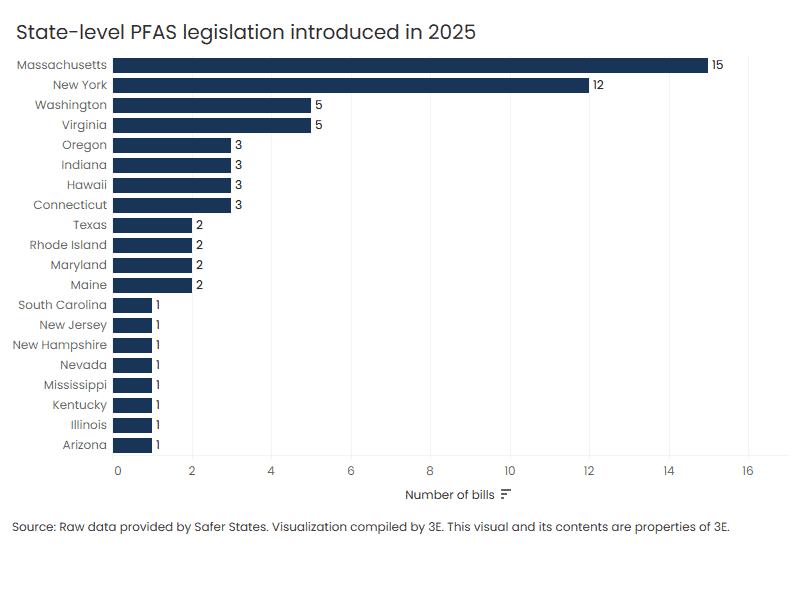
As of 21 January, 20 states have introduced 65 bills seeking to regulate PFAS in 2025, with Massachusetts leading the pack with 15 in the last three weeks. According to Bergeson, this explosion of state-level legislation is not surprising and will likely expand soon.
“As the federal level inclination for PFAS regulation diminishes, you will see a corresponding and commensurate uptick in the states that are already [passing laws], and there are significant numbers of them. That is going to be one of the primary targets of public health activists and nongovernmental organization activist areas. Because of the perception that the feds are not doing their job, there will be tremendous pressure on state legislative bodies to fill the void,” Bergeson told 3E. “The tsunami of legislation that we saw in 2024 will almost certainly be enhanced in 2025 and thereafter. We see no signs of it abating.”
According to Wells, companies should prepare for state actions over the next year. “The legislation that will come out of the states around restricting PFAS is likely to be more consistent with what has already been passed, and each state will put a new tweak on something that makes it a little bit tricky to comply with. But I think it will be more of the same in terms of restricting products. I also think there will be more activity around PFAS clean up and drinking water quality levels.”
Challenges Facing PFAS Regulations in 2025
While state legislatures have made PFAS regulation a concern, they face significant hurdles in implementation. According to Bergeson, one major issue is the lack of understanding of how pervasive PFAS are and how to regulate them effectively. “They started out [saying] let us just get rid of all these chemicals, which means most of our citizenry would be denied products by 2025. They just bit off far more than they could chew because the complexity is greater and the pervasiveness of PFAS broader than anyone envisioned three or four years ago.”
Because fully banning PFAS cannot be done, the commercially unavoidable use issue is still very undeveloped in most regulatory frameworks at the state level, she added, spawning the need for more subject matter experts. “When it comes to legislation, it is a story as old as time: legislators jump the gun and then realize their laws are much more aspirational than realistic,” said Bergeson.
Wells echoed this sentiment, highlighting specific problems that Maine legislators have faced as an example. “Maine passed a lot of PFAS legislation, and then after getting it all in place, realized it would take a tremendous amount of resources to review all the necessary information to ban PFAS, and then it was not even clear what they were going to do with all that information. They ended up having to pull things back and rewrite the legislation, pulling back the requirement to notify all products containing PFAS. Now the government only needs to be notified of critical uses. Maine still sets a very high bar for what is considered a critical use.”
New Hampshire's Rung, a Democrat serving the state's 12th District, and Wisconsin's Wimberger, a Republican serving the state’s 2nd District, also shared their frustrations with trying to find ways to hold polluters accountable without negatively impacting the economy or harming innocent individuals.
For Rung, there is no clear path forward. “I am not optimistic because of the cost of finding alternative chemicals to serve PFAS. New Hampshire does not have a sales or income tax, so getting any type of spending measures passed is very difficult. When you look at what is going on with PFAS and understand the health implications, fixing that requires municipal water systems to be constructed and filtering of existing water. All that costs a lot of money.”
Rung also shared frustration with the veto of a bill she introduced that would have held PFAS emitters liable for cleaning up contaminated areas. This issue mirrors Wimberger’s issues with Wisconsin’s Governor Tony Evers over a bill that would have set standards for PFAS in the state, helping free up $125 million in funding initially set aside to remediate PFAS contamination. The Wisconsin governor vetoed the bill over concerns that it would limit the Wisconsin Department of Natural Resources’ (DNR) authority. Wimberger criticized the decision, arguing that it leaves innocent landowners vulnerable.

“The way that Wisconsin law functions is that if PFAS passes through their property into the water table and then into a neighboring property, they become what we would describe here as emitters. The law does not care how PFAS gets on the property, just that you possess it, and then it goes to the neighbor, so people unknowingly become emitters. Because of this, we have people who are terrified of having their property tested for PFAS and being [held] liable for the contamination.”
Wimberger noted that despite the state having a compensation program to help landowners clean wells on their property of contamination from various sources, including PFAS, some landowners are hesitant to take advantage of the grants. Wimberger states that the reason behind this is that “once you tell the DNR that you have a contaminated well, it’s a self-incriminating statement.” The senator believes that the consequences will be far-reaching, affecting property values and water quality statewide and leaving many landowners in an uncomfortable situation. “If you are stuck in a position of choosing clean water and being financially ruined, it’s a terrible dilemma.”
Zeldin reflected similar concerns in his Senate confirmation hearing, stating, “It is something that is a big issue to you, and it will therefore be a big issue for me. That passive receiver issue could get passed down to the consumer, where they end up paying for the cleanup costs in a way that we need to be cognizant of at the EPA.”
Legal and Financial Implications for Businesses
Outside of state legislative actions, the legal landscape around PFAS is becoming increasingly litigious, with lawsuits targeting manufacturers, alleged polluters, and even unsuspecting landowners. As of 11 December 2024, 31 state attorneys general have initiated PFAS litigation against PFAS manufacturers, and according to Bergeson, this is just the start. “There is no dearth of energetic and innovative lawyer[s] to [optimize] every common civil law, criminal law, and administrative law remedy that could be used to shift the burden for remediation to entities perceived not to be doing their job,” she stated.
In a conversation last year, Bergeson described the recent wave of PFAS class action litigation and the likelihood that it would continue into 2025. Wells shared similar predictions for the new year, stating, “It’s not if but when these companies will have to deal with not only state legislative actions but major class action lawsuits.” Several companies have already had to pay millions and even billions in settlements over these lawsuits, with 3M as a recent example, agreeing to pay $10.3 billion over 13 years in a settlement with Minnesota over PFAS contamination.
Advice for PFAS Manufacturers
With the complicated patchwork of state PFAS regulations and litigation set to only grow in complexity over 2025, companies must be ahead of the curve. Bergeson points out that in addition to the fractured nature of 50 different states having different types of PFAS regulations, there is no consistent definition of what is even considered PFAS in the first place. Because of this, she recommends that companies “calibrate [their] stewardship to the most expansive definition of PFAS” to prepare for upcoming regulations.
Wells shared similar advice for what companies should be doing to prepare for upcoming regulations, warning that, “If companies haven’t fully identified all the PFAS in their products and made efforts to try and eliminate it or at least not sell into the states where they are banned, they may be caught out and be faced with heavy fines and lawsuits.” To avoid this, she says companies must have good programs in place to ensure there is verification and testing to cover all avenues of potential PFAS contamination, whether intentional or unintentional.
Wells also stresses the importance of testing for other chemicals related to PFAS, stating that “a lot of these watchdog groups and enforcement organizations will be searching for total organic fluorine, so if you have fluorine in your product at all, you are going to have to explain where it is coming from. It will be important that you know how to test [for fluorine and] explain where it is coming from.”
Both Bergeson and Wells also stress that while deadlines for many of these regulations have passed and are either not being enforced or being pushed into the future, companies need to be prepared for when they are finally implemented. As Bergeson states, “Deadlines keep getting pushed into the future, but they are coming. They are not off the chart. They are just getting delayed.”
What 2025 Means for PFAS Regulations
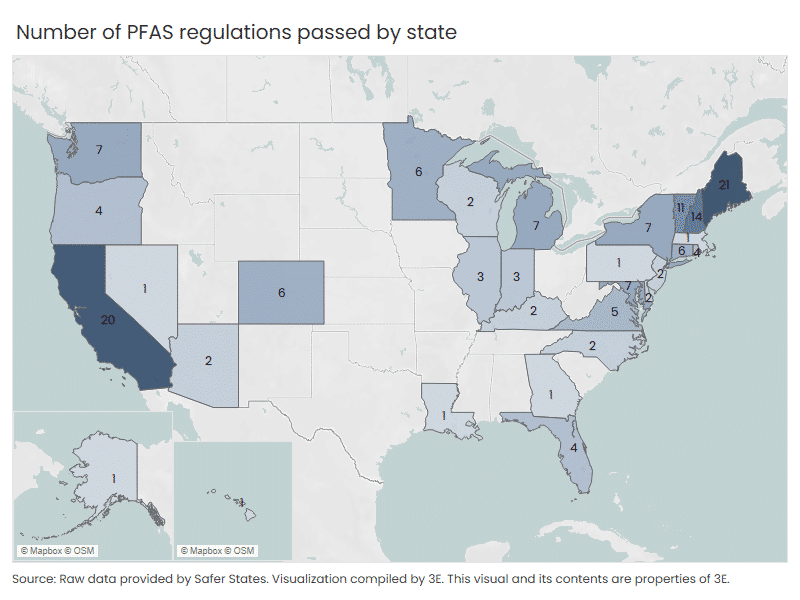
As 2025 unfolds, regulations and litigation around PFAS are clearly set to expand. The mounting public awareness and legislative focus on forever chemicals are set to reshape industry and environmental policies at the state level. For companies, the shifting regulatory landscape underscores the urgent need to adapt. Businesses must align their practices with new and evolving state laws and anticipate broader shifts in litigation and public perception that may influence their operations and supply chains.
Proactive measures, such as thorough testing and investing in alternative chemicals, will be essential to maintaining compliance with upcoming regulations’ ever-shifting definitions and deadlines. As the pressures to address PFAS grow, 2025 is likely to be defined by the loosening of federal regulations balanced by intensifying state actions to compensate.
——————————————-
Editor’s Note: 3E is expanding news coverage to provide customers with insights into topics that enable a safer, more sustainable world by protecting people, safeguarding products, and helping businesses grow. With our 2025 Outlook series of articles, we examine the regulations, trends, challenges, and achievements shaping our companies, our industries, and our world in 2025 and beyond.
About the Contributor: Dolan Harrington is a Data Journalist at 3E. His analytics career has spanned organizations including Delta Air Lines, Pendo (a unicorn product analytics startup), and S&P Global. He has a master's degree in business analytics from William & Mary.


Insights straight to your inbox
Sign Up NowReporter
Christopher Bornmann
Christopher Bornmann is the State Regulatory and Legal Action Reporter for 3E based in Washington, D.C. He covers the latest legal developments and updates in environmental, health, and safety (EHS) that impact the U.S. at the state level. He has experience working for the U.S. House of Representatives and national advocacy groups.

Related Resources
News
EU Omnibus Packages Part 5: Omnibus V – Simplifying EU Defense Regulation
News
EU Omnibus Packages Part 4: Omnibus IV — Product Regulation, Simplification, and Compliance
News
Athletes Disqualified at 2026 Winter Olympics Over PFAS
News
EU Omnibus Packages Part 3: Simplifying EU Agricultural Regulation