
Related

EU Omnibus Packages Part 5: Omnibus V – Simplifying EU Defense Regulation
EU Omnibus Packages Part 4: Omnibus IV — Product Regulation, Simplification, and Compliance

Athletes Disqualified at 2026 Winter Olympics Over PFAS

EU Omnibus Packages Part 3: Simplifying EU Agricultural Regulation
According to Gartner, sixty-nine (69%) of CEOs recognize that sustainability leads to growth. For anyone following the trend of Environmental, Social and Governance (ESG), this statistic should not be overly surprising given investors' vested interest in the long-term viability, reputation, and technological capabilities of the businesses that they have a stake in.
The challenge used to be complying with complex regulatory requirements, with a lens toward risk aversion, such as avoiding fines and mounting civil penalties. However, lately the focus has shifted. The goal is no longer to reach the threshold of managing compliance effectively; it is to become a market leader in sustainability. Thus, a company needs to meet the compliance challenges of today, while keeping in mind the viability of the business in the future and to secure that future by meeting voluntary sustainability standards and receiving internationally accepted certifications.
Sustainability in business (for manufacturers particularly), can begin as early in the process as deciding what raw materials to use and how to achieve sustainable product design. However, sustainability should not only be considered at the start; rather it should be integrated into every business workflow and decision.
The evolving role of compliance in business
Regulatory compliance is a term that can bring up negative emotions. The deterrent effect of violations and additive penalties is daunting and there is mounting pressure on companies to manage compliance effectively. However, one trait that market leaders often exhibit is a quiet confidence in their company's compliance. When companies have a handle on compliance, it allows the strategic leaders to think about business processes in a wholistic way and to consider how to position the company as a sustainability leader.
However, viewing compliance as an opportunity, instead of an obligation, is easier said than done. Depending upon where a company is based, there are a massive number of requirements to be met.
For instance, imagine that a manufacturer has its largest facility in Minnesota, with smaller warehouses in Iowa, Illinois, and Wisconsin. Even this regional company faces regulatory requirements in multiple jurisdictions. For each chemical used, the company's compliance team must keep track of both environmental and safety requirements at the federal level and for the four states where the business operates. If parts of the products are assembled through a supply-chain network, then the company must also keep track of its suppliers' compliance status.
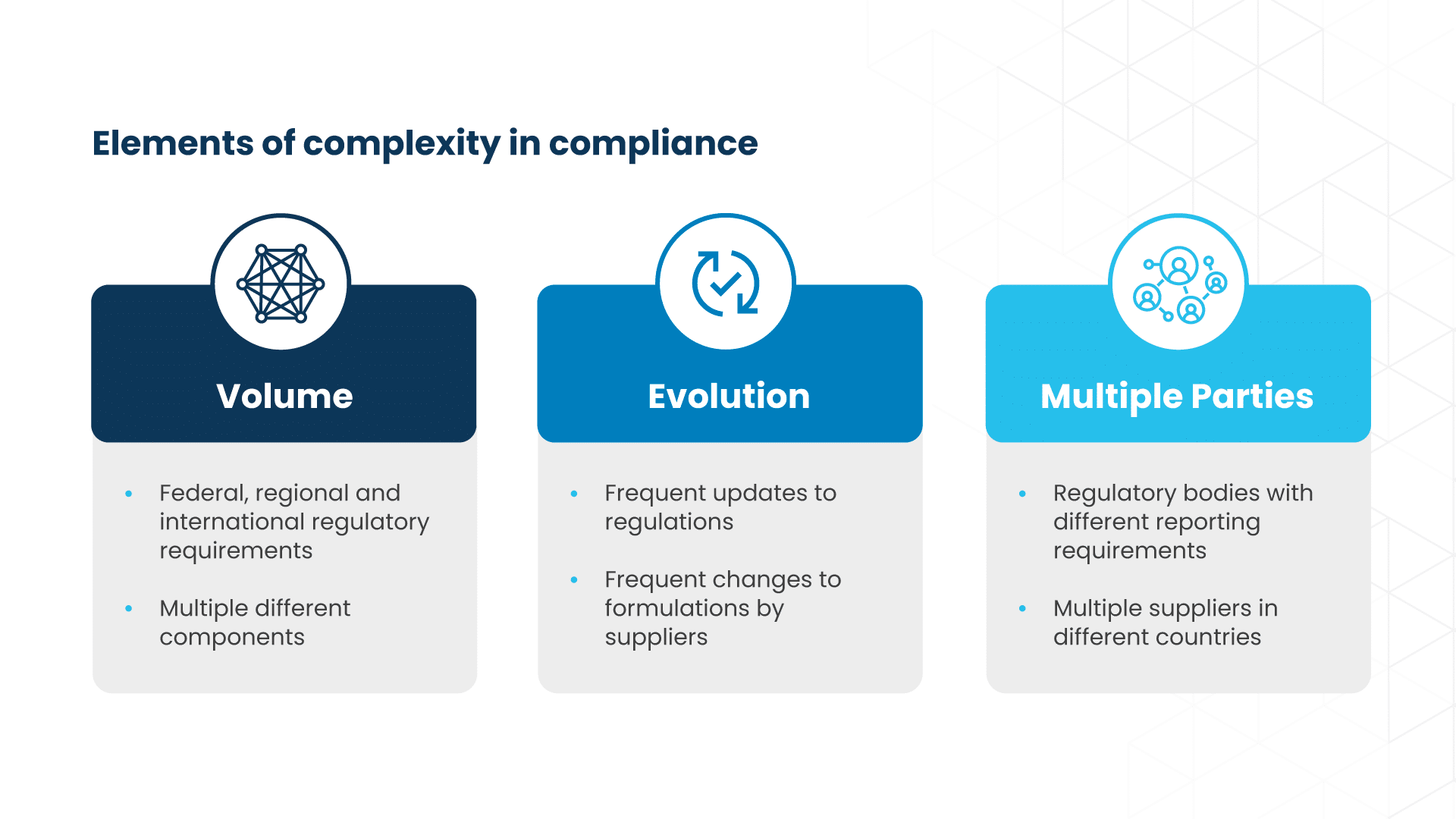
Manufacturers, however, are often international. It is likely that, added to that United States hypothetical, a larger company could have distribution centers in France, Japan, and India. Examining federal level and regional level requirements abroad is yet another complexity that many companies face (particularly because one specific chemical may be regulated differently across international borders).
There is tremendous value in being flexible when it comes to the raw materials that can be used to make a product. Up until recently, Per- and polyfluoroalkyl substances (PFAS), were found in non-stick pans, firefighting gear, and many other products that touch customer lives. The recent pivot in regulation requires companies to go “back to the drawing board” to find suitable substitutions.
Unlike the 1980's, manufacturers now have the software tools that can help manage these complicated regulatory challenges. For example, instead of having an internal team spend hours compiling and then updating Safety Data Sheets (SDS) for specific chemicals, one now has the ability for a software “assist” that can save time and boost confidence in compliance. When there are regulatory changes (e.g., PFAS) utilizing a software provider can help companies avoid regrettable substitutions, which occur when one substitutes one harmful chemical for another that may also be subject to regulation in the near future.
Technology provides the opportunity for internal teams to focus on sustainability as well as compliance. For example, as part of a corporate initiative, the C-Suite may seek to become International Organization for Standardization (ISO) certified, meet Global Reporting Initiative standards, or develop products that hold the GREENGUARD label.
By meeting certain internationally recognized benchmarks, companies can boost some of the “intangible” yet vital aspects of market leadership such as brand name recognition and reputation.
The business case for sustainability
There are certainly some recognizable tangible benefits of sustainability. According to The Sustainability Dividend: A Primer on Sustainability ROI, by Matteo Tonello, Head of Benchmarking and Analytics at The Conference Board, Inc., of 45 polled corporate executives, 76% want to strengthen their company's sustainability story (Figure 2).
When looking at the business case for sustainability, there is a desire to identify tangible benefits. According to the Primer Figure 4, tangible benefits include overhead specific savings, such as the reduction in water and energy use at company production facilities. The intangible benefits include brand reputation which affects both the company's relationship with consumers and the ability to strengthen the company from within by recruiting a motivated workforce with shared values.
One obvious, but often overlooked benefit is that a company's future – its ability to exist for decades – can be impacted greatly by its sustainability practices. A company that relies heavily on regulated (and now banned) PFAS faces potential product recalls and losses. A company that horizon scans the regulatory news for upcoming trends is better positioned to either avoid use of a controversial chemical or adjust its product design efficiently before recalls are necessary.
In addition, a company that is either required to, or voluntarily, releases corporate sustainability reports is bound to see the bigger picture, both in terms of what the company's environmental and social impacts are to the greater society, and in terms of how workflows and the use of chemicals could be more efficient.
The label “market leader” is not one easily obtained. Below is a guide for making the transition from compliance to sustainability leader.
Guide: from compliance to leadership
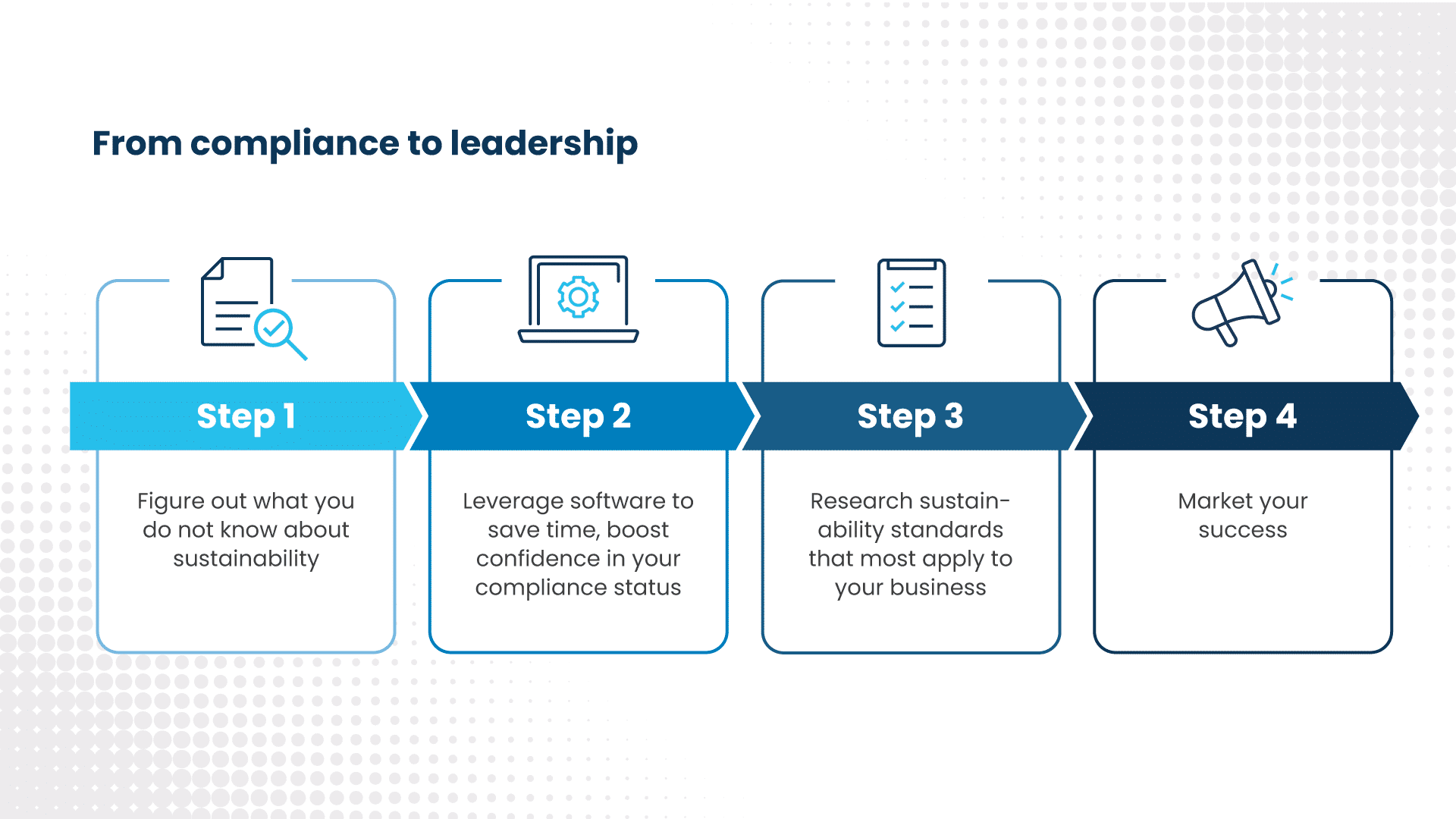
Step 1: Figure out what you do not know about sustainability
There are so many facets of sustainability that it is best to start with the baseline of what you know and what you do not know. Sustainability can mean corporate transparency in meeting the Sustainable Development Goals (SDGs). It can mean managing internal facilities for better environmental performance (e.g., reduced water use, recycled waste, renewable energy consumption).
Sustainability can be surveying your use of chemicals and determining which ones are ripe for substitution with safter alternatives. It can mean overhauling your SDS, ensuring that suppliers abide by best practices, and creating “passports” called Digital Product Passports (DPPs) that ensure visibility as products travel throughout your supply chain.
Sustainability can even be viewed as a larger capacity building effort – such as sponsoring an environmental project in another country. Staying on top of sustainability developments (such as getting resources sent straight to your calendar or inbox) is a great way to improve your knowledge of sustainability in general and help determine how your company’s goals can align with sustainability.
Step 2: Leverage software to save time, boost confidence in your compliance status
With hundreds of SDS to write and keep up-to-date, and possibly the same number of regulatory requirements to comply with, it becomes imperative that you support the expertise of your internal team using technology. Software solutions that inventory the vast number of chemicals used, tie them to regulatory requirements, and manage SDS at facilities are vital. When there are regulatory changes, software can help companies track those changes so that they avoid future recalls and other surprises.
In addition, supply chains are more complicated than ever. It is the ultimate responsibility of the corporate entity running the manufacturing plant as a whole to hold suppliers to their standards of compliance. Software solutions can assist in establishing or maintaining transparency in the supply chain.
Step 3: Research sustainability standards that most apply to your business
The sustainability standards that exist are vast and not all will apply to your industry sector. Thus, it is important to sift through the standards that are available and make a plan/sustainability roadmap to meet those standards.
- Research both global and industry specific sustainability standards
- Determine which standards apply to your business
- Write out business plans: which employees or teams will tackle pieces of the sustainability roadmap? Which standards should be a priority? What is the timeframe for meeting certain standards? What are the deadlines for corporate reporting (e.g., ESG reports) and how can the teams meet those deadlines?
Step 4: Market your success
Companies that are leaders in sustainability do not hide their accomplishments. It is important to celebrate success so that you can boost your brand reputation.
Effective marketing includes:
- Posting corporate sustainability reports on the company's website
- Creating social media campaigns about sustainability
- Including sustainability in your corporate mission statement and other corporate documents
- Attending sustainability conferences to network with peers
Of course, becoming a market leader is just the first goal. Maintaining your status as a market leader requires staying up-to-date on new sustainability standards and approaches.
Sustainability is the future; it is time to lead the way
Sustainable business starts with compliance. However, in order to meet the needs of the modern consumer, businesses need to be at the forefront of ESG. If the goal is to be a market leader, there steps can be taken to move a business from merely one that complies with regulatory requirements, to one that anticipates changes, innovates for the future, and integrates sustainability into business practices and workflows. Software solutions can help by tracking both regulatory compliance as well as progress meeting sustainability standards.
There is no denying that success relies on forethought, and it is possible to become a market leader implementing ESG trends. After all, the goal is to go beyond the threshold of compliance – by creating products that delight customers, protect them from harm, and perhaps even contribute to the greater good of society.
How can we help enable sustainability efforts?
3E is dedicated to product safety and stewardship. By using software solutions that allow companies to manage the entire lifecycle of a product, lead in sustainable product design, and use safer chemicals, 3E is your partner in the journey from compliance to market leadership.
Learn how 3E can transform your compliance strategy into a growth engine for market leadership. Contact our team today!
Schedule a consultation!


Insights straight to your inbox
Sign Up NowRelated Resources
News
EU Omnibus Packages Part 5: Omnibus V – Simplifying EU Defense Regulation
News
EU Omnibus Packages Part 4: Omnibus IV — Product Regulation, Simplification, and Compliance
News
Athletes Disqualified at 2026 Winter Olympics Over PFAS
News
EU Omnibus Packages Part 3: Simplifying EU Agricultural Regulation