Related

EU Omnibus Packages Part 5: Omnibus V – Simplifying EU Defense Regulation
EU Omnibus Packages Part 4: Omnibus IV — Product Regulation, Simplification, and Compliance

Athletes Disqualified at 2026 Winter Olympics Over PFAS

EU Omnibus Packages Part 3: Simplifying EU Agricultural Regulation
On May 11, 2025, European Commission (EC) President Ursula von der Leyen hosted the first Strategic Dialogue on the future of the chemical industry in Europe with representatives from the sector. The purpose of the dialogue was to identify priority measures to support competitiveness for the European Union (EU) chemical industry while ensuring sustainability, security, and safety.
In her remarks, President von der Leyen recognized the key role the chemical industry plays in all aspects of Europeans’ lives, starting with the products they use every day. Further, more than one million people in the EU are employed in the chemical industry, which in turn supports other key industry sectors such as defense, healthcare, and energy.
Recalling the Commission’s commitment to boosting the competitiveness of European industry, including by supporting innovation, President von der Leyen underscored the role of the Clean Industrial Deal - Europe’s roadmap for decarbonization and competitiveness - as well as its focus on four key pillars: mitigating high energy costs, improving access to capital, addressing the skills gap, and simplification, as well as the need to diversify supply chains.
Industry representatives at the meeting requested the fast implementation of the Competitiveness Compass, the Clean Industrial Deal, and the Affordable Energy Action Plan. Attendees also discussed high energy costs, unfair trade practices, the impact of U.S. tariffs, the complexity of the EU's regulatory framework, and support for the sector as it transitions to a more digital and green future.
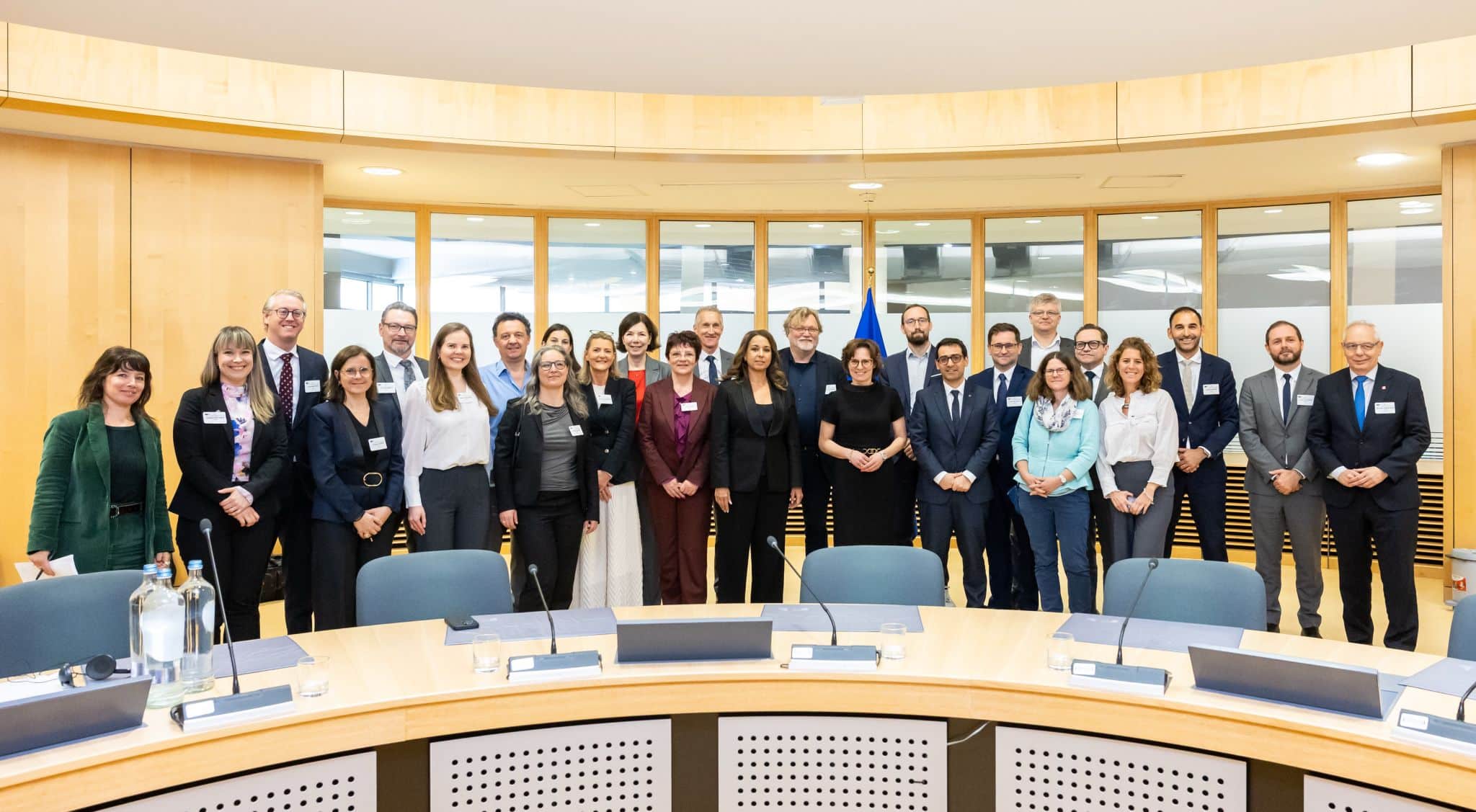
At the meeting, President von der Leyen announced the commission’s commitment to an action plan for the chemical sector by summer, a sector-specific Omnibus, as well as a Chemicals Industry Package by the end of the year.
The European Chemical Industry Council (Cefic), in its comments about the Strategic Dialogue, noted, “It is clear that our industry is the mother of all industries and fundamental for Europe's future. Our EU chemical industry supports Europe's ambitions, but we need to discuss how we achieve these. We cannot deliver on these goals if we lose our industrial base to other regions.”
Tension Between Competitiveness and Commitment to the Green Deal
In her remarks, President von der Leyen reaffirmed that maintaining the status quo cannot be the future of Europe's chemical industry, adding, “We must be at the forefront.” She did insist she would “stay the course” when it came to the European Green Deal.
According to the European Environmental Bureau, the only environmental nongovernmental organization (NGO) in attendance, the meeting revealed a “clear tension between industrial demands for public subsidies, cheaper energy, and regulatory rollbacks, and the commission's ongoing commitment to the European Green Deal.” The meeting included representitives from over a dozen chemical companies, as well as the European Chemicals Agency (ECHA), Cefic, the European Consumer Organization (BEUC), trade unions, and others.
Patrick ten Brink, EEB Secretary General, said: “It's time we stop taking decades to regulate what takes weeks to market. Strengthening REACH [Regulation on the Registration, Evaluation, Authorization, and Restriction of Chemicals], banning harmful substances, and investing in transparency, traceability, and safer alternatives will build a healthier, circular, more resilient, and economically future-proof Europe - and help prevent future scandals like those caused by PFAS [per- and polyfluoroalkyl substances].”
The EEB urged the EC to accelerate the shift towards a carbon-neutral, circular, zero-pollution, and toxic-free chemicals sector.
According to EEB, “The chemical industry is a significant contributor to climate change and harmful chemical pollution that affects human health - yet it remains one of the biggest blind spots in climate policy. Globally, the sector emits an estimated 3.3 billion tonnes of CO₂ each year - three times more than aviation - and is the largest industrial energy consumer, using 60% of Germany's LNG.”
The group, noting that the EU stands at a pivotal point in shaping its chemical regulatory policies, said it welcomed the EC's promises to deliver a chemical industry package that includes the simplification of REACH and clarification on PFAS.
“Europe's failure to regulate PFAS is written in our blood. We can't let that legacy continue. Simplification must mean faster decisions - not weaker protections. Smart, strengthened regulation - not deregulation - is the real driver of competitiveness, innovation, and public trust,” said Tatiana Santos, EEB head of Chemicals Policy.
Jobs Crisis Must Be Addressed
Esther Lynch, the head of the European Trade Union Confederation (ETUC), told the EC that the time for talks over growing redundancies is over and urgent action is necessary. “Every day in Europe, around 500 skilled manufacturing workers are losing their livelihoods with no alternative employment prospect. That is a crisis that requires European action but so far the European Commission has failed to take measures that match the urgency of the situation,” said Lynch.
According to Lynch, “Millions of working people [are] worried about their futures [and] want to see every commissioner focused on protecting their jobs and supporting European industries. Trade unions always welcome real social dialogue but the time for talking has long passed. The commission need[s] to bring forward a European industrial plan to protect and create new quality jobs by investing in our industries.”
The Chemical Industrial Package must deliver investment plans to revitalize the sector, protect strategic molecule production, and preserve quality jobs in Europe, according to the ETUC, which called on the EC to:
- Adopt a job protection scheme, similar to the SURE program, which saved jobs during the pandemic, to prevent irreversible losses in the EU's industrial capacity.
- Provide a Just Transition Directive that ensures companies proactively plan for change, avoiding slash-and-burn job cuts and ensuring workers have a right to paid reskilling on work time.
- Suspend the EU's economic governance rules to allow member states to adopt economic policies to support long-term investments and sustainable growth.
Michael Vassiliadis, industriAll Europe's president, also called on the EC to focus on certain initiatives, including a chemical industrial package that must “deliver a plan of investments to revitalize the industry, defend the production of strategical molecules and preserve good quality jobs in the continent.”
Further, a robust and certain regulatory framework is needed, he added, “one that upholds environmental and labor standards, strengthens the implementation of REACH and its risk-based approach, allocates more resources to ECHA's registration process, and ensures greater enforcement and inspections to guarantee that workplaces and workers are properly prepared for chemical exposure.”
Can Competitiveness and Sustainability Go Hand-in-Hand?
In a LinkedIn post, Jessika Roswall, the European commissioner for Environment, Water Resilience and a Competitive Circular Economy, noted, “As we navigate these challenging times, we recognize the pressures facing the chemicals industry: high energy and feedstock prices, global competition, supply chain disruptions, and the urgent need to shift towards more sustainable practices. This sector is at the heart of Europe's industrial strength, and we must ensure it remains safe, competitive, resilient, and innovative.”
Saying it is “truly the 'industry of industries,'” Roswall asserted that chemicals policy is key to the circular economy.
“I firmly believe that competitiveness and strong health and environmental protections go hand in hand. Our high standards are a competitive advantage, driving innovation and positioning European businesses as leaders in sustainable solutions.” She added she was encouraged to see representatives from leading chemical companies, trade associations, and unions as well as ECHA actively engage in the conversation, calling the dialogue “a crucial step towards a cohesive and sustainable strategy for the chemicals industry.”
The coming weeks will be impactful for the future of EU chemicals regulation. The long-awaited REACH revision is reaching a critical stage, and as the EC prepares its chemicals package, everyone at the table at the Strategic Dialogue likely was speculating on the direction Europe will take: Will it double down on the European Green Deal, lean further towards deregulation, or discover a new path between the two?


Insights straight to your inbox
Sign Up NowIndustry Editor
Sandy Smith
Sandy Smith is an award-winning newspaper reporter and business-to-business journalist who has spent 20+ years researching and writing about EHS, regulatory compliance, and risk management and networking with EHS professionals. She is passionate about helping to build and maintain safe workplaces and promote workplace cultures that support EHS, and has been interviewed about workplace safety and risk management by The Wall Street Journal, CNN, and USA Today.

Related Resources
News
EU Omnibus Packages Part 5: Omnibus V – Simplifying EU Defense Regulation
News
EU Omnibus Packages Part 4: Omnibus IV — Product Regulation, Simplification, and Compliance
News
Athletes Disqualified at 2026 Winter Olympics Over PFAS
News
EU Omnibus Packages Part 3: Simplifying EU Agricultural Regulation