Related

EU Omnibus Packages Part 5: Omnibus V – Simplifying EU Defense Regulation
EU Omnibus Packages Part 4: Omnibus IV — Product Regulation, Simplification, and Compliance

Athletes Disqualified at 2026 Winter Olympics Over PFAS

EU Omnibus Packages Part 3: Simplifying EU Agricultural Regulation
In today's data-driven world, AI isn't just on the map - it's the fast lane. From mining critical insights and tracking regulatory shifts to forecasting risk, monitoring employee health and safety metrics, and streamlining reporting, AI is steering the future of EHS, sustainability, and compliance. But as professionals take the wheel, what roadblocks and green lights lie ahead on the journey? This series of articles will help you navigate the future of AI in EHS.
Designing a new chemical molecule is laborious, time-consuming, and expensive. It has traditionally relied on the expertise of highly skilled scientists who spend years examining the structure of existing molecules, tweaking them in pursuit of improving their performance, and addressing their setbacks. It's a painstakingly slow process.
This is just one of the reasons why solving the per- and polyfluoroalkyl substances (PFAS) toxicity and persistence problem is proving to be such a challenge. The old system of trial and error can't produce rapid results, but the process is now ripe for transformation in the artificial intelligence (AI) revolution.
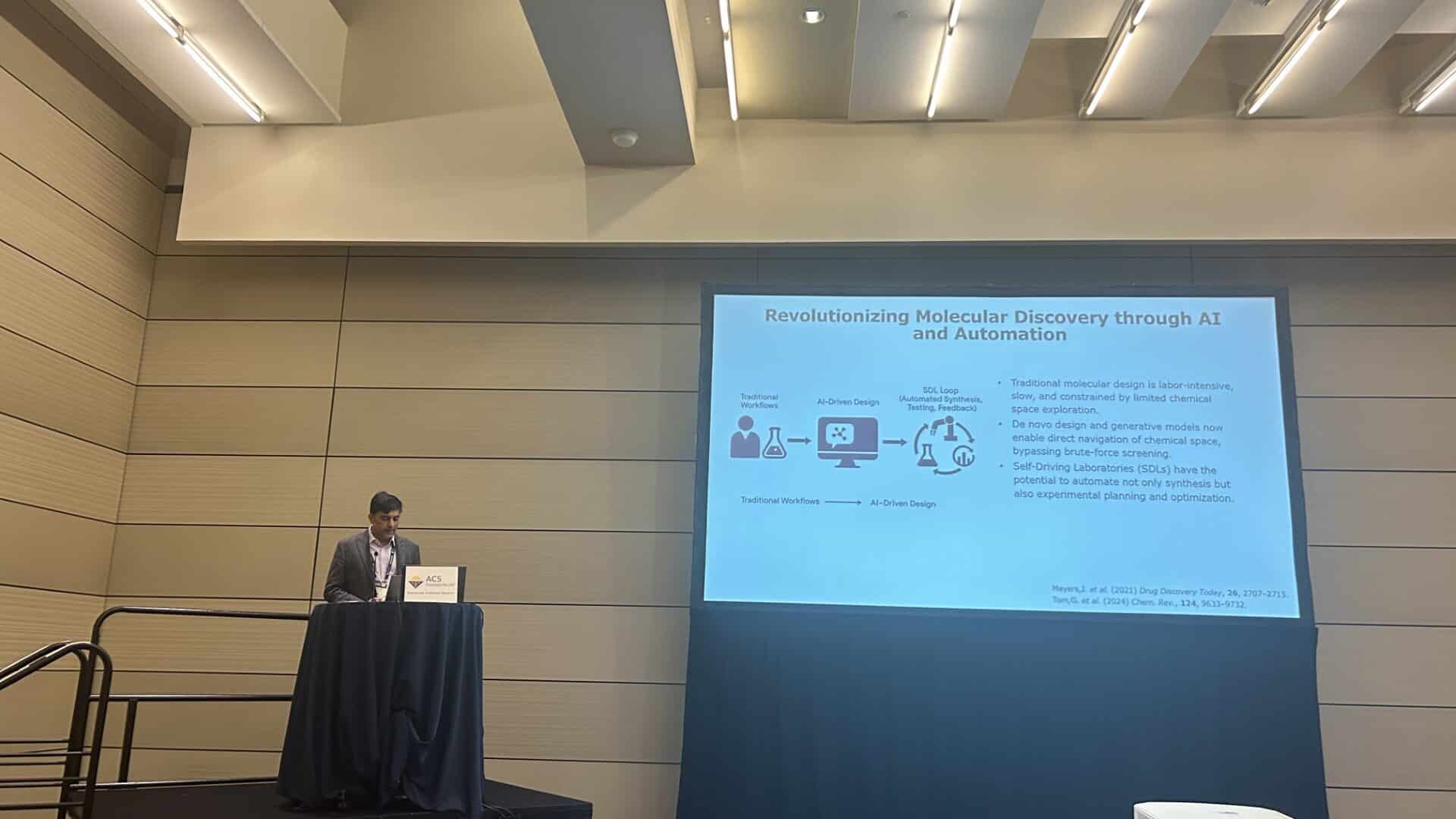
During an August 21, 2025, lecture at the American Chemical Society's (ACS) fall meeting, held in Washington, D.C., and attended by 3E, Ruchir Shah, CEO and scientific chief of Sciome, explained how the research and informatics firm is seeking to exploit the power of large datasets and algorithms to create entirely novel chemicals.
“We have come up with a patented approach based on our large language model trained with data from PubMed and other reputable databases to train it on millions and millions of chemical structures,” said Shah. “We can direct it to design novel chemicals with desired properties, but we can also have it avoid certain properties such as toxicity.”
Sciome decided to embark on this program after the company noticed a significant demand for more rapid chemical research and development from large chemical companies that are eager to address environmental concerns around their existing products and to make changes in advance of any forthcoming regulations.
PFAS is a great example of this; governments around the world are under pressure to ramp up their regulation of PFAS compounds, as 3E has previously reported in several articles, including one on the UK’s efforts to limit PFAS in firefighting foam and one on how the EU is facing pressure from nongovernmental organizations over PFAS use. However, manufacturers are struggling in some instances to come up with effective replacements in time.
One of the main desirable characteristics of PFAS chemicals is their flame-retardant capacity, which is why Sciome asked its AI to search for novel flame retardants. “But we also asked it to avoid toxicity. It gave us 176 novel molecules,” said Shah. Those novel structures were then further screened with AI to determine if they had a limited oxygen index value greater than 27, which would indicate that a molecule is indeed flame retardant.
“Around two thirds passed that test and they seem to do what we want them to do, but also avoid the bad things,” he said. “But as every chemist knows, it's one thing to design a molecule and another to be able to synthesize it. You have to be able to scale it up. We used an MIT (Massachusetts Institute of Technology) tool to check that.” The final stage is to verify whether they work in the real world and so far, Shah and his colleagues have successfully done so with 20 of the chemicals. “We're going to do as many as we can within budgetary constraints,” he said.
The use of AI in this way is just one example of how the scientific discovery process is being sped up by the technology. Most recently, a new antibiotic was discovered with the help of AI and if chemical companies can leverage AI effectively, it may enable them to be one step ahead of regulators.


Insights straight to your inbox
Sign Up NowEMEA News Editor
Benjamin Plackett
Benjamin Plackett is a science journalist based in London with 15 years of experience covering emerging trends within chemistry research as well as the chemical and pharmaceutical industries. As the EMEA news editor, he oversees the expansion of 3E’s proprietary news in the region in collaboration with other editors and reporters.

Related Resources
News
EU Omnibus Packages Part 5: Omnibus V – Simplifying EU Defense Regulation
News
EU Omnibus Packages Part 4: Omnibus IV — Product Regulation, Simplification, and Compliance
News
Athletes Disqualified at 2026 Winter Olympics Over PFAS
News
EU Omnibus Packages Part 3: Simplifying EU Agricultural Regulation