Related

EU Omnibus Packages Part 5: Omnibus V – Simplifying EU Defense Regulation
EU Omnibus Packages Part 4: Omnibus IV — Product Regulation, Simplification, and Compliance

Athletes Disqualified at 2026 Winter Olympics Over PFAS

EU Omnibus Packages Part 3: Simplifying EU Agricultural Regulation
Artificial intelligence (AI) seems, at first glance, to be a miracle cure for any dilemma blocking progress to a sustainable future. With its astonishing capacity to recognize patterns in unstructured data and provide usable information, it would seem as though AI is the tool the world has been waiting for to catalyze sustainability and find solutions to the planetary environmental crises.
However, as is often the case, the power of the solution is tempered by human-centered variables, including business and academic priorities, expertise in specific fields, and intellectual silos that prevent the sort of collaboration that would allow AI to reach its full potential.
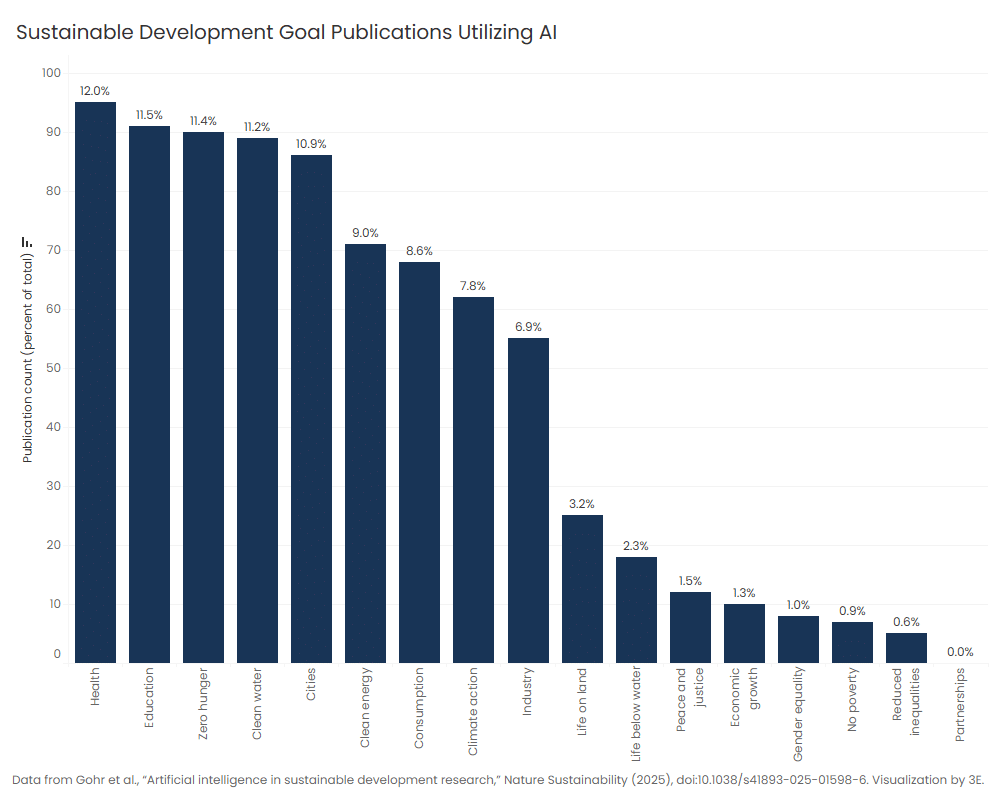
A recent article in Nature Sustainability highlights the difficulty of balancing the power of advanced AI applications with deep sustainability expertise to find practical solutions to some of sustainability's seemingly intractable problems. In “Artificial Intelligence in Sustainable Development Research,” authors Charlotte Gohr and Gustavo Rodriguez et al. show that current academic research has a gap between sophisticated AI methodologies and deep domain expertise in sustainability. While there is considerable academic research focusing on AI's ability to improve forecasting, system optimization, data mining, and accelerated experimentation in areas like clean energy efficiency and vegetation, AI is underutilized in social sustainability areas such as reducing poverty and increasing social equity.
The authors also note that the discourse surrounding AI is often dominated by techno-optimists who see it as a revolutionary leap toward miraculous solutions, when, in fact, those solutions will require deep sustainability expertise and cross-disciplinary collaboration. Until that happens, much AI research in sustainability remains focused on optimization in technical areas like water resource management, vegetation monitoring, energy systems, and pollution control.
3E recently sat down with Prof. Henrik von Wehrden, the head of the research group that published the article, to dig more deeply into the application of AI in sustainability research and in practice. Prof. von Wehrden is professor and chair of Normativity of Methods at Leuphana University in Lüneburg, Germany, and an associate at the Institute for Sustainability Education and Transdisciplinary Research. He has published sustainability research in several academic journals, has been a scientific project manager for many sustainability projects, and is the driving force behind the Sustainability Methods Wiki, which provides extensive insights into the methods, terms, and tools that support sustainability.
Literature Review: Backbone of Innovative Research
Every researcher knows the tribulations and peril of the literature review, in which you review the existing literature to find gaps and opportunities to say what hasn't been said or to reframe and even refute what has. When looking at the application of AI in sustainability and identifying the most popular areas of research, that can mean reviewing thousands of articles, many of which are little more than collections of buzzwords that have no deep relationship with sustainability. After narrowing the number down to 792 of the most relevant papers, von Wehrden and his team found some discouraging patterns.
“When you look at prominent topics like sustainability, poverty, and gender, there's not a lot of research from people who actually work on these areas,” said von Wehrden. “That's really sad because you have lots of labor statistics, studies, and data, so it would be perfectly possible to use AI and machine learning to work on gender issues, which would open a lot of dimensions on injustices in the world.”
That lack of research on the social elements of sustainability is, according to von Wehrden, endemic to the nature of the scientific community, in which research has to be attractive to a wide enough audience to generate funding and, eventually, commoditization for industry. It also reflects the silos and disciplinary disparity between the researchers working on AI and sustainability.
“The people most closely associated with AI and machine learning are not the same people we have working on gender issues, who might be cultural studies and social science researchers who do very qualitative research,” said von Wehrden. “Most research is optimization and modeling for industry in the technical literature.”
The article provides further evidence of this lack of research into the application of AI to some of the social aspects of sustainability. AI is widely used in United Nations Sustainable Development Goals (SDGs) related to health, education, and environmental modeling. However, there were only seven papers in the most-cited literature related to poverty reduction (SDG 1), with few examples of proposed AI-based poverty reduction tools.
According to the article, the dearth of applications of AI to social sustainability has its origins not only in the priorities and skill sets of the researchers but in the available data that would support those projects. Social data is often difficult to model because there isn't enough of it to feed large language models, and what is available has qualitative and contextual variables. Ethics and privacy laws can also restrict research access to critical social data.
Promise and Peril of AI in Sustainability
Von Wehrden's group found that many of the most interesting research papers came from regions like Spain and Italy that were using AI to deal with specific regional problems related to sustainability.
“You might have a whole farm or municipality building made completely transparent with Arduinos, with all the energy flows and costs that you need for maintenance, and so on,” said von Wehrden. “Then you can use machine learning to optimize the buildings or understand the complex systems of modern farming. These were really amazing papers, and if more people would utilize these connections to see how they can leapfrog toward sustainable development goals with the help of AI that would be fantastic. Right now, it's more of a sales pitch.”
While the literature reviews von Wehrden's team conducted have shown that the deep work on sustainability and AI is the reserve of only a few dedicated sustainability specialists, von Wehrden sees AI's ability to bring sophisticated coding skills to those specialists as a revolutionary advance.
“The fantastic thing is that crunching code is getting a lot faster,” said von Wehrden. “In the past, programming was a gateway that a lot of people [sustainability specialists] could not pass. Now more people can utilize that so they can think out of the box, take the ideas they have, and just solve them.”
According to von Wehrden, many of the problems in sustainability research come down to data quality, but AI will play a critical role in providing a remedy for that problem as well.
“The data itself is there,” said von Wehrden, “but you can't connect it, or you have different data formats and they can't communicate with each other. But all these things will go out the window in the next few years and this will be a completely different landscape.”
AI and Sustainability: Solving Complicated Problems
As the research article has shown, data science and sustainability remain somewhat isolated for now, with a lack of shared priorities and research interests.
“Many data scientists just want to write code and hack,” said von Wehrden. “Those who are really versatile in sustainability science have no idea about analysis or data, so these are really separated, and that shouldn't be the case.
For sustainability to flourish in the age of AI, von Wehrden said that data scientists and sustainability specialists will both need to collaborate and to think seriously about their traditional skill sets.
“In 10 years, AI will do a lot of what data science is doing now, like pattern recognition, so we need to ask deeper questions about what those patterns mean, what sort of problems can we solve with those patterns. We live on a finite planet and we need to make compromises. We don't have infinite resources. These are ethical questions that are deeply human, and I don't want to leave that to an AI. Compared to complicated ethical discussions about global food distribution, hunger, poverty, and other injustices, self-driving cars are pretty easy.”
Von Wehrden's research is based on a deep understanding of the critical connections between the power of data and the responsibility of using our technological and societal privilege for the benefit of humanity as a whole. For sustainability researchers and data scientists, that means better collaboration and interdisciplinary research approaches.
“We need to be the connective tissue for a transdisciplinary field to help us understand our responsibilities and get the expertise we need,” said von Wehrden. “We can get data scientists together with specialists on things like sanitation to make connections and bring real solutions to the people.”
Sustainability scientists, in particular, need to meet the challenge of incorporating more data-based approaches into their work.
“Sustainability scientists need to utilize this technology,” said von Wehrden. “They need to boost their understanding and come up with new moves. Humans can become pretty stuck in our heads when it comes to solutions, and AI can be great at helping us find new ways of doing things.”
For von Wehrden, retaining that connection between the power of technology and our human responsibilities will be the foundation of the practice of sustainability.
“AI is outcompeting us in terms of pattern recognition,” said von Wehrden. “But people still need to work hard to connect the data and ask the right questions, to talk to the communities and understand what the problems are to begin with. AI can recognize the patterns in the data, but it doesn't know what they mean. People still need to make that effort.”
Von Wehrden sees AI as existing at a pivotal point in its development today. At the moment, he said, it's hit a stumbling block with its energy requirements contributing to climate change and constraining its ability to scale to where it needs to be to solve the really critical problems. At the same time, once it moves past that, von Wehrden sees a future in which AI becomes the foundation of a new way of understanding the world.
“There are a lot of people saying AI is going to become conscious and take over,” said von Wehrden. “I don't buy into that. But I think we need to grow up. Scientific disciplines keep people in silos in which they have their terms of knowledge and ignore other kinds of knowledge. You have to trust other people's work and understand what other disciplines are doing, and the whole idea of scientific disciplines needs to go out the window. We can educate younger generations to combine the things that interest them and do things that are really big in which AI is not one fixed thing.”
As part of this evolution of scientific disciplines, von Wehrden sees AI as having the potential to move beyond simply analyzing published results of successful research and incorporating the masses of data from the scientific process itself.
“Everybody publishes what worked,” said von Wehrden. “No one publishes what didn't work because that's not how you get peer-reviewed publications, so much of that research goes into a desk drawer. But imagine if large language models include all the stuff that didn't work. Now the whole research landscape is completely different. This is what's going to happen with many things, and I think in the next 20 or 30 years, we're going to be looking at a very different educational, economic, and scientific system.”


Insights straight to your inbox
Sign Up NowReporter
Graham Freeman
Graham Freeman is based in Toronto, where he covers ESG and sustainability news. Graham has been a content and technical writer in the technology industry for more than a decade. He has also worked as a professor and lecturer at Queen’s University, the University of Toronto, and George Brown College.

Related Resources
News
EU Omnibus Packages Part 5: Omnibus V – Simplifying EU Defense Regulation
News
EU Omnibus Packages Part 4: Omnibus IV — Product Regulation, Simplification, and Compliance
News
Athletes Disqualified at 2026 Winter Olympics Over PFAS
News
EU Omnibus Packages Part 3: Simplifying EU Agricultural Regulation