Related

EU Omnibus Packages Part 5: Omnibus V – Simplifying EU Defense Regulation
EU Omnibus Packages Part 4: Omnibus IV — Product Regulation, Simplification, and Compliance

Athletes Disqualified at 2026 Winter Olympics Over PFAS

EU Omnibus Packages Part 3: Simplifying EU Agricultural Regulation
Parts 1 and 2 of our Conference Chatter series on the Hub Live from Climate Week NYC 2025 looked at some of the candid and engaging conversations on topics like technology innovation, leadership, and the financial realities of sustainability. This final article looks at the importance of how we talk about sustainability and climate change, and how the power of words can help to bring everyone to the same side.
Everyone Has a Story to Tell
Scientific complexity often dominates discussions about climate change. Research presentations and articles are rich with big numbers and colorful charts delivered by highly educated scientists telling us about our possible future if we don't act now on this dire mathematical reality.
While what they tell us might well be true, numbers and charts don't always do a good job of telling people a story they can understand about their role in addressing climate change. At worst, those stories obfuscate the reality behind mathematical and scientific complexity; at best, they can convey a sense of hopelessness and helplessness.
United Nations Framework Convention on Climate Change (UNFCCC) Executive Secretary Simon Stiell said that while the climate situation might look bleak, it is important to note how much progress the world has made in the 10 years since the Paris Agreement.
“If we look at this 10-year journey since Paris, before Paris, the world was on a 5° global heating trajectory,” said Stiell. “We're now down to around 3°.”
Stiell noted that with $2 trillion in global investment in renewables in 2024, 90% of renewables are now cheaper than fossil fuels, but that there is a challenge to translating that progress into a jargon-free message that resonates with the everyday lives of the communities living through the impact of climate change.
“Not enough time is spent on discussing the benefits of climate action,” said Stiell, “and how that … impacts ordinary people in their daily lives. When we can start translating that, I think that starts cutting through some of the alternative narratives that are presented.”
The Secretary of State for Energy Security and Net Zero of the United Kingdom Ed Miliband highlighted the importance of storytelling in conveying success and pushing back against narratives based on disinformation.
“The world has made progress, and we do need to narrate that and we do need to affirm that,” said Miliband. “I think there's a danger of people saying, 'Well, you've been talking about this problem for 30 years, have you actually made a difference?' and the answer is a resounding 'yes.'”
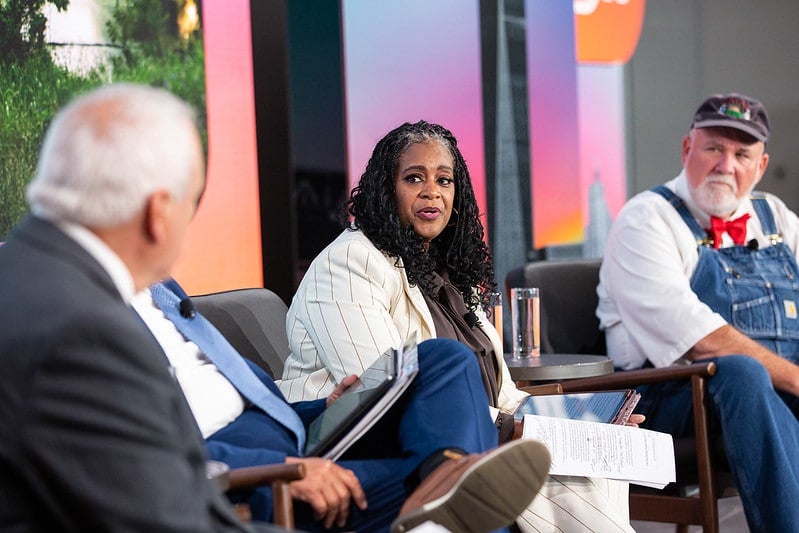
Founder and Executive Director of the Deep South Center for Environmental Justice Beverly L. Wright said telling the right story about climate change will be a critical component of getting young people to engage with the vision of an equitable form of climate justice.
“I think our biggest problem is that we have not been successful in changing the narrative, and one of the things that may help us will be young people,” said Wright. “It will require a completely different conversation with young people. I was told that democracy requires an educated populace; well, the environment requires an environmentally literate populace. We need to be working toward making certain that our children are educated properly so that they make the change.”
In a discussion about the challenges of managing Scope 3 emissions, Margaret Kim, CEO of the Gold Standard Foundation, said that the story about creating a sustainable world also needs to grow beyond simply telling everyone good news stories, and that people who want to inspire innovation need to become comfortable integrating stories about failure into their narratives so we can learn from what didn't work.
“We need to enable corporations to have that place, have that room to innovate, try, fail, and learn from it,” said Kim. “As long as companies publicly disclose their journey, we should be able to embrace that failure. We need to move away from success-and-failure culture, pass-or-fail culture, because this journey is going to be constant failure to get to that final success and beyond.”
Stories Have Two Sides
CEO of Climate Group Helen Clarkson pointed out that while those fighting against climate change need to improve their ability to tell compelling stories, others have already learned how to do that effectively.
“We're seeing leaders play into the fossil fuel industry's message box,” Clarkson said. Sustainability advocates need to counter the fossil fuel industry's narrative that renewable energy sources will make energy less affordable - a story that resonates with everyday concerns of citizens and voters worldwide. Clarkson highlighted the importance of showing people the positive benefits of the energy transition.
“We need that truth out, and we need to be building the right projects and showing the public that it's possible,” she said. “And it's not just possible, but it's not going to reduce their quality of life or make it more expensive.”
Clarkson also emphasized that the climate change narrative has often failed to give people hope or direction about what they can do, and that the story needs to change to become one that celebrates achievements and provides a clear direction about what we need to do next.
“Let's be honest about how we talk about climate change,” said Clarkson. “We tell people about the massive problems and the radical systemic changes we need, and then when they say, 'What can I do?' we offer them reusable tote bags and infographics. We've been selling a feeling of powerlessness.”
Words Matter
Anyone who has delivered a speech in a boardroom, at a conference, or even at a wedding knows that words matter. Beneath large-scale structures like narratives and storytelling, sometimes the individual words you use can make a world of difference between a message resonating with an audience and having it fall flat.
Chief Scientist Katharine Hayhoe of The Nature Conservancy said that when addressing an audience that is skeptical about the impact of anthropogenic climate change, even the term “climate change” can be a problematic element that gets the discussion off track. Hayhoe related how at one event in Texas, she tried not saying “climate change” at all, instead framing the discussion as being about the everyday consequences people will experience as a result of climate change, including water scarcity, droughts, and long-term trends. Hayhoe said that people can be very receptive to the data when they see themselves in the solutions and don't hear highly politicized language, and that she got broad support for her ideas even from those who didn't believe in climate change. She emphasized that solutions have to address both the heart and the hands - emotional responses and practical applications - to get people on board.
“That taught me that we can talk about this issue if we start with the heart, why it matters to both of us as parents, as citizens of that location, as people who do the same thing and care about the same things,” said Hayhoe. “Then we bring in the hands, something practical we can do together to help fix it. Often, once we have those conversations and bring people along, once they see themselves in the solutions, their objections to the science evaporate.”
Founder and CEO of Nature is Nonpartisan Benjamin Backer said that people on all sides of the political divide need to recognize the uncomfortable reality that people think locally and not globally. There are no universal solutions to climate change about which everyone cares. Instead, they care about the problems that face them every day.
“People in Salt Lake, Utah, or Provo, Utah, they care about the Salt Lake, and they care about the air quality and the water quality,” said Backer. “They do not care about sea level rise at all. Farmers in the Midwest do not care about sea level rise at all; they care about keeping the farms for the next generation so they can feed their families. People in Florida do not care about Salt Lake; they care about Florida.”
Backer said that when discussing sustainability with people in a hyper-partisan environment, replacing global concerns like climate change with local concerns based on a shared love of nature can be the key to building a nonpartisan environmental movement in which objections disappear and collaboration can begin.
“Everyone has a tie to nature in their own communities that resonates with them, that they have a personal tie to,” said Backer, emphasizing that while climate change is a politically precarious topic, related topics like clean air, clean water, and habitat restoration have bipartisan support above 90% in the U.S.
“Nature can be the bridge to all of us because every single person wants forests to be conserved for future generations, everyone wants the national parks to be funded, everyone wants clean air in their communities, including in Lubbock, Texas, or in Midland, Texas, the oil capital of the United States,” said Backer. “When you open up with that, you build the most unlikely alliances possible.”


Insights straight to your inbox
Sign Up NowReporter
Graham Freeman
Graham Freeman is based in Toronto, where he covers ESG and sustainability news. Graham has been a content and technical writer in the technology industry for more than a decade. He has also worked as a professor and lecturer at Queen’s University, the University of Toronto, and George Brown College.

Related Resources
News
EU Omnibus Packages Part 5: Omnibus V – Simplifying EU Defense Regulation
News
EU Omnibus Packages Part 4: Omnibus IV — Product Regulation, Simplification, and Compliance
News
Athletes Disqualified at 2026 Winter Olympics Over PFAS
News
EU Omnibus Packages Part 3: Simplifying EU Agricultural Regulation