
Related

EU Omnibus Packages Part 5: Omnibus V – Simplifying EU Defense Regulation
EU Omnibus Packages Part 4: Omnibus IV — Product Regulation, Simplification, and Compliance

Athletes Disqualified at 2026 Winter Olympics Over PFAS

EU Omnibus Packages Part 3: Simplifying EU Agricultural Regulation
In June 2022, the Colorado House of Representatives passed House Bill 22-1355, the Producer Responsibility Program for Recycling, creating an extended producer responsibility (EPR) program focused on packaging and paper products. The legislation is part of a growing national effort to shift the cost of recycling from taxpayers and local governments to the companies that create the waste. Under the law, packaging producers must either join a designated producer responsibility organization (PRO), in the case of Colorado this is the Circular Action Alliance (CAA), or create an individual plan that complies with the state's recycling and sustainability requirements.
The goal of the Colorado legislation is to make recycling more efficient and accessible to all Coloradans, regardless of where they live in the state, something the state has been struggling with.
“Our recycling rates in Colorado are hideous. I was born and raised here, and I couldn't even believe it, because we think of ourselves as such a green, beautiful state and recycling did not bear that out. [Our recycling rate] is 15.5% … well below the national average,” State Senator Lisa Cutter, one of the bill's original sponsors, told 3E in an interview.
Cutter, who began working on zero waste legislation as a newly elected state representative in 2019, said the bill faced many changes and setbacks on the way to its final passage. After an early attempt at zero-waste legislation failed, Cutter successfully pushed for a special interim committee focused on waste reduction. The bipartisan, bicameral committee worked with industry experts to better understand the issue and lay the groundwork for an EPR program that matched Colorado's specific needs.
“Recycling is a complicated thing, [in] the way systems are set up. It was very patchwork. If a city has a really great system that they're already running, instead of trying to create uniformity, we just said, 'You can keep up with what you're doing and we'll reimburse you,'” Cutter explained.
Roadblocks to Passage
According to Cutter, the law's intent is about economics as well as the environment. By pairing the bill with one that created Colorado's Circular Economy Development Center, the legislators aimed to create incentives for businesses to help build a circular economy in the state.
“By setting up the center and then setting up EPR, we were hoping that they would work together, and we would capture more materials that could then be used by businesses in Colorado to create products and have our own supply chain of materials. We fought hard for this bill because we knew it would help the economy in the long run, and it was an investment in this circular economy,” said Cutter.
Despite bipartisan support and expert backing, there were challenges to getting the bill passed. Cutter explained that there were those in certain manufacturing industries that wanted carve-outs that would have fundamentally undermined the purpose of the bill. Still, concessions had to be made.
“We ended up making some special concessions for [some] small businesses and craft brewers, because craft breweries are big in Colorado. We accommodated when we could and my philosophy is if it's going to be difficult for someone [and] their solution makes sense, fine,” she said, adding they also didn't want to create a pattern where everyone could make their own exceptions.
The bill faced another hurdle after being passed by the house. The Colorado State Senate stalled the bill in the final days of deliberations, but eventually a compromise was reached.
“It came down to the wire one of the last days, and so to save the bill, they negotiated that it had to come back through for legislative review again,” Cutter said. They sent it back through the state's Joint Budget Committee even though it didn't have anything to do with state money.
“We held our breath, but it ended up passing,” she remembered. “[Now] it's underway and getting rolling.”
Industry Reaction
Since EPR laws are so new in the U.S., it is hard for industry experts to measure their exact impact. Rob Keith, membership and policy director of AMERIPEN (American Institute for Packaging and the Environment), said it is just too early to fully understand the industry impact EPR laws have in other states because they have not been implemented long enough.
“We don't 100% know what it looks like,” Keith said. “I think companies are, at this point in 2025, staring a little bit more down the barrel in terms of what the costs are going to be, what the actual practical implications are going to be. But we still aren't at the point where we fully know what it looks like to have these laws.”
AMERIPEN, a packaging industry trade organization, is advocating throughout the legislative and regulatory process of EPR laws all over the country on behalf of its members. One of the biggest measures the association is pushing for is cost-sharing EPR models that divide financial responsibility between producers and other stakeholders such as local governments, haulers, or recyclers, rather than 100% producer responsibility models. Keith cited Minnesota's EPR legislation as what the industry hopes to see more of, as the law offers a scaled cost-sharing approach, starting with 50% producer responsibility and ultimately landing at 90%.
AMERIPEN is also advocating for standardized definitions, as each state's EPR rules differ from other states, making it even harder to identify the exact impact and harmonize operations.
“Maine is very different from Colorado, which is very different from Oregon, which is very different from California,” Keith said.
AMERIPEN Executive Director Lynn Dyer said that the organization's members operate in all 50 states, so finding workable solutions for members “so that they're not having five … or 10 different [reporting schemes is] going to be really critical.”
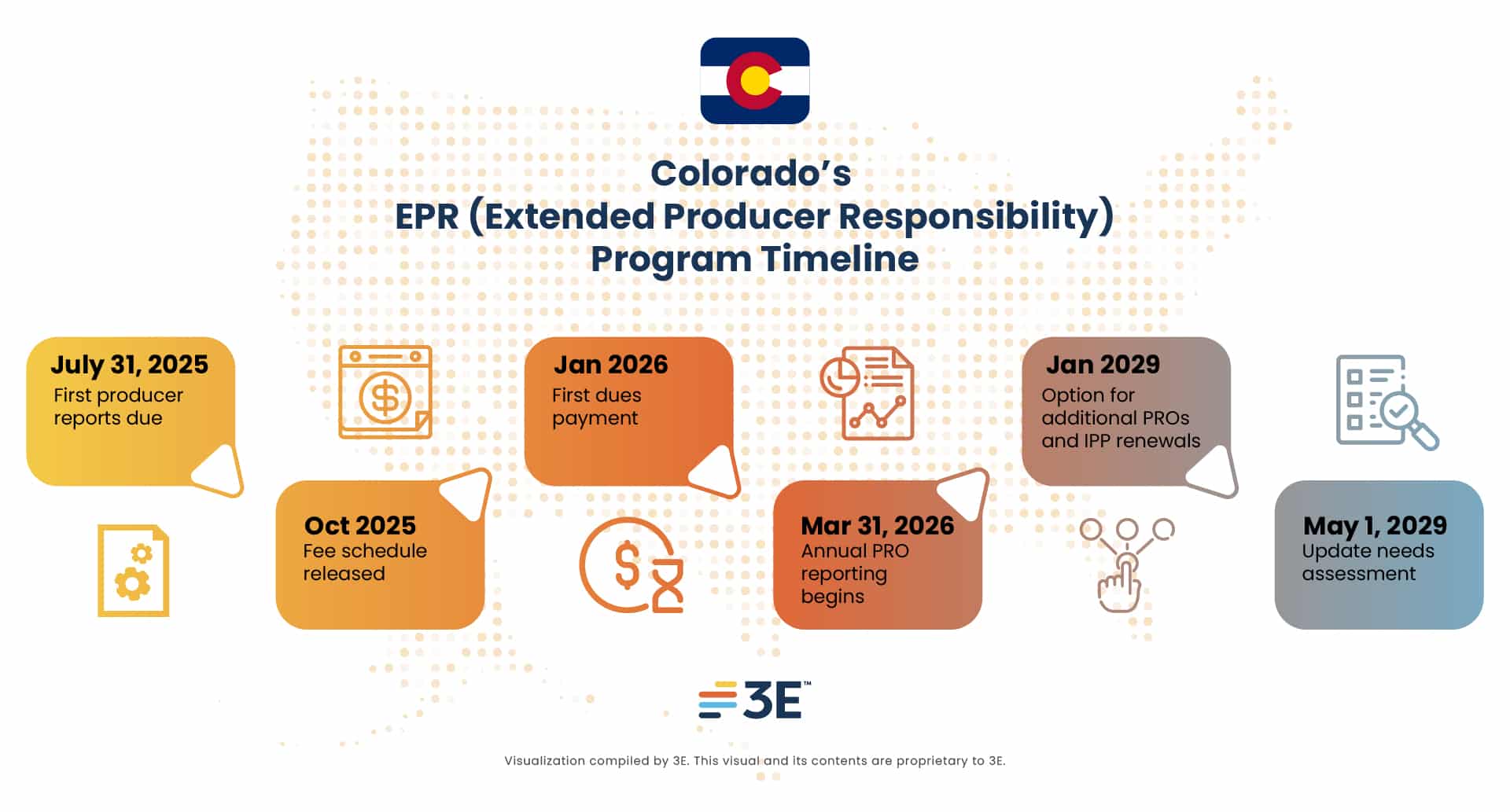
As for industry action, the first producer reports are due on July 31, 2025. Producers must sign the Colorado State Addendum and submit data on the weight and type of packaging and paper materials sold in Colorado, including estimates of their recyclability and content composition, through the CAA's state-specified reporting portal. Reports will be due annually and must be supported by documentation retained for at least five years.
The Future for EPR in Colorado
Cutter, now in her final year as a legislator, hopes future lawmakers will continue to expand the program. One of her top goals is adding compost to the EPR framework. “We're hoping to be able to roll compost into the program because that is just such a huge issue. It touches so many different areas - food waste, methane release, and all kinds of things. I would really like to see that tackled in EPR eventually, and I think that's the long-term goal.”
Looking back on the effort, Cutter credits a strong coalition of environmental advocates and a skilled lobbyist for the bill's success. She emphasized the importance of stakeholder engagement and public education. “I think people felt truly heard and that the process was good. They did such a good job of educating people that people were excited about this. It's kind of a wonky policy and people all over know about it,” she said.
Cutter also reflected on the future of the bill for the U.S. based on how EPR has been expanding worldwide. “I went on a trip with a state legislator organization to see how they do [EPR] in the European Union. We had a lot of conversations with industry, and I think people recognize that it's worked really well all over the world for years. I think that industry in the states has seen it coming. And the more states here that do it, the more inevitable it is, and I think they're getting on board.”


Insights straight to your inbox
Sign Up NowReporter
Christopher Bornmann
Christopher Bornmann is the State Regulatory and Legal Action Reporter for 3E based in Washington, D.C. He covers the latest legal developments and updates in environmental, health, and safety (EHS) that impact the U.S. at the state level. He has experience working for the U.S. House of Representatives and national advocacy groups.

Related Resources
News
EU Omnibus Packages Part 5: Omnibus V – Simplifying EU Defense Regulation
News
EU Omnibus Packages Part 4: Omnibus IV — Product Regulation, Simplification, and Compliance
News
Athletes Disqualified at 2026 Winter Olympics Over PFAS
News
EU Omnibus Packages Part 3: Simplifying EU Agricultural Regulation