
Related

EU Omnibus Packages Part 5: Omnibus V – Simplifying EU Defense Regulation
EU Omnibus Packages Part 4: Omnibus IV — Product Regulation, Simplification, and Compliance

Athletes Disqualified at 2026 Winter Olympics Over PFAS

EU Omnibus Packages Part 3: Simplifying EU Agricultural Regulation
Compliance Timeline is a monthly feature highlighting key regulatory compliance timelines across jurisdictions, leveraging 3E's research team's insights to keep readers informed of crucial upcoming deadlines and changes in global chemical regulations.
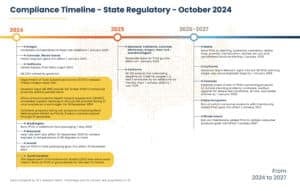
The U.S. State Regulatory Calendar for October 2024 focuses on major actions in California around toxic chemicals and PFAS, and one notable PFAS case in North Carolina.
California OEHHA Considers Listing Vinyl Acetate as Carcinogen
The California Office of Environmental Health Hazard Assessment (OEHHA) announced this month that on 19 December 2024, it will hold a meeting to discuss the potential listing of vinyl acetate as a carcinogen. This listing will fall under the Safe Drinking Water and Toxic Enforcement Act of 1986, or Proposition 65.
Vinyl acetate, commonly used in the production of plastics and food-contact materials, is one of five chemicals under consideration. Businesses must provide clear warnings before exposing individuals to the chemical if listed. The meeting will take place in the Sierra Hearing Room in Sacramento, with options for remote participation via Zoom.
Proposition 65 requires the state to maintain an updated list of chemicals known to cause cancer, congenital disabilities, or reproductive harm. The Carcinogen Identification Committee (CIC), composed of experts appointed by Gov. Gavin Newsom, will review scientific evidence compiled by OEHHA staff and public comments submitted during the consultation period, which ended on 18 November 2024. If the OEHHA lists the chemical, it would require compliance with Proposition 65’s warning requirements within one year of listing.
California DTSC Addresses Possible Carcinogens in New Priority Product Work Plan
In other toxic materials news, the California Department of Toxic Substances Control (DTSC) has released its 2024-2026 Priority Product Work Plan under the Safer Consumer Products Program, focusing on reducing exposure to hazardous chemicals in consumer products. The plan targets beauty and personal care products, building materials, cleaning supplies, and children’s items, emphasizing the protection of vulnerable populations, including workers, children, and marginalized communities. The DTSC plans to explore safer alternatives and regulate at least five priority products over the next three years, hosting public workshops to gather feedback.
On 1 November 2024, the DTSC also initiated rulemaking to list nail products containing methyl methacrylate (MMA) as a Priority Product under the Safer Consumer Products (SCP) regulation. Often found in nail products, MMA poses significant health risks despite past regulatory actions, including its prohibition in California nail salons. MMA exposure has been linked to skin damage, respiratory issues, reproductive toxicity, neurotoxicity, and ocular damage. Nail salon workers face heightened risks due to prolonged exposure in inadequately ventilated environments, often without proper protective equipment.
The DTSC’s work plan prioritizes addressing such hazards, using expanded authority under Senate Bill 502 to require manufacturers to disclose product ingredients and close critical data gaps. By targeting harmful chemicals like MMA and other toxic pollutants like microplastics, the DTSC aims to mitigate health risks while promoting safer consumer products.
California Enacts Groundbreaking T.A.M.P.O.N. Act to Ban PFAS in Menstrual Products
California Gov. Newsom signed the Take All Menstrual Product-PFAS Out Now (T.A.M.P.O.N.) Act, a landmark law banning the manufacture, sale, and distribution of menstrual products containing intentionally added per- and polyfluoroalkyl substances (PFAS) by 1 January 2025. These “forever chemicals,” known for their persistence in the environment and links to severe health issues like cancer, reproductive complications, and liver damage, are commonly found in tampons, pads, menstrual cups, and menstruation underwear. The law also requires unintentional PFAS contamination in such products to be minimized by 2027, with standards set by the DTSC by 1 January 2027.
To enforce the law, the DTSC must develop regulations by 1 January 2029 that clearly define the implementation, interpretation, enforcement, and other specifics of the new regulations. Manufacturers must also register with the DTSC and provide product information by that date to comply with the law. Violations will result in civil penalties starting at $10,000 per offense, with funds collected earmarked for enforcement efforts.
The T.A.M.P.O.N. Act is part of California’s broader initiative to eliminate PFAS from consumer products, joining recent bans on the chemicals in cosmetics, clothing, and firefighting foam. Advocates emphasize the importance of this regulation, citing studies that found PFAS in a significant percentage of menstrual products tested, posing unique risks to users.
California Strengthens PFAS Regulation in Consumer Products With AB 347
In more PFAS news from California, Gov. Newsom signed Assembly Bill 347, which places juvenile products, textiles, and food packaging under the authority of the DTSC, which is tasked with enforcing PFAS prohibitions. The law also narrows the definition of juvenile products to specified items, such as cribs, playmats, and strollers, to focus enforcement on products most likely to expose children under 12 to PFAS. By 1 July 2029, manufacturers of these products must register with the DTSC, pay registration fees, and submit compliance certifications confirming adherence to PFAS restrictions.
AB 347 also authorizes the DTSC to test products or rely on third-party testing to ensure compliance. Beginning 1 July 2030, the department will enforce the law through penalties starting at $10,000 per offense and may issue injunctions to prevent noncompliant products from being sold. Revenue from penalties and registration fees will fund the PFAS Enforcement Fund to support these regulatory efforts. A mandatory report detailing compliance and enforcement activities will be submitted to the state legislature by 1 July 2033, ensuring transparency and accountability.
The legislation provides a phased timeline, allowing manufacturers time to comply while prioritizing public health and environmental safety.
North Carolina Implements Interim PFAS Groundwater Limits
The North Carolina Department of Environmental Quality (DEQ) has introduced interim groundwater limits for PFAS effective as of 15 October 2024. These temporary standards will remain in place for up to 12 months as the agency works to finalize permanent groundwater regulations for PFAS. Citizen concerns over contamination in domestic water wells prompted these new limits, which align with North Carolina’s broader strategy to address PFAS pollution in groundwater, surface water, and drinking water. The state has been heavily concerned with PFAS regulation since the discovery of “GenX” contamination in the Cape Fear River in June 2017.
Businesses tied to PFAS contamination may face new scrutiny, as properties exceeding the interim limits may trigger remediation responsibilities. The DEQ also intends to use these standards to establish discharge limits in new environmental permits, potentially impacting manufacturing, waste management, and agribusiness industries.
Adnan Malik contributed to this article.
Editor’s Note: 3E is expanding news coverage to provide customers with insights into topics that enable a safer, more sustainable world by protecting people, safeguarding products, and helping businesses grow. Deep Dive articles, produced by reporters, feature interviews with subject matter experts and influencers as well as exclusive analysis provided by 3E researchers and consultants. All information is accurate as of the date of publication.


Insights straight to your inbox
Sign Up NowReporter
Christopher Bornmann
Christopher Bornmann is the State Regulatory and Legal Action Reporter for 3E based in Washington, D.C. He covers the latest legal developments and updates in environmental, health, and safety (EHS) that impact the U.S. at the state level. He has experience working for the U.S. House of Representatives and national advocacy groups.

Related Resources
News
EU Omnibus Packages Part 5: Omnibus V – Simplifying EU Defense Regulation
News
EU Omnibus Packages Part 4: Omnibus IV — Product Regulation, Simplification, and Compliance
News
Athletes Disqualified at 2026 Winter Olympics Over PFAS
News
EU Omnibus Packages Part 3: Simplifying EU Agricultural Regulation