Related

EU Omnibus Packages Part 5: Omnibus V – Simplifying EU Defense Regulation

EU Omnibus Packages Part 4: Omnibus IV — Product Regulation, Simplification, and Compliance

Athletes Disqualified at 2026 Winter Olympics Over PFAS

EU Omnibus Packages Part 3: Simplifying EU Agricultural Regulation
2024 was a challenging year for the global automotive industry, impacting industry leaders in both the manufacturing sector and chemical sector. Markus Kamieth, CEO of BASF, highlighted the trend on an international level in the company's Q3 earnings call.
“Compared to our expectations at the beginning of the year, the business development in the automotive industry and the agricultural sector is weaker,” Kamieth said. “This will continue to negatively impact our earnings development in the surface technologies and the agricultural solutions segments in the coming months.”
In its earnings call, BASF pointed to several global factors influencing earnings:
- In Europe, the 2023 production boost spurred by pent-up demand was short-lived and has not been sustained.
- In North America, the lack of demand and increasing inventories is leading companies to delay or cancel the release of new models.
- In China, weak domestic demand continues to decrease sales.
U.S. automotive production has been declining since the pandemic, and global production trends follow a similar pattern with a 5% decline in 2024, particularly pronounced in Europe. Although the continued production decline hurt companies in Q3 of 2024, manufacturing companies and chemical companies alike could potentially find saving grace in the future of electric vehicles (EVs).
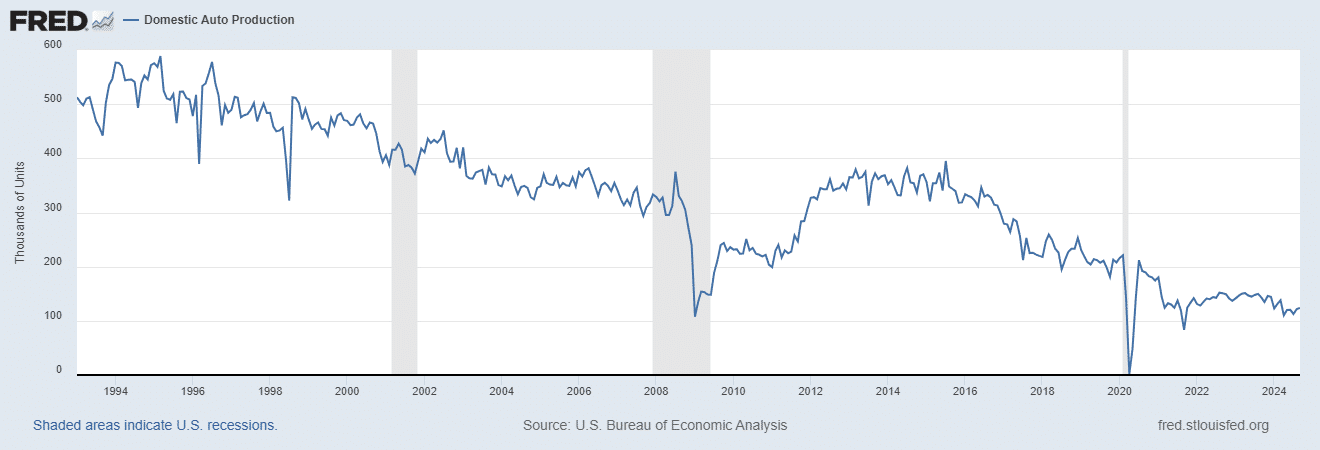
*** U.S. Bureau of Economic Analysis, Domestic Auto Production [DAUPSA], retrieved from FRED, Federal Reserve Bank of St. Louis, November 20, 2024.
Earnings Impacts: Manufacturing Companies
As expected, weakness in the global automotive industry hit car manufacturing companies particularly hard in Q3. The Volkswagen Group's Q3 earnings <Volkswagen Group's nine-month results impacted by higher fixed costs and restructuring provisions | Volkswagen Group> after tax plunged 63.7%. Similarly, competitor BMW Group reported a 61% drop in operating profit in the most recent quarter.
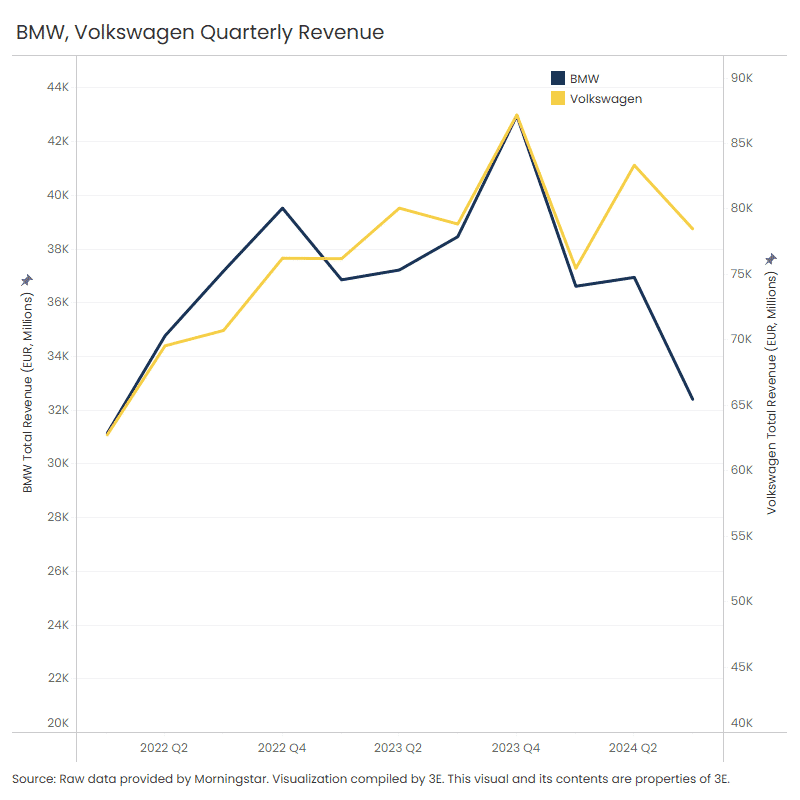
“Given an intensifying competitive environment as well as the ongoing transformation of the industry towards better electric mobility, this is clearly a call for action,” said Volkswagen CFO Arno Antlitz in the company's Q3 earnings call. “We have to step up our efforts to improve our competitive position and cost structures.”
Thomas Puls, senior economist of environment and transport at the German Economic Institute, said the hits the German automotive sector is taking seem amplified because the country is coming off a golden age of automotive production from 2000 to 2018, before it entered a decline. Now, post-pandemic and following the short-lived post-pandemic boom, the German automotive sector faces challenges in all three of its major markets: Increased competition in China; weakening demand in Europe; and uncertainty in what the next U.S. administration will mean for international trade.
“We are coming from a very generous position,” Puls said. “But now we are facing a perfect storm.”
Puls said the technological change from internal combustion engines (ICE) to EVs is a difficult, but necessary, transition for car companies. The investment required to meet those technological changes, along with significant EV competition from China, continue to have a significant impact on auto production.
Earnings Impacts: Chemical Companies
Auto manufacturers are not the only ones feeling the pinch of global automotive weakness. Further up the supply chain, chemical companies were also impacted by the international softness in the automotive market in Q3.
Dow Chemical Company noted that a lack of demand for automotives in Europe and China continue to be a pressure point for the company’s global business. Although BASF saw a successful quarter in many of its sectors, it was offset by significantly declining sales in surface technologies, which are utilized by the automotive industry.
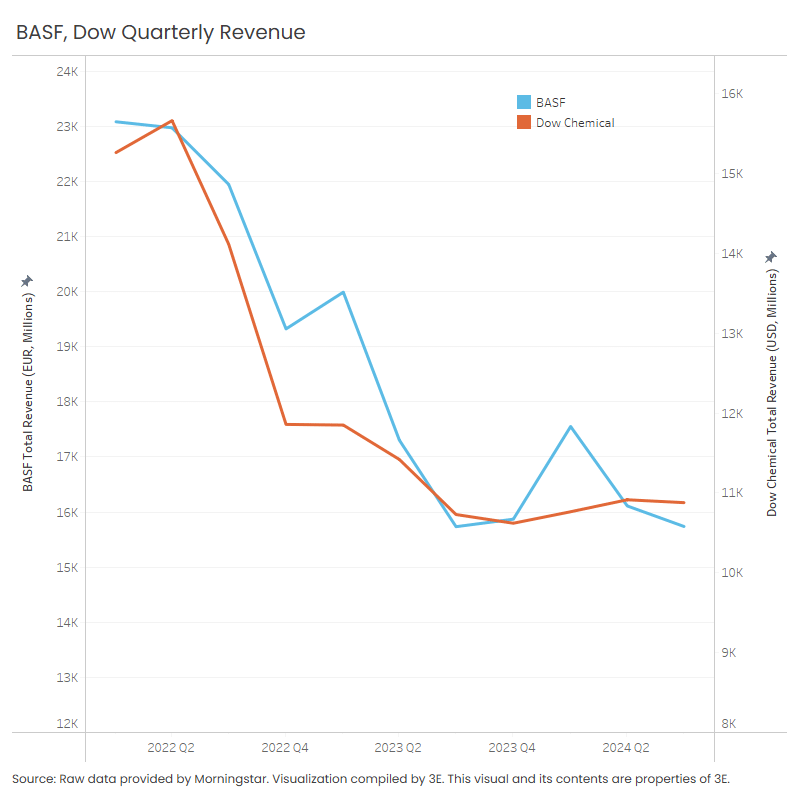
“The overall production volume trajectory … is worrying us right now because Q3 momentum has not been good,” Kamieth said, commenting on the automotive industry. “And with what’s to be expected in Q4, that’s certainly a headwind that we have to face.”
The Future Is EVs
While companies saw a decline in sales due to the weakness in the automotive industry, they found strength in their involvement in producing EVs and materials for EVs. And as Puls said, “the future is the electric car,” and Q3 earnings across industries reflect that, despite a slight global slowdown in EV sales in 2024.
Despite its decline in automotive sales, BMW still saw significant battery electric vehicles (BEV) growth in Q3, with a 19% sales share increase. Volkswagen also saw an increase in BEV order intake. Foxconn, a manufacturing company based in China, reported a 20% increase in year-over-year sales, attributable in part to its expanded EV portfolio.
The favorable EV market is not just promising for manufacturing companies, but it is good for chemical companies, too. Martha Moore, chief economist at the American Chemistry Council, told 3E that while there is a lot of chemistry that goes into producing both ICE vehicles and EVs, polymer content in EVs is greater than that in ICE vehicles.
“As that market evolves, that's good news for chemistry producers and all of the chemistry that goes into battery materials,” Moore said.
2025 Outlook
Although there is opportunity for the market to favor EVs, Puls shared concerns that legislation around them is likely to present more challenges for European automakers. He said while there is favorable momentum on the supply side of EVs, the big question mark is whether there will be the consumer demand to match, due in part to the German government repealing a subsidy for consumers buying EVs at the beginning of 2024. Additionally, the target value of carbon dioxide (CO2) emissions for companies under the European Union CO2 regulation could be significantly lower next year, meaning companies have hefty fines in their future. Puls said the calculated fines for all car makers are around €18 billion.
“Pushed by the German government, we have a very weak EV market, which is obviously poison for the next year with these fines looming on the horizon,” Puls said. “And it's also pretty devastating for the oil production sites in Germany trying to build electric cars for the European market.”
The U.S. market is looking more optimistic. Moore said that even though the market for EVs slowed down in the past year, there is still momentum, and the U.S. is on track to see an increase in overall vehicle sales and assemblies going into 2025 as interest rates start to go down.
“The U.S. economy is fairly healthy,” she said. “We've seen some loosening in the labor market, but it's still relatively good conditions which are supportive for the auto sector.”
Many other factors are at play in determining what will happen with the international automotive industry in 2025, including China's overall economic standing, the trade changes in U.S. tariff policies under a new administration, and the degree to which the EU bolsters its CO2 regulations.
———
Editor's Note: 3E is expanding news coverage to provide customers with insights into topics that enable a safer, more sustainable world by protecting people, safeguarding products, and helping businesses grow. Deep Dive articles, produced by reporters, feature interviews with subject matter experts and influencers as well as exclusive analysis provided by 3E researchers and consultants.
About the Contributor: Dolan Harrington, Data Journalist, 3E.


Insights straight to your inbox
Sign Up NowReporter
Sheridan Wood
Sheridan Wood is 3E's Industry Reporter. She has reported on local, state, and national news for public radio stations KACU, The Texas Standard, and National Public Radio. She has won regional and national reporting awards from the Society of Professional Journalists.

Related Resources
News
EU Omnibus Packages Part 5: Omnibus V – Simplifying EU Defense Regulation
News
EU Omnibus Packages Part 4: Omnibus IV — Product Regulation, Simplification, and Compliance
News
Athletes Disqualified at 2026 Winter Olympics Over PFAS
News
EU Omnibus Packages Part 3: Simplifying EU Agricultural Regulation