
Related

EU Omnibus Packages Part 5: Omnibus V – Simplifying EU Defense Regulation
EU Omnibus Packages Part 4: Omnibus IV — Product Regulation, Simplification, and Compliance

Athletes Disqualified at 2026 Winter Olympics Over PFAS

EU Omnibus Packages Part 3: Simplifying EU Agricultural Regulation
Digital Product Passports in PVC Products: Elevating Sustainability and Transparency
VinylPlus is the European PVC industry association committed to reducing the environmental footprint of PVC products, enhancing recyclability, and promoting circularity. In 2011, VinylPlus took a stand for sustainability by launching its Voluntary Sustainable Development Programme of the European PVC industry. Focusing on driving sustainable practices among PVC providers, this program has advanced from promoting waste reduction, lowering carbon emissions, and using safer additives, to achieving greater overall product transparency, circularity, and sustainability.
Delivering measurable results and meeting aspirational sustainability goals requires data and information shared across the supply chain in reliable, consistent formats that deliver complete product transparency. With this in mind, in January 2025, VinylPlus launched the VinylPlus Digital Passport Programme with the help of 3E and member companies, Beaulieu International Group, Renolit, and Sioen.
What Are Digital Product Passports?
Digital Product Passports (DPPs) are digital documents that contain critical product information including compliance data, certifications, life-cycle details, and sustainability metrics. DPPs make it easy to share and store product data with multiple different stakeholders in a consistent, secure, and meaningful format.
The journey to DPP and product transparency was littered with obstacles
Embarking on the journey to develop DPPs for PVC products was not without obstacles. VinylPlus hoped to identify and address challenges in a pilot to test DPPs for three plasticized PVC products: tarpaulins, cushion flooring, and roofing.
Collecting, managing, and sharing comprehensive product, composition, compliance, and sustainability data across the supply chain is a major undertaking for companies in any industry. However, the PVC industry faces some particularly challenging conditions. For example, collecting and maintaining precise and accurate data regarding the use of recycled materials in products is critically important, not only for accurate sustainability reporting, but also for effective product use and end-of-life recycling. At the same time, specific content formulations can reveal proprietary information, requiring careful curation and aggregation to protect competitive advantage. Accurate and complete data collection from suppliers worldwide can also be a challenge yet is critically important. Given the typically long life of PVC products, ensuring accessibility of the DPP decades later presents a problem. The pilot was designed to reveal and address these and other obstacles to establish foundational best practices for the industry as a whole.
Challenges and Solutions in Adopting Digital Product Passports
Critical sustainability challenges facing the PVC industry include waste management at the product's end-of-life, increased adoption and usage of recycled materials, and controlling substances of concern.
The VinylPlus pilot team outlined both mandatory and voluntary data elements for the DPPs, focusing on compliance with relevant sustainability regulations, required languages, and a standard for digital availability of DPPs for at least ten years. The three products selected for the pilot each presented its own unique challenges and learnings.

article
Identify Substances of Concern Early for Smooth Product Launches
February 12, 2025

article
Driving Sustainability in the European PVC Industry with VinylPlus®
January 14, 2025
Collaborative Efforts for Circularity in the PVC Industry
Beaulieu International Group produces indoor flooring made with cushion vinyl. The company's objective was to enable closed loop recycling of the product. This resilient floor covering has a lifecycle of some 25 years, so the DPPs needed to be available at the end of two or more decades. The team used digital watermark technology, which embeds invisible, machine-readable information directly into products. It is imperceptible to the human eye, but highly resilient and can be accessed straight off the product at the end of use.
Renolit manufactures PVC roofing membranes that provide durable, waterproof protection for buildings. They are subject to Construction Products Regulation (CPR) requirements, making them ideal for inclusion in the pilot. In order to encourage end-of-life recycling into other Renolit products, accurate material assessment is required. Some ingredients can't be mixed, elevating the importance of an accurate product material composition.
Sioen Industries NV manufactures coated technical textiles. The DPP on this product would serve to inform customers about product specifications, proper handling, sustainability performance and repair, remanufacture and recycling options. Repair and remanufacture is common for these products. However, missing information about compositions can make refurbishment impossible.
Results
The DPP pilot project allowed participants to understand the process of creating DPPs and work through logistics. Some of the most vexing challenges addressed in the pilot include:
- Connecting DPPs with product is a challenge – Digital records must be maintained and made available for literally decades after a product is purchased. The link to the digital record must also be embedded in the product in a way that maintains integrity in rigorous conditions. The pilot identified several different approaches, depending on the product.
- Content outline required – With so many different ESG frameworks and different compliance standards that apply to products, it's important to outline the specific content required for inclusion in the DPP. One recommendation resulting from the pilot was that regulatory bodies attempt to harmonize standards moving forward. The pilot team identified both mandatory and voluntary data elements for Digital Product Passports focusing on the ESPR and the CPR. Data also had to be provided in official language of the Member State.
- Stakeholder engagement required – The creation and maintenance of DPPs requires engagement of stakeholders from across the supply chain. In addition, collaboration among competing manufacturers is also beneficial to help advance transparency and sustainability of the industry as a whole.
The full VinylPlus White Paper is available online and tells the story of establishing a foundation for successful DPP implementation across an entire industry.
3E Case Study: PVC Pilot Projects for Circular Economy
In addition to the VinylPlus pilot, 3E also supports streamlined supply chain data management and sharing for other manufacturers in the PVC industry.
Multi-national luxury vinyl tile manufacturer, Novalis Innovative Flooring, has suppliers and customers around the world. Stakeholders across the value chain need to understand the products' composition to properly specify, use, transport, install, and uninstall flooring. In addition, Novalis is committed to advancing sustainability and is working to comply with a number of chemical compliance regulations and voluntary sustainability frameworks. DPPs provided an ideal way for them to consolidate and share critical information for all of these purposes in one location.
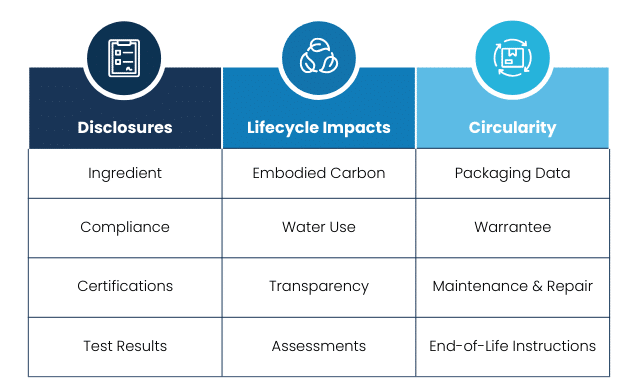
3E Exchange's Digital Product Passports allow Novalis to issue surveys to suppliers to collect and track product composition and sustainability data. 3E Exchange then layers on the latest compliance requirements by region, translates materials into appropriate languages and builds a DPP that Novalis can offer stakeholders from installers and specifiers, to end users with information including:
- Product and manufacturers details
- Chemicals of concern and composition
- Safe use, maintenance and repair information
- Carbon footprint and other environmental impacts
- End-of-life recycling options and instructions
With 3E Exchange, Novalis can achieve material traceability, keep information up-to-date, and respond to ad hoc inquiries.
article
Case Study: How Novalis Uses Digital Product Passports to Drive Sustainability and Supply Chain Transparency
April 1, 2025
How Digital Product Passports Support the EU Green Deal
While the VinylPlus DPP project tells the story of striving for increased circularity in the vinyl industry, the value of DPPs applies to industries across the board. 3E Exchange DPPs can help any industry maintain critical information that elevates transparency and sustainability. DPPs play a critical role in achieving the EU Circular Economy Action Plan, as part of the EU Green Deal. Forward-thinking manufacturers can start establishing a foundation now for DPPs.
Regardless of where you are in the process, 3E can help you take the next step. Schedule a consultation today.


Insights straight to your inbox
Sign Up NowRelated Resources
News
EU Omnibus Packages Part 5: Omnibus V – Simplifying EU Defense Regulation
News
EU Omnibus Packages Part 4: Omnibus IV — Product Regulation, Simplification, and Compliance
News
Athletes Disqualified at 2026 Winter Olympics Over PFAS
News
EU Omnibus Packages Part 3: Simplifying EU Agricultural Regulation