Related

EU Omnibus Packages Part 5: Omnibus V – Simplifying EU Defense Regulation
EU Omnibus Packages Part 4: Omnibus IV — Product Regulation, Simplification, and Compliance

Athletes Disqualified at 2026 Winter Olympics Over PFAS

EU Omnibus Packages Part 3: Simplifying EU Agricultural Regulation
On 5 December 2024, more than 25 years after negotiations began, the European Union (EU) and the Southern Common Market, known as MERCOSUR - consisting of Argentina, Brazil, Paraguay, Bolivia, and suspended member Venezuela - reached an agreement to create a free trade zone covering more than 700 million people and 25% of global gross domestic product (GDP), making it one of the largest free trade zones in the world.
MERCOSUR currently imposes high tariffs on imported goods, including 35% on cars, clothing, and leather shoes; 14% for pharmaceuticals; and up to 18% on chemicals. The new agreement will remove tariffs on 91% of goods exported from the EU to Mercosur.
“For Europeans, it opens up a vast region to freely trade with, including access to critical raw materials, and diminishes the risk of competitors replacing us in our absence,” said High Representative for Foreign Affairs and Security Policy/Vice-President of the European Commission Kaja Kallas. “The deal creates a market for over 700 million people and saves businesses in Europe billions in EUR annually in tariffs. For both sides, it will lead to many more jobs and opportunities. This is good foreign policy and a good day for the EU and our partners in Latin America.”
A Troubled Path to Success
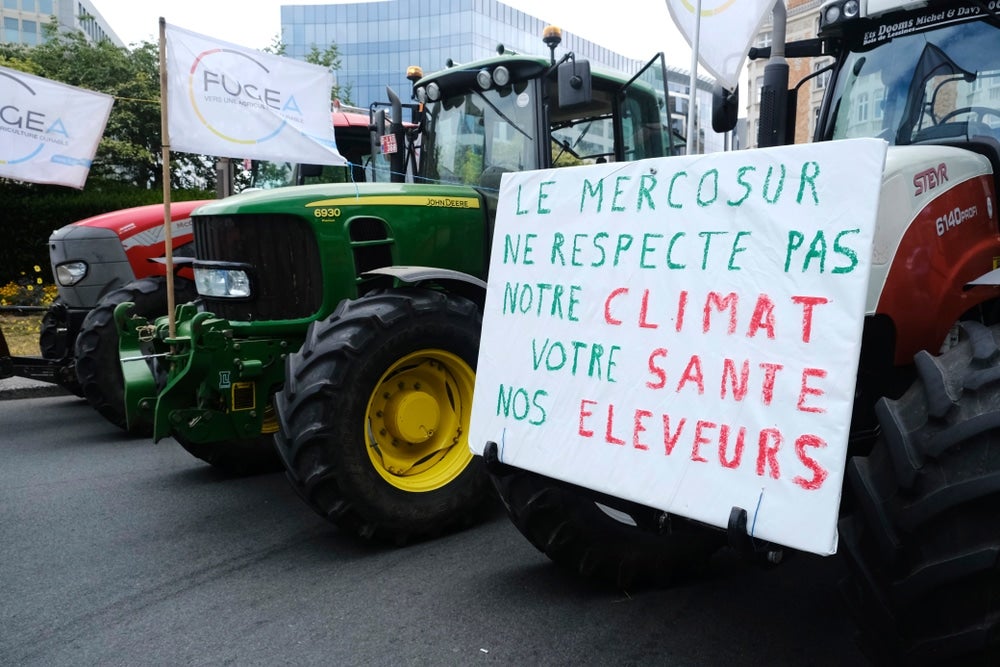
Up until a few hours before the announcement, it remained far from certain that any agreement was going to be possible. France has resisted the deal out of concern that MERCOSUR agriculture industries will flood the EU market with cheap poultry and beef, which would undercut French agriculture. Opposition to the deal has united broad sections of French society, especially French farmers, and has caused significant tensions between France and Germany after repeated French vetoes during negotiations.
EU Commission President Ursula von der Leyen flew to Uruguay on 5 December to give the talks the final push they needed to cross the finish line.
However, despite the agreement, hostilities remain. France continues to oppose the deal and has joined a coalition with Poland to block the agreement. Italy, Ireland, the Netherlands, and Austria have also expressed reservations about implementation.
Von der Leyen has sought to assure dissenters that the agreement will be to the benefit of every EU member state. “We have listened to the concerns of our farmers and we acted on them,” said von der Leyen. “This agreement includes robust safeguards to protect your livelihoods. EU-Mercosur is the biggest agreement ever, when it comes to the protection of EU food and drinks products. More than 350 EU products now are protected by a geographical indication. In addition, our European health and food standards remain untouchable. Mercosur exporters will have to comply strictly with these standards to access the EU market. This is the reality of an agreement that will save EU companies €4 billion worth of export duties per year.”
The agreement will still require approval from member states of the EU Council and the European Parliament.
Environmental Groups Decry Mercosur Agreement
Beyond the bureaucracy, environmental groups have also expressed their opposition to the deal, asserting that it will violate several climate laws, encourage the use of banned pesticides, and undermine efforts to establish a global plastics treaty.
“This agreement encourages the import of highly polluting and health-damaging items that will soon be banned from the European market,” said Greenpeace Brazil Executive Director Carolina Pasquali. “In practice, it can lead to increased deforestation, as we exchange commodities-often sourced from deforested areas, including the Amazon-for the import of pesticides, automobiles, combustion engines, and plastics. It is also concerning that negotiations surrounding the agreement with Mercosur have been used as bargaining chips to delay and make the European Union's Anti-Deforestation Law more flexible.”
Greenpeace further accused the EU of splitting the agreement into separate instruments that eliminate member states' right to veto the deal and remove it from national and regional scrutiny.
———
Editor's Note: 3E is expanding news coverage to provide customers with insights into topics that enable a safer, more sustainable world by protecting people, safeguarding products, and helping businesses grow.


Insights straight to your inbox
Sign Up NowReporter
Graham Freeman
Graham Freeman is based in Toronto, where he covers ESG and sustainability news. Graham has been a content and technical writer in the technology industry for more than a decade. He has also worked as a professor and lecturer at Queen’s University, the University of Toronto, and George Brown College.
Related Resources
News
EU Omnibus Packages Part 5: Omnibus V – Simplifying EU Defense Regulation
News
EU Omnibus Packages Part 4: Omnibus IV — Product Regulation, Simplification, and Compliance
News
Athletes Disqualified at 2026 Winter Olympics Over PFAS
News
EU Omnibus Packages Part 3: Simplifying EU Agricultural Regulation