
*Updated 1.13.2025
With the realization of the health impact from PFAS, new PFAS regulations are popping up around the globe. Be prepared to manage your product compliance – no matter where you operate – and protect your compliance status and brand reputation. In this article, we examine current PFAS regulation around the globe, highlighting efforts by the European Union, United States, and Asia Pacific to address harm caused by this broad class of chemicals. Key takeaways and predictions are provided so that you may be at the forefront of compliance and sustainability in PFAS management.
Per- and polyfluoroalkyl substances (PFAS) are chemicals widely used in industries such as aerospace, automotive, food & beverage, textiles, construction, firefighting, and electronics. What makes them unique, and thus valuable in many products, is their ability to act as an oil and water repellent, to provide friction reduction, and to insulate products. However, these qualities are also what make PFAS so dangerous to human health. Once PFAS enter the environment (and our bodies), they may bioaccumulate causing increased toxicity. PFAS are known for their great persistence in the environment.
In the past few years, there has been an acknowledgement among regulators that PFAS must be controlled.
For instance:

The matrix of PFAS regulation is complex, as multiple countries are taking an aggressive stance on eliminating PFAS in commerce and mitigating risks related to improper disposal or accidental release.
PFAS Around the Globe
Geographically a regulatory overhaul is coming from all directions. The European Union (EU), the United States (U.S.), and Asia-Pacific are all approaching the challenge of PFAS, yet they are doing so in unique ways.
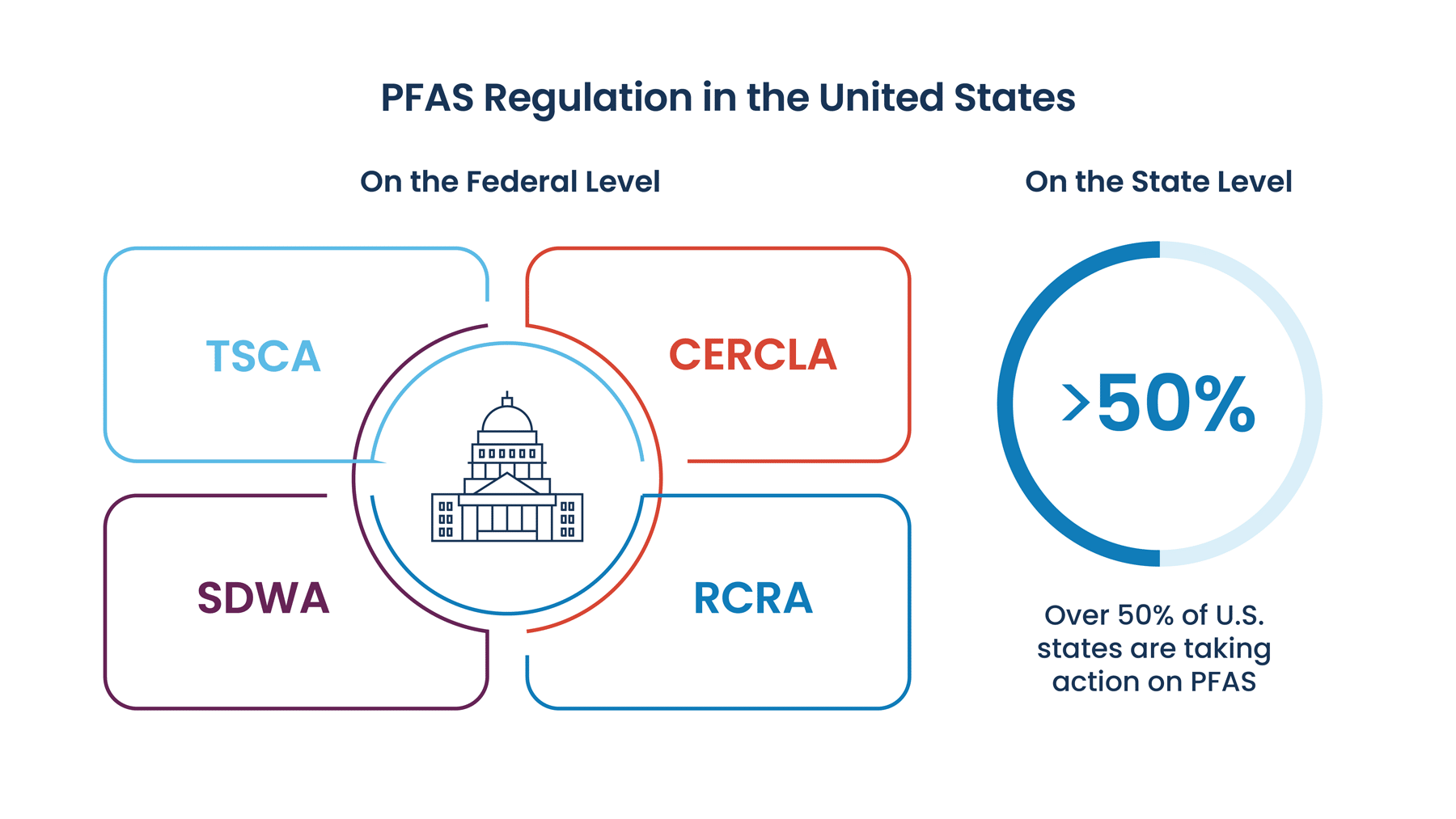
Tactically, countries are employing numerous statutes and regulatory schemes to control PFAS. For example, in the U.S. alone PFAS are (or will soon be) regulated under the Toxic Substances Control Act (TSCA), the Comprehensive Environmental Response, Compensation and Liability Act of 1980 (CERCLA), the Resource Conservation and Recovery Act (RCRA), and the Safe Drinking Water Act (SDWA). In addition, U.S. states have their own bans on PFAS separate from the federal regulations. Thus, companies operating in certain states must be aware of both the state-specific bans and the overarching federal requirements.
The EU’s Approach
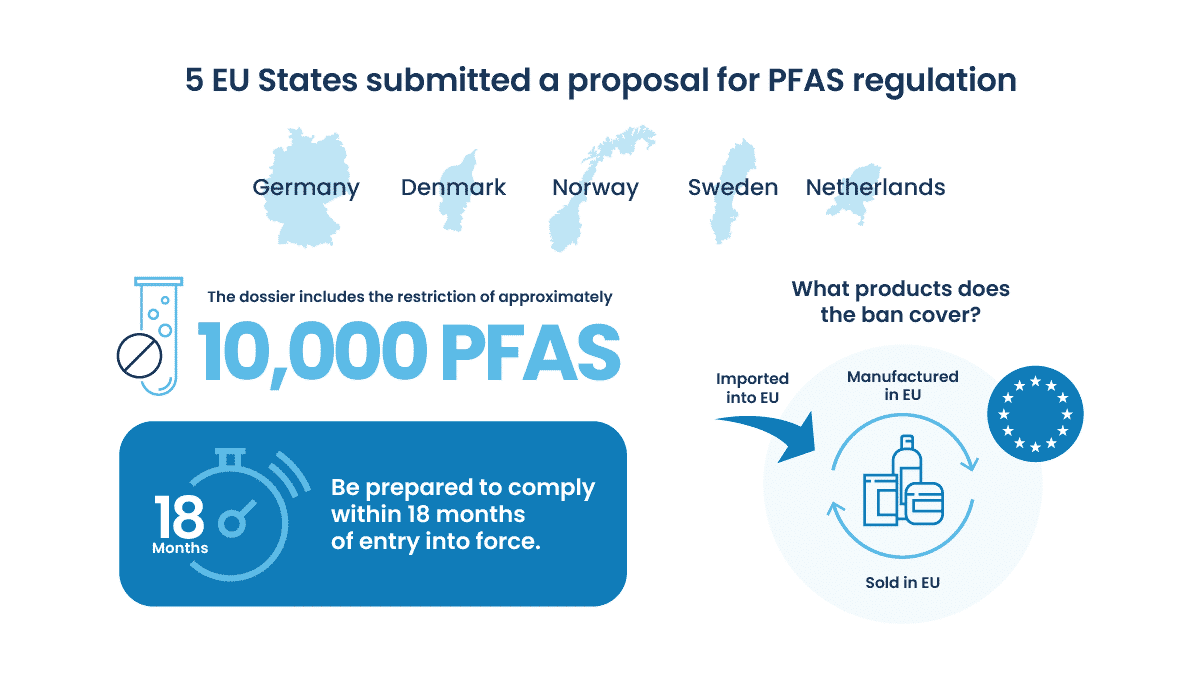
The EU's main mechanism for regulating chemicals is the Registration, Evaluation, Authorisation and Restriction of Chemicals (REACH) regulation. Five EU states (Germany, Denmark, Norway, Sweden, and the Netherlands) recently submitted a proposal for PFAS regulation (in the form of a dossier) to the European Chemicals Agency (ECHA). The dossier includes the restriction of approximately 10,000 PFASs for the EU. Pursuant to the administrative process: ECHA receives public comment, ECHA committees submit their opinions, and the European Commission decides whether to make the legislation into enforceable law. 3E predicts that the effective date of the new law will likely occur during the years 2026 or 2027.
Important points:
- The proposed ban covers companies in a variety of industries that manufacture products containing PFAS, sell and/or import PFAS in the EU, and otherwise use PFAS.
- There are two options presented in the dossier:
- A complete ban – with a transition period of 18 months OR
- A complete ban that includes narrowly defined and time-limited derogations of 5 or 12 years for certain uses of PFAS. Note: these derogations would be added to the transition period of 18 months. (*Citations below).
If the new restriction is finalized, it automatically applies to all EU member states. In addition, all European Economic Area (EEA) states must comply with EU regulations.
Other considerations that are important to this restriction and the allocation of derogations are the following:
- Technical feasibility
- Whether the products made are of critical importance (e.g., medical use vs. cosmetic use)
- How easily replacements can be found
This restriction is significant due to the number of PFAS included, the broad coverage of industries, and the plethora of uses covered.
See also: DEEP DIVE: PFAS in Europe: France Makes a Bold Move
The U.S.'s Approach
As mentioned above, the U.S. is employing many statutory and regulatory options to address PFAS on a federal level. The below list includes recent developments in PFAS regulation.
*Safer States: Bill Tracker
TSCA: In response to the dangers of PFAS, the EPA finalized a new PFAS reporting rule under Section 8(a)(7). Companies that currently manufacture and/or import (or have manufactured and/or imported) products containing PFAS must electronically report on “PFAS uses, production volumes, byproducts, disposal, exposures, and existing information on environmental or health effects” from January 1, 2011 forward (88 FR 70516; see the Federal Register).
CERCLA: On April 17, 2024, the EPA signed a final rule designating perfluorooctanoic acid (PFOA) and perfluorooctane sulfonic acid (PFOS) as hazardous substances. Companies must “immediately” report any release of these two PFAS to the appropriate authorities if they “meet or exceed” reportable quantities. See the Federal Register for more info.
SDWA Final Standard: The final PFAS National Primary Drinking Water Regulation (NPDWR) was announced on April 10, 2024. The Maximum Contaminant Level for both PFOA and PFOS is 4.0 parts per trillion. See the Federal Register for more info.
RCRA: The EPA is proposing to list 9 PFAS as hazardous constituents. If finalized, this rule would consider these PFAS during RCRA facility assessments and RCRA corrective action processes.
On the state level, many US states have banned PFAS in products in order to protect their citizens.
For example, California, Colorado, Connecticut, Hawaii, Maine, Maryland, Minnesota, New York, Oregon, Rhode Island, and Washington all ban PFAS in food packaging. For a visual, see this map from Safer States.
Asia-Pacific's Approach
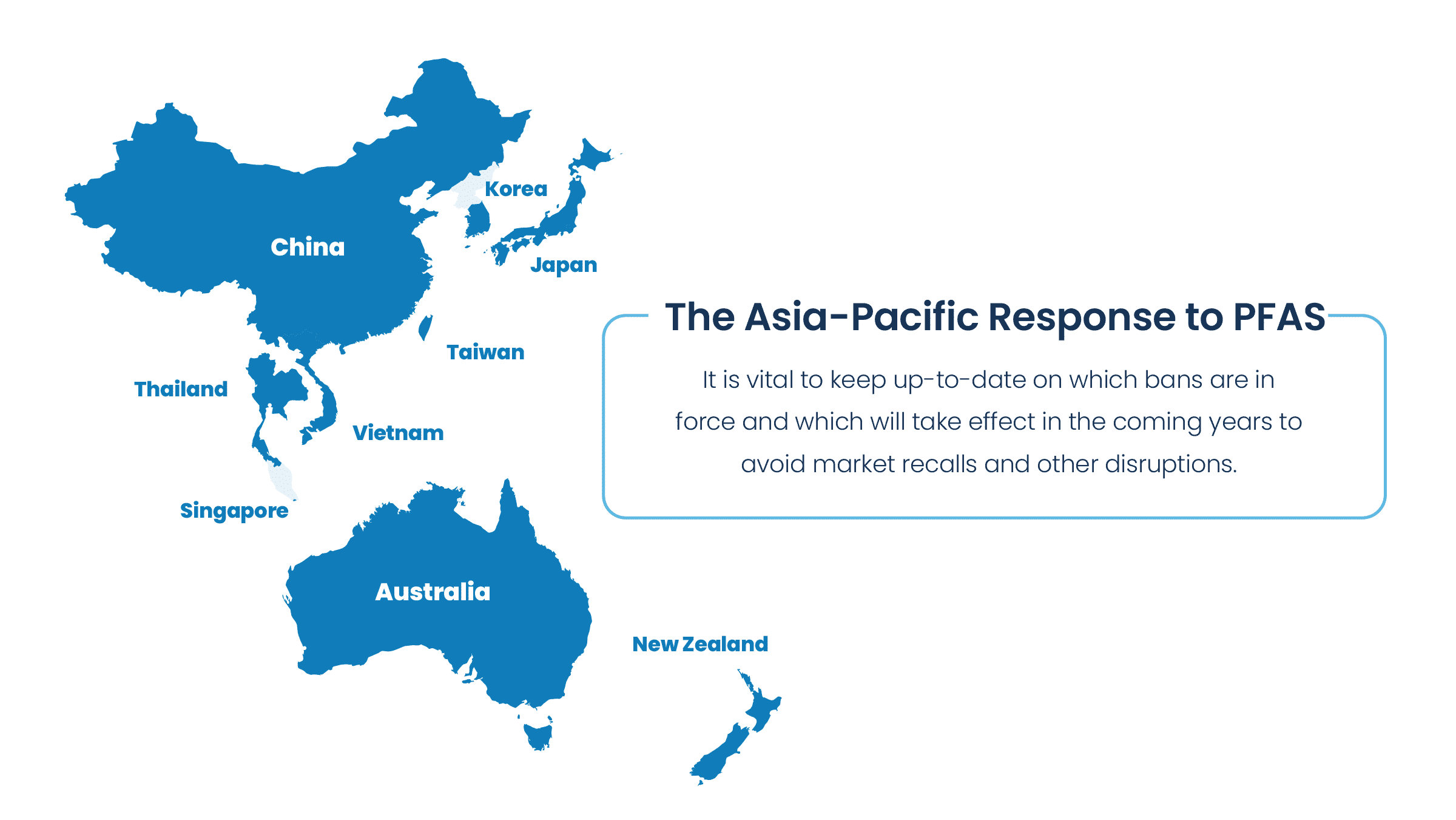
The Stockholm Convention on Persistent Organic Pollutants (POPs) influences the Asia-Pacific region’s PFAS regulations. A common approach under these agreements is to classify PFAS as POPs, leading to restrictions or prohibitions on major PFAS groups, such as PFOA and PFOS, and Perfluorohexanesulfonic acid (PFHxS), its salts and related substances.
At the national level, regulations governing PFAS in the Asia-Pacific are often integrated into existing chemical management frameworks. These PFAS substances are typically classified as highly toxic or hazardous under chemical control legislation in various countries, including Australia, China, Japan, South Korea, New Zealand, Taiwan, Thailand, Vietnam, and Singapore. In cases where the manufacturing or importing of PFAS is not explicitly prohibited, companies must obtain permits, such as licenses, before they can manufacture, import, distribute, or use these substances. These regulatory measures are consistent with implementing the Stockholm Convention into national legislation.
Several countries are adopting or planning to implement progressive measures on PFAS to align with regulatory trends set by the US and EU. For instance, following the EU’s lead, New Zealand will ban PFAS in cosmetics starting January 2027. Additionally, concerns over PFAS contamination in drinking water are also increasing. Taiwan plans to enforce limits on the maximum PFAS content in drinking water by July 2027. Similarly, Japan restricts PFAS in drinking water and monitors their presence.
See the Secretariat of the Stockholm Convention, “Acceptable Purposes: PFOS, its salts and PFOSF” and “Chemicals proposed for listing under the Convention” for more information on POPs.
Definitions Matter
One final note is that countries (and even U.S. states) do not define PFAS the same way. The impact of differing definitions is that companies operating in multiple jurisdictions must be aware of the actual chemical structure of the substances used in their products to confirm whether their products do, in fact, contain PFAS.
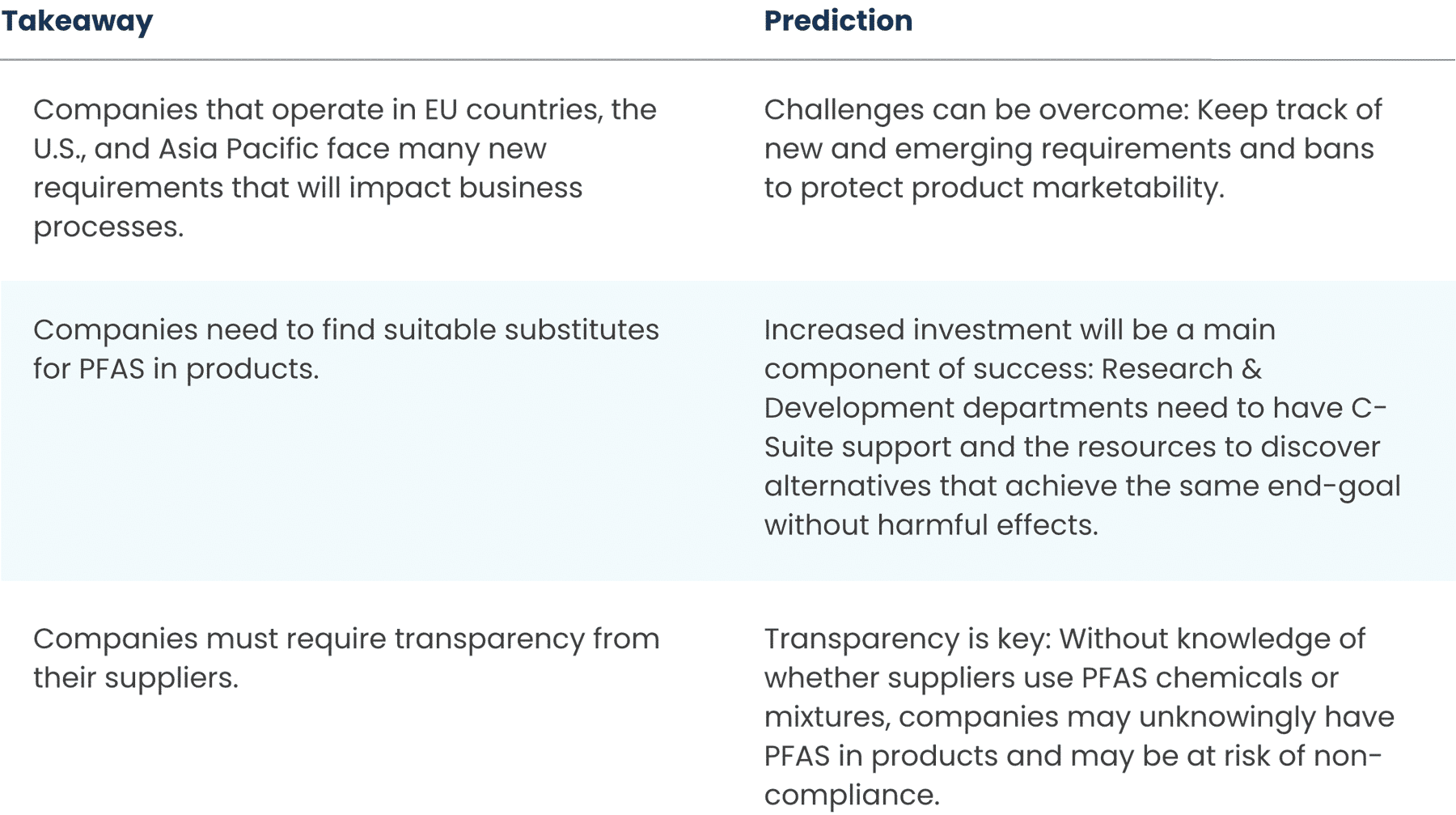
Key Takeaways and Predictions
Citations:
Time, “All The Stuff In Your Home That Might Contain PFAS 'Forever Chemicals,” May 19, 2023.
3E, “Deep Dive: Experts Anticipate Surge in PFAS Legislation in 2024,” February 6, 2024.
EWG, “Suspected Industrial Discharges of PFAS.”
Ruttloff, M. and Burchert, T., Gleiss Lutz, Public Law “PFAS Restriction Proposal on the EU Level,” (03.21.2024).
European Chemicals Agency (ECHA) (ECHA/NR/23/04), “ECHA publishes PFAS restriction proposal,” (02.07.2023).
Safer States, “Bill Tracker.”
Secretariat of the Stockholm Convention, “Acceptable Purposes: PFOS, its salts and PFOSF.”
Secretariat of the Stockholm Convention, “Chemicals proposed for listing under the Convention.”
Contact an expert today!


Insights straight to your inbox
Sign Up NowRelated Resources

News
EU Omnibus Packages Part 5: Omnibus V – Simplifying EU Defense Regulation
News
EU Omnibus Packages Part 4: Omnibus IV — Product Regulation, Simplification, and Compliance

News
Athletes Disqualified at 2026 Winter Olympics Over PFAS

News
EU Omnibus Packages Part 3: Simplifying EU Agricultural Regulation