Related

EU Omnibus Packages Part 5: Omnibus V – Simplifying EU Defense Regulation
EU Omnibus Packages Part 4: Omnibus IV — Product Regulation, Simplification, and Compliance

Athletes Disqualified at 2026 Winter Olympics Over PFAS

EU Omnibus Packages Part 3: Simplifying EU Agricultural Regulation
Climate Week kicked off in New York City on September 21, 2025. Billed as the world's largest non-COP (Conference of the Parties) gathering of global sustainability leaders, the event featured more than 1,000 events around the city dedicated to renewable finance, technology innovation, climate justice, and other critical issues on the sustainability agenda. This year's theme of “Power On” focused on helping the global community remain ambitious and hopeful in the face of a challenging geopolitical environment.
This is the first in a short series of articles that will look at some of the major themes that arose during the streamed sessions on The Hub Live on September 22 and 23.
Needs of Developing Countries and Importance of Finance
The impact of climate change is not felt the same way across the globe. When climate-driven weather creates monster storms that roar through vulnerable communities, the resilience of infrastructure and the ability to recover have a significant impact on the consequences of that weather event.
“When hurricanes go through the U.S., most of the U.S. is fine,” said Climate Envoy from the Caribbean Community (CARICOM) Dr. James Fletcher. “When it happens in the Caribbean, the whole region is devastated on a regular basis.”
Prime Minister of Antigua and Barbuda Gaston Browne highlighted that while his region produces less than 0.01% of carbon emissions, it suffers a disproportionate impact from climate change.
“Climate change is a threat multiplier,” said Browne. “For small islands, it turns every storm into a fiscal catastrophe, every drought into a food security emergency, and every inch of sea-level rise into an existential threat.”
Damage to urban infrastructure and commercial capacity are not the only consequences of climate change in vulnerable communities. Minister of Climate Change from the Republic of Vanuatu Ralph Regenvanu emphasized that there is also the incalculable loss of identity that comes from the destruction of landmarks that have been the focus of cultural life for thousands of years in some regions.
Climate financing has been a contentious topic of discussion at every COP and environmental meeting over the last few years, and while there has been some progress toward finding an equitable model for giving vulnerable regions the resources they need to become resilient in the face of the devastating impact of climate change, the issue is far from settled. Developing nations want opportunities to grow and thrive while being resilient in the face of climate change, not simply to survive.
“Resilience is not an abstract concept. It's something we have to deal with every day,” said Fletcher. “We talk about bouncing back, but we don't want to bounce back, we want to bounce forward. If you're constantly bouncing back, three years later you're at the same point you were three years ago.”
Mexico’s Minister of Environment and Natural Resources Alicia Bárcena Ibarra emphasized that while adaptation is going to be a critical approach for many countries, it will necessitate new ways of financing that will take time to create. This could include bonds or hurricane clauses that allow climate-impacted countries to have a moratorium on repaying debt while recovering from climate-induced weather damage. She also noted the importance of community participation in all adaptation approaches to ensure they don't become theoretical, top-down mandates that are ill-suited to the needs of the communities they are supposed to serve.
Browne said that any financing approach has to account for the economic realities of places like Antigua and Barbuda, and that rigorous and equitable financing models will provide the best approach to helping those regions adapt to a climate crisis that is beyond their control.
“Climate financing is not charity,” said Browne. “It is justice, and it is certainly survival, especially for small-island developing states.”
Bold Leaders Need to Step Up
Many speakers noted the importance of leadership taking bold action and acknowledging difficult realities, even if it doesn't win votes or support from industry.
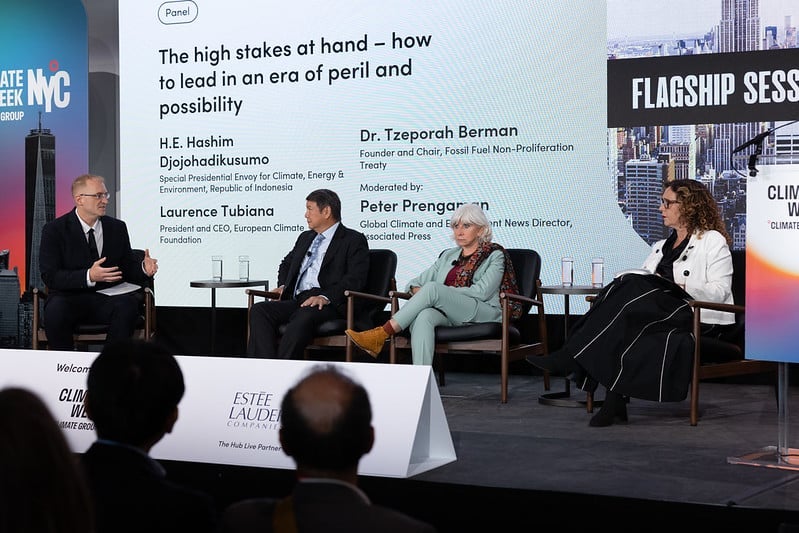
Founder and chair of the Fossil Fuel Non-Proliferation Treaty Tzeporah Berman said that political leadership needs to find the courage to meet the climate change problem by addressing the root causes and preventing them from growing.
“We can't just build the good stuff,” said Berman. “We have to stop building the bad stuff, because the atmosphere doesn't care how many solar panels we build; the atmosphere cares how many fossil fuel projects we don't. When we look at the question of what bold leadership looks like, it means those in a position of power need to stop pretending they're climate leaders while supporting more drilling, more fracking, and more LNG. We have to stop expanding oil, gas, and coal, and we have to stop investing in fossil fuels.”
President and CEO of the European Climate Foundation Laurence Tubiana said that while the EU has been a sustainability leader in the past, evolving geopolitical realities are presenting significant challenges. Citing the invasion of Ukraine, sustainability reform in the EU, and policy changes in the U.S., she said there is a global push against climate policy, with some exceptions in countries like Brazil, Indonesia, and China.
“We need a plan,” she said. “We need a trade and investment partnership to develop the transition with cooperative aspects and not extractivism, not just picking the resources out of a country but culturally developing the value chain.”
Sustainability vs. Economic Reality
While the importance of climate change remains near the top of many corporate agendas, the reality of capitalism is that companies exist to make a profit. Many companies are unable to support environmental action without a financial justification for doing so. As such, it becomes especially important to find opportunities for profit while at the same time protecting the environment, since the cost of not taking action could be much higher.
“Climate risk is financial risk,” said Carine Smith Ihenacho, chief governance and compliance officer at Norges Bank Investment Management. “It cuts across all asset classes, it affects the global economy, it affects individual companies, and it affects us as an investor.”
As always, the cost of energy is a significant factor in every economic decision. Special Representative of the U.N. Secretary-General Damilola Ogunbiyi urged the importance of equitable energy security for everyone. She noted that while energy emissions reached an all-time high of 37.8 billion tons in 2024, 84% of the world lives in developing countries that need jobs and opportunities for youth, and that those regions need more energy to support their innovation culture and national economies. Sustainable energy could provide lower costs and more opportunities, but with many developing regions hungry for energy, the energy transition will be more important, and potentially more contentious, than ever.
Indonesian Special Presidential Envoy for Climate, Energy, and Environment H.E. Hashim Djojohadikusumo spoke candidly on the importance of acknowledging economic realities in building a sustainable world.
“The reality is that Indonesia is a major producer of fossil fuels,” said Djojohadikusumo. “That's the reality. Indonesia is the second biggest producer of coal, and we are the largest exporter of seaborne coal. A lot of the growth, a lot of the economy, a lot of the GDP of Indonesia comes from fossil fuels.”
However, Djojohadikusumo acknowledged that at the same time as it faces these realities, Indonesia's islands are disappearing because of rising sea levels, making it one of the world's biggest victims of climate change.
Djojohadikusumo explained that economic realities mean fossil fuels will continue to play a critical role in supporting the economic life of the nation.
“There's a lot of pressure on Indonesia to phase out coal,” he said. “I can tell you that's not real, and one of the major problems that we have is social progress and employment. To create employment, we would need cheap energy to fuel our factories. It's impossible politically and socially to close down all our coal, so that's the dilemma we have.”
Djojohadikusumo noted that a sustainable world built on equity and not outdated colonial attitudes will require some of the more developed countries to recognize the justice in letting developing nations take advantage of the resources they have.
“In Indonesia, we have a lot of civil society, a lot of NGOs, and there is a lot of disgruntlement and a lot of anxiety and unhappiness about the major power - the United States - pulling out of the major treaty [The Paris Climate Agreement],” said Djojohadikusumo. “So, a lot of Indonesians are not happy. We've just started developing. We started industrial development only about 50 or 60 years ago, whereas countries like the United States have been doing it since the Industrial Revolution of the 18th century. Where is the climate justice?”
Closing Thoughts
Sustainability and the fight against climate change are on the defensive. Economic downturns, energy prices, and geopolitical conflict are ratcheting up the tension on environmental advocates. At the same time, climate-driven weather events are demonstrating exactly what the future is going to look like if nothing is done to prevent them from happening.
The voices from the front line of climate change are telling us about the daily emergencies they face, but there is no uniformity in that message. The reality is that every community has different needs, and many developing nations have to balance the reality of short-term economic growth with the long-term risks of taking advantage of natural resources like fossil fuels.
Climate Week 2025 featured candid voices from across the political and geographical spectrum, and while all of them support taking action to fight climate change, many of them also acknowledged that there is no single vision for getting there, and that whatever solutions we do come up with will not necessarily be for the greater benefit of everyone.


Insights straight to your inbox
Sign Up NowReporter
Graham Freeman
Graham Freeman is based in Toronto, where he covers ESG and sustainability news. Graham has been a content and technical writer in the technology industry for more than a decade. He has also worked as a professor and lecturer at Queen’s University, the University of Toronto, and George Brown College.

Related Resources
News
EU Omnibus Packages Part 5: Omnibus V – Simplifying EU Defense Regulation
News
EU Omnibus Packages Part 4: Omnibus IV — Product Regulation, Simplification, and Compliance
News
Athletes Disqualified at 2026 Winter Olympics Over PFAS
News
EU Omnibus Packages Part 3: Simplifying EU Agricultural Regulation