Related

EU Omnibus Packages Part 5: Omnibus V – Simplifying EU Defense Regulation
EU Omnibus Packages Part 4: Omnibus IV — Product Regulation, Simplification, and Compliance

Athletes Disqualified at 2026 Winter Olympics Over PFAS

EU Omnibus Packages Part 3: Simplifying EU Agricultural Regulation
This story is part of a series, with the next focusing on plastic packaging EPR laws to come out in June.
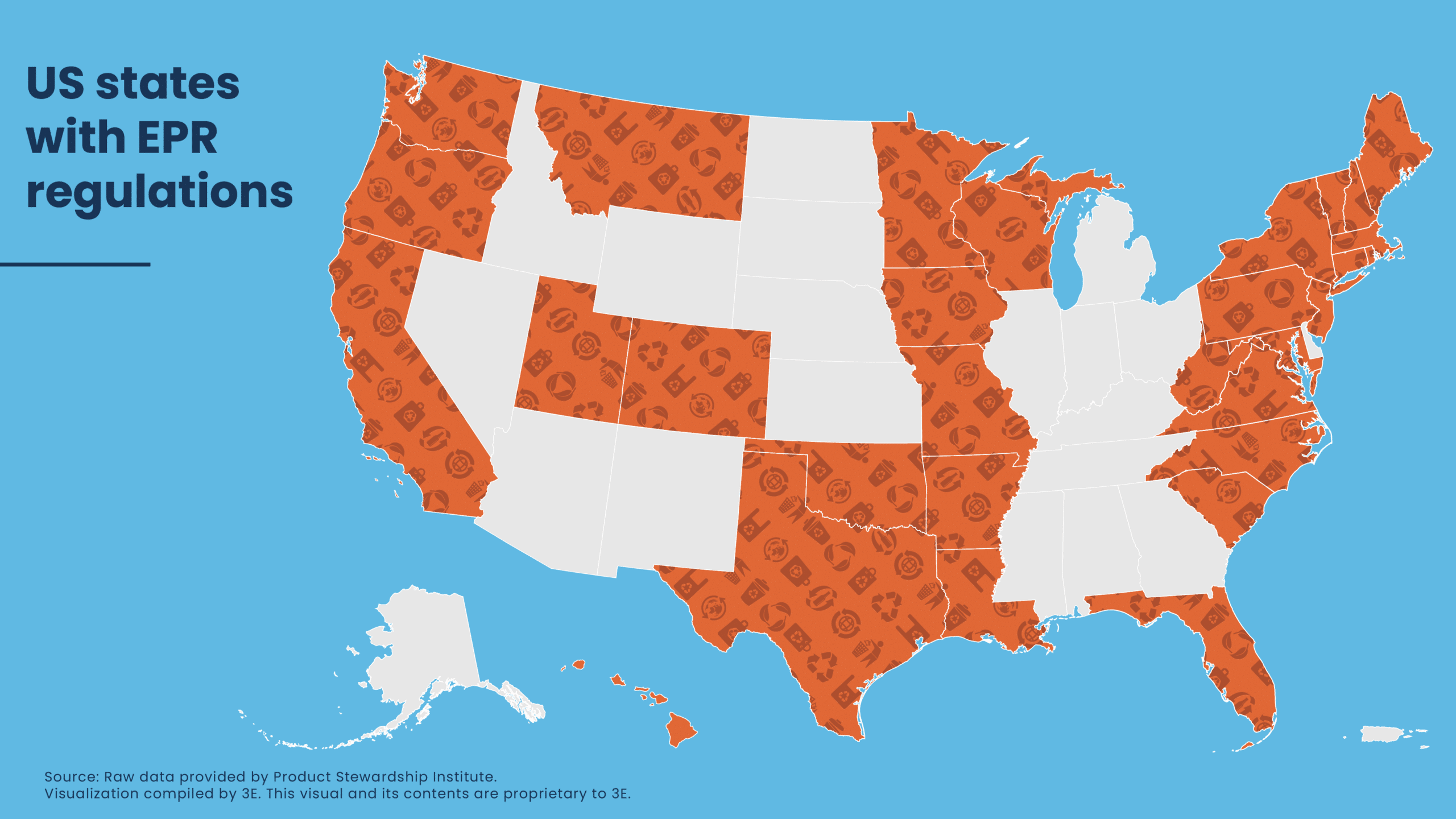
In 1991, Minnesota and New Jersey ushered in the first two Extended Producer Responsibility (EPR) laws in the U.S. These laws, focused on the disposal of rechargeable batteries, were the first attempts in the U.S. by state governments to come to terms with the increase in recyclable waste ending up in landfills across the country. As of 2025, 34 states and the District of Columbia have EPR laws, covering products ranging from textiles to plastic packaging. These efforts were often led by coalitions of local governments, environmental advocacy groups, and public health advocates, citing frustrations with mounting waste management costs and concerns about environmental health.
EPR is a policy framework that requires manufacturers to finance the collection, recycling, or safe disposal of their products once consumers dispose of them. While the concept has gained traction in many countries, most notably in the European Union (EU), the U.S. has yet to pass any EPR regulations at the federal level. This absence of a nationwide EPR policy has resulted in a fragmented policy landscape, where states vary widely in both the products covered and the scope of their regulations.
State–by–State Approach
EPR laws in the U.S. vary significantly in their design and enforcement, with some states requiring multiple steps for industries to be compliant, including detailed stewardship plans and performance goals, while others opt for looser frameworks with little to no oversight.
For example, California, a leader in EPR legislation, passed SB 54 in 2022, which includes incredibly ambitious recycling goals for plastic producers in the state. The three primary stipulations under the regulation are that;
- 25% of plastic packaging and food ware is reduced from the source by 2032
- 100% of packaging and plastic food ware must qualify as recyclable or compostable by 2032
- 65% plastic packaging and food ware recycling rate by 2032
The bill also required that any expanded polystyrene (EPS) sold in the state meet a 25% recycling rate by the beginning of 2025. This was not met, so EPS producers are now prohibited from selling, offering for sale, distributing, or importing EPS food service ware in or into California.
This contrasts with states like Maine and Oregon, which have EPR laws that focus more on general reporting of produced material, with reporting and possible restrictions to take place after 2026. Both states also include exemptions within their EPR laws for packaging, with Oregon exempting small and medium-sized enterprises - defined as “…producers, retailers, or wholesalers that, in the most recent calendar year, had gross sales of less than $1 million in the state” - and Maine exempting beverage containers from its EPR reporting requirements.
Roadblocks and Resistance
The uneven adoption of EPR policies in the U.S. can be traced, in part, to resistance from segments of the business community. Some industry representatives have argued that EPR laws will raise costs, reduce efficiency, and place an undue burden on manufacturers. The plastics and chemical industries in particular have raised objections, arguing that market-based recycling systems are more effective than regulatory mandates.
During the process to pass SB 54 in California, the American Chemistry Council (ACC) raised concerns over the efficacy of the bill.
“Although ACC was actively participating in SB 54 discussions, after careful review of the final legislation we believe it is not the optimal legislation to drive California towards a circular economy,” said Joshua Baca, then vice president of plastics at the ACC.
EPR initiatives have also faced significant roadblocks in implementation, with goals for reclamation and recycling often pushed back or missed entirely. For example, the first major EPR recycling program, the Rechargeable Battery Recycling Corporation (RBRC), promised a 70% collection rate on rechargeable batteries by 2001. The RBRC did not end up hitting that goal, and today, less than 15% of rechargeable batteries are being recycled.
EPR Success
Despite setbacks, the case for EPR has grown stronger in recent years. Local governments see EPR as a way to shift costs of waste management from the taxpayer to the producers profiting from the sale of the products. Hennepin County, Minnesota, reported nearly $700,000 in savings in the first two years of the implementation of its e-waste EPR law. These laws also help local governments expand their recycling sites, making recycling easier for consumers. When Wisconsin enacted its e-waste law, the number of permanent collection sites increased by 70% within two years. Oregon saw a similar jump in paint drop-off locations after its EPR law passed.
Newer laws are also increasingly including stronger enforcement tools, such as requiring producers to meet specific recovery targets, submit reports, fund public outreach, and pay oversight fees. Some states are also using eco-modulated fee structures that incentivize better product design, charging smaller fees for goods that are easier to recycle or reuse, and more for those that generate waste or contain toxic materials.
These successes have increased the support for these programs by environmental and public health advocates, which see the laws as a tool to reduce toxic pollution and encourage safer product design.
“We need EPR because our recycling system isn't producing the right results. We need to ensure that systems are financially sound, that producers of packaging create packaging that is recyclable at scale, and remove barriers to access and problematic materials. Only then – when we streamline our system for businesses and consumers – can recycling be a productive tool in our toolbelt to end plastic leakage into nature,” said the World Wildlife Fund in a statement on EPR.
Recent studies have pushed back against claims that EPR raises consumer prices. Research by the Natural Resources Council of Maine and the Conservation Law Foundation found that producers were unlikely to pass the costs of EPR onto consumers, and that EPR laws could save Maine's municipal taxpayers at least $16 million a year and could increase Maine's recycling rate by nearly 30% within 8-10 years.
The Need for a Federal Framework
Despite growing support and the success of some state EPR programs, the U.S. has yet to implement any EPR laws at the federal level. Advocates argue that a national framework is critical to reducing regulatory complexity and encouraging national companies to support and expand EPR efforts.
“There is some consistency in some areas, but there is also quite a bit of variation in what’s included,” said Peter Hargreave, president at Policy Integrity Inc., and program manager for Colorado for the Circular Action Alliance at an advisory board meeting last July. “[We are] trying to provide more of a standardized approach. There are some issues as we look to implement [programs] and to ensure producers understand what their requirements are.”
Federal action could help provide producers with a consistent framework for their own recycling responsibilities and unlock new funding for recycling infrastructure. While the Senate Committee on Environment and Public Works has held hearings on the possible implementation of federal EPR laws, no bills have advanced through Congress. Until then, EPR in the U.S. will remain a patchwork of state laws, with producers responsible for keeping up with an ever-changing landscape of legislation.


Insights straight to your inbox
Sign Up NowReporter
Christopher Bornmann
Christopher Bornmann is the State Regulatory and Legal Action Reporter for 3E based in Washington, D.C. He covers the latest legal developments and updates in environmental, health, and safety (EHS) that impact the U.S. at the state level. He has experience working for the U.S. House of Representatives and national advocacy groups.

Related Resources
News
EU Omnibus Packages Part 5: Omnibus V – Simplifying EU Defense Regulation
News
EU Omnibus Packages Part 4: Omnibus IV — Product Regulation, Simplification, and Compliance
News
Athletes Disqualified at 2026 Winter Olympics Over PFAS
News
EU Omnibus Packages Part 3: Simplifying EU Agricultural Regulation