Related

EU Omnibus Packages Part 5: Omnibus V – Simplifying EU Defense Regulation
EU Omnibus Packages Part 4: Omnibus IV — Product Regulation, Simplification, and Compliance

Athletes Disqualified at 2026 Winter Olympics Over PFAS

EU Omnibus Packages Part 3: Simplifying EU Agricultural Regulation
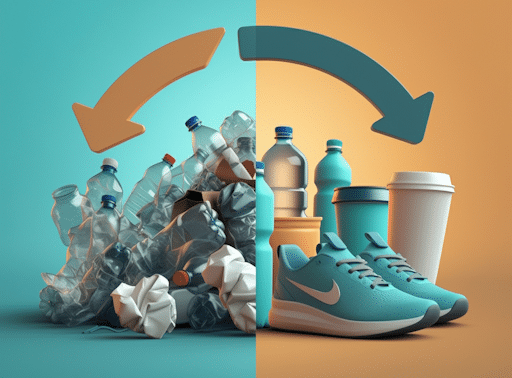
Extended producer responsibility (EPR) is a policy approach that attempts to address the problem of product waste by giving producers and manufacturers responsibilities beyond the point of sale.
In the past, consumers were primarily responsible for disposing of end-of-life products responsibly, either through recycling or disposal. Under EPR, producers must shoulder more of this responsibility through packaging and labeling requirements, support for recycling or reuse, and disposal methods that minimize their impact on the environment.
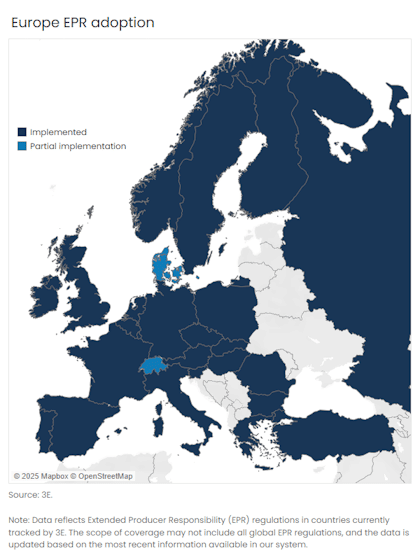
EPR is a critical component in the European Union's (EU) vision of a circular economy as part of its Green Deal. This analysis provides a brief overview of the EU's different legal mechanisms for EPR.
The Evolution of EPR
The concept of EPR was first introduced in the EU in the early 1990s. EPR emerged as a new environmental policy principle, aiming to shift waste management responsibility from municipalities to producers. The Packaging and Packaging Waste Directive (94/62/EC) (PPWD) in 1994 marked the first major legislative application, requiring producers to finance or organize the recovery and recycling of packaging waste. In its early form, the focus of EPR in the EU was end-of-life waste management, and implementation was largely voluntary or industry-led.
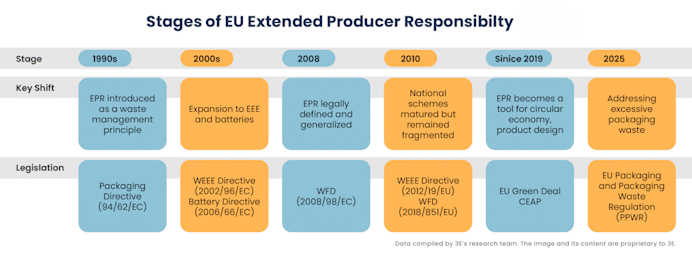
With the publication of the Waste Electrical and Electronic Equipment Directive (2002/96/EC) (WEEE) and the Battery Directive (2006/66/EC) in the early 2000s, EPR obligations expanded to key waste streams. For the first time, these directives introduced take-back obligations, collection targets, recycling quotas, and system requirements for registration and reporting. Producers also became responsible for financing and organizing the treatment and disposal of their products at end-of-life. The directives began to create more structured national compliance schemes. Some member states imposed stricter requirements (e.g., France, Germany), which increased the complexity of compliance efforts.
At the end of that decade, the Waste Framework Directive (2008/98/EC) (WFD) explicitly defined EPR in EU legislation as a policy tool applicable to a wide range of product categories and provided a general legal basis for its application across different waste streams. It also set the legal basis for future expansion and encouraged member states to establish EPR systems. This marked a shift from treating EPR as a sector-specific mechanism to recognizing it as a horizontal instrument of EU environmental policy.
Impact of the Waste Framework Directive on EPR
In the 2010s, the WEEE Directive was revised (2012/19/EU) and the amendments to the WFD (2018/851/EU) came into force, with the consequence that EPR schemes became more comprehensive and mandatory, with clearer enforcement rules. Member states implemented national registers, compliance fees, and reporting tools.
The WFD defines the basic principles of waste management to ensure the protection of human health and the environment. It introduces a polluter-pays principle and EPR requirements, as well as guidelines for hazardous waste, definitions of by-products, criteria for determining when waste ceases to become waste and becomes a product or secondary raw material, and targets for reuse, recycling, and recovery.
The Waste Hierarchy is the foundation of the WFD. It focuses on preventing waste as the preferred method, then moves down in order of preference to reuse, recycling, recovery, and finally, disposal.
The 2023 Amendment to the Waste Framework Directive proposed extending the principles of the WFD to include textile waste, which did not fully adhere to the principles of the WFD and the waste hierarchy. Textile waste has become an important area of focus with the rise of “fast fashion” companies that helped to push the total textile waste generated in the EU in 2019 to 12.6 million tons. These amendments require member states to create new mechanisms for textile waste, which must be supported by additional facilities for collection, sorting, reuse, and recycling.
By the end of the 2010s, the three classic EPR directives were established and implemented by national law. However, their implementation remained fragmented, and the national laws had different product scopes and different definitions of “producer,” as well as various fee structures and reporting frequencies. These discrepancies increased compliance costs and administrative burdens for producers operating across borders.
Green Deal: EPR Comes of Age
Since the introduction of the EU Green Deal in 2019, the understanding of EPR has changed. The Green Deal sets the political agenda and broad strategy of promoting economic growth decoupled from resource use while reducing greenhouse gases (GHGs) by at least 55% by 2030 and achieving zero emissions by 2050. The Green Deal itself does not provide technical legislative detail but is an umbrella strategy supported by extensive legislative mechanisms for climate, energy, agriculture, industrial policy, and finance. It also positions EPR as a strategic enabler of circularity, sustainable product policy, and environmental accountability.
The Circular Economy Action Plan (CEAP) was introduced in 2020 with the goal of making sustainable products the norm in the EU market and to support the circular economy. It describes a new comprehensive understanding of EPR, explicitly defines EPR as a central policy instrument, and lays out concrete actions to expand and harmonize it. The CEAP is the main EU document defining the modern role of EPR, and it frames EPR as a mandatory, harmonized tool for circular economy transformation. EPR is now seen as a driver of sustainable design, circularity, and green innovation, not just waste handling.
The CEAP contains the following key points regarding EPR:
- EPR scope is expanded to new sectors, including textiles, furniture, and construction products, as well as food containers and single-use plastics.
- Harmonized packaging EPR systems. This led to the Packaging and Packaging Waste Regulation 2025/40 (PPWR) proposal, which was published in the official journal in January 2025.
- Link with Digital Product Passports. EPR systems will be connected to product tracking and traceability tools, such as Digital Product Passports (DPPs) under the Eco-Design for Sustainable Products Regulation (ESPR).
PPWR entered into force on February 11, 2025, and will apply from August 12, 2026, replacing the PPWD. The most significant changes in the PPWR are the measures for secondary raw materials, manufacturing, recycling, and reuse, including:
- Restrictions on many single-use plastics, including food packaging
- Minimal packaging weight and volume and avoiding unnecessary packaging
- Targets for minimum percentage of recycled content in packaging by 2030 and 2040
- Bring-your-own-container requirements for take-away food businesses
- Minimal substances of concern in packaging, such as per- and polyfluoroalkyl substances (PFAS).
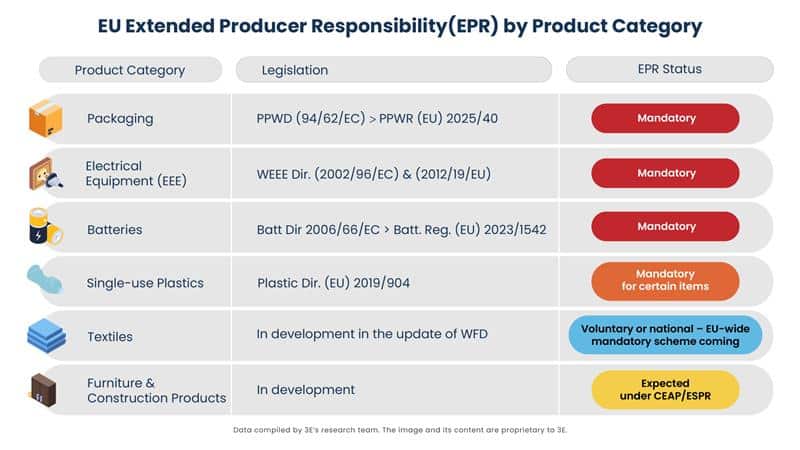
The image below shows the main EPR mechanisms that apply to different product types within the circular economy.
Utilizing Design to Reduce Waste
EPR is an important component of a circular economy that supports innovation, efficiency, and sustainability. By taking on more responsibility for the life cycle of the products they create, producers can design features like recyclability and reusability into their products, which will reduce waste that ends up in the environment or in landfills and will provide sustainable foundations for the EU economy.
Editor's Note: 3E is expanding news coverage to provide customers with insights into topics that enable a safer, more sustainable world by protecting people, safeguarding products, and helping businesses grow. Expert Analysis articles, produced by 3E subject matter experts, researchers, and consultants as well as external thought leaders, examine the regulations, trends, and forces impacting the use, manufacture, transport, and export/import of chemicals.
About the Contributor: Adnan Malik is a Production Specialist and Graphic Designer on 3E's News team. With nearly a decade of experience, he specializes in various design solutions. He holds a Diploma in Information Technology, which complements his extensive expertise in various fields and Industries.
About the Contributor: Dolan Harrington is a Data Journalist at 3E. His analytics career has spanned organizations including Delta Air Lines, Pendo (a unicorn product analytics startup), and S&P Global. He has a master's degree in business analytics from William & Mary.


Insights straight to your inbox
Sign Up NowRelated Resources
News
EU Omnibus Packages Part 5: Omnibus V – Simplifying EU Defense Regulation
News
EU Omnibus Packages Part 4: Omnibus IV — Product Regulation, Simplification, and Compliance
News
Athletes Disqualified at 2026 Winter Olympics Over PFAS
News
EU Omnibus Packages Part 3: Simplifying EU Agricultural Regulation