Related

EU Omnibus Packages Part 5: Omnibus V – Simplifying EU Defense Regulation
EU Omnibus Packages Part 4: Omnibus IV — Product Regulation, Simplification, and Compliance

Athletes Disqualified at 2026 Winter Olympics Over PFAS

EU Omnibus Packages Part 3: Simplifying EU Agricultural Regulation
In May 2025, the U.S. Environmental Protection Agency (EPA) rolled back several regulations of per- and polyfluoroalkyl substances (PFAS) in drinking water. This marks a significant change from the way the Biden administration approached PFAS, but state governments have not been deterred from regulating the “forever chemicals.” On the contrary, since the beginning of this year, nine states have adopted 17 new PFAS regulations, and 36 states are considering another 201.
This pullback from the federal government, combined with the multiple states that are acting in response, has led to a patchwork of PFAS regulations across the U.S. To make things more complicated, state and private attorneys have sued the federal government and manufacturers over PFAS contamination.
To discover how companies can better navigate these myriad PFAS regulations and lawsuits, 3E sat down with Lynn L. Bergeson, managing partner of Bergeson & Campbell, P.C., in Washington, D.C.
Lynn has earned an international reputation for her deep and expansive understanding of chemical product governance programs including the Toxic Substances Control Act (TSCA), the Federal Insecticide, Fungicide, and Rodenticide Act (FIFRA), and the European Union Registration, Evaluation, Authorization, and Restriction of Chemicals (REACH) Regulation.
Q: Recently, the federal government rolled back the maximum contaminant levels (MCLs) for four out of six PFAS chemicals that the Biden administration had set limits on for drinking water and pushed back deadlines for the other two substances. What have you seen in terms of reaction to that decision?
The original 2029 deadline in effect was posing significant challenges for drinking water authorities to comply with these deadlines. For the authorities and others directly impacted by the deadlines that were fast approaching, the rescission of most of those drinking water standards is good news. I think most people would agree that the science is controverted here when it comes to establishing regulatory drinking water standards. PFOA [perfluorooctanoic acid] and PFOS [perfluorooctane sulfonate] are by any independent standard bad actors, but probably not as much in circulation these days because of the withdrawal of those substances from the marketplace. So, for many, the decision to push the date to 2031 was welcome news.
Q: How are recent federal budget proposals and regulatory delays affecting state-level efforts to address PFAS contamination?
Most states would be of the view that the very significant reductions in categorical funding in the FY 2026 budget, which has been zeroed out, and state revolving funds, which have been proposed to be reduced by 90%, would greatly diminish opportunities for states to implement water infrastructure programs that are intended to diminish or reduce PFAS in state water concentrations.
From the perspective of state regulators and state governors, this is a discouraging note, reflecting a broad view by this administration that the states are left to their own devices. The very significant proposed FY 2026 budget reductions would have a decidedly chilling effect on states' ability to implement both permitting and other infrastructure requirements to diminish the concentrations of PFAS in drinking water.
The other federal initiative we all expected to see is the Trump administration's decision to extend the date for compliance with TSCA 8(a)(7). Many of our clients have been implementing a lot of regulatory surveillance in their supply lines to comply with a forthcoming deadline for TSCA 8(a)(7) reporting. But based on the interim final rule issued on May 13, those deadlines have now been pushed back, again.
The potential downside is that it places the regulated community into a prolonged state of uncertainty. The TSCA 8(a)(7) rule has been around for a while now. Many companies have already conducted due diligence to determine what PFAS is intentionally added and whether any meets the narrative definition of a PFAS under the 8(a)(7) rule. They have tried to harmonize those obligations with evolving state-level requirements. So, the downside here is that it is challenging to know what is going to be required, by when, or how much effort to put into complying with the next wave of requirements. There is just a lot of regulatory whiplash, and this adds uncertainty.
Q: What are some of the other things that you have seen in the FY 2026 budget that might impact industry?
The proposed budget includes a reorganization of the Consumer Product Safety Commission (CPSC), including significant staffing cuts. The CPSC would also lose federal funding, which will impact its ability to regulate and implement PFAS restrictions in consumer products to the extent the CPSC was inclined to do that.
Some might see that as welcome news. Public health activists and NGOs probably don't. From the perch that I occupy representing industry, I see it as another layer of straddling the ever-curious divide between product stewardship, tort litigation, and federal regulatory requirements. Even though the federal government is not pursuing some of these initiatives, it still puts regulated entities in a suspended state of uncertainty regarding what their obligations are given the shifting sands of funding and enforcement.
Q: Let's turn to the states. What initiatives have you seen in 2025 so far, and where do you see state regulatory action going?
There are a growing number of state initiatives that are worth noting in Washington, Illinois, Vermont, California, and Minnesota. Let us focus on Minnesota because that program invited concern given the January 1, 2026, reporting obligation for intentionally added PFAS marketed in the state going forward. Before the deadline was recently extended, that state’s program loomed large for many of our clients.
If you have a product with intentionally added PFAS that is going to be sold, offered for sale, or distributed in Minnesota, January 1, 2026, feels like tomorrow. So, it came as welcome news when we heard that the Minnesota Pollution Control Agency (MPCA) has decided to extend that deadline to July 1, 2026.
According to the agency, MPCA is issuing the extension outside the formal rulemaking process to help “ensure program success.” That reporting obligation was a big commercial concern, and there has been a lot of churn around it. There was a public hearing on May 22. There are still major open questions around what qualifies as “intentionally added,” what is a “function,” and how to address PFAS added as, for example, a processing aid upstream in the process where PFAS does not remain in the final product.
It is not surprising that it has been pushed back six months to July 1, 2026. There was too much uncertainty in implementing the law that requires work before going final.
Q: In our last conversation, we talked about how some states were rushing into PFAS regulation and then pulling back. Have you seen more of that this year?
The states that are coming online now have really taken to heart the lessons learned from the pioneers of PFAS regulation and seem to be more circumspect in terms of defining terms, understanding the logistical implications, and being more mindful of the burden on state resources to track and implement program requirements.
The Washington Department of Ecology accepted comments through July 20, 2025, so that is another program to watch. It would require reporting by January 31, 2027, of intentionally added PFAS consistent with the items set forth in the proposed rule, as well as restrictions on PFAS in certain consumer products.
In New Mexico, the state seems willing to consider the toxicological differences that certain fluoropolymers have in contrast with the more traditional persistent, bioaccumulative, and toxic properties of some PFAS. The Illinois legislature also passed HB 2516, which bans certain consumer products with intentionally added PFAS and calls for a scientific assessment of the data concerning fluoropolymers. The measure awaits Governor Pritzker's signature. That is similar to what New Mexico did, [which is] distinguishing between different kinds of PFAS based on toxicological profiles. Other states are pursuing other measures.
To me, these initiatives reflect a maturation of the state approach to regulating PFAS, more tempered by the realities of the day, and of the effort that these programs require.
Q: California also made significant changes to existing PFAS regulations, is that correct?
Yes. There is an amendment to a California bill to remove language regarding intentionally added PFAS that is water soluble. SB 682, passed by the [state senate] on June 3, would have banned products that include intentionally added PFAS that is water soluble, unless it is a currently unavoidable use. That language was added as an amendment, showing a greater appreciation of the complexity and commercial implications of some of these state restrictions, as well as the diversity, toxicological complexity, and enormity of the task of ridding the state of products that might expose PFAS to citizens of the state. The bill has since been amended to remove that language, demonstrating the difficulty in drafting PFAS legislation.
Q: Last time we talked, we discussed these class action lawsuits coming up against U.S. PFAS contamination. So even with the federal government withdrawing, you do not see that affecting litigation?
Yes. There may even be a perverse inverse relationship between these realities: the more the federal government and certain states temper their activities, the more active litigants become, believing that litigation is a form of pressure that will achieve the same practical goal of reducing PFAS released into the environment.
In other words, even though the government may do little or nothing, private entities may still get sued because its products that have been proven to contain intentionally added PFAS are claimed to pose risks.
There is nothing more compelling than staring down a multimillion-dollar class action suit claiming adverse human health and environmental effects allegedly caused by your products. Once you are in that soup, it is very hard to extricate yourself, and litigation can go on for a long time.
PFAS is a significant contaminant of concern for entities alleging adverse human health effects and environmental degradation. I do not see diminished activity in this space any time soon. Even with this backdrop of federal regulators retreating a bit and revisiting some of these rules, there is still a significant level of litigation. There is still a lot of liability being alleged. Insurers are continuing to reduce their coverage for PFAS contamination, and I do not see any change in the near future.
Q: On the note of insurers pulling back their coverage of PFAS-related damages, is that something that is accelerating as the federal government pulls back, or are things staying the same?
Probably not too much change. I am not an insurance expert, but insurers are risk averse. Coverage for PFAS contamination is hard to find. Coverage is available, but the plans are expensive and have big carveouts.
On the good news side, some new analytical techniques are showing more precise speciation between and among PFAS compounds, which could help with liability coverage. On the other hand, newer technologies can detect PFAS at shockingly low levels. For those who believe that any PFAS exposure is harmful, this precision can be a double-edged sword.
Speciation is a technological advance worth celebrating. But if you can now detect PFAS at parts-per-trillion levels, it is not necessarily good news when you are arguing that your product is safe. In fact, it may make liability harder to avoid if your particular PFAS is fingerprinted.
Q: You just mentioned the concern around figuring out who exactly is responsible when PFAS is detected. Have you noticed any regulatory developments aimed at clarifying who is responsible for upstream PFAS?
I have not seen much underway on that front. It is a scientifically complicated area. Determining who the emitter is, or who is ultimately responsible for contamination, is incredibly difficult. A PFAS compound could have transformed five times by the time it reaches the receptor who is alleging adverse health or environmental effects.
Proving that your PFAS was not the cause is challenging. That is difficult for juries, those implementing regulatory cleanup standards, and others in making liability determinations. It is just the tip of the iceberg in terms of how hard these issues are in practice.
Some states are categorically protecting what they call passive receivers, like agricultural entities, landfills, water utilities and those that may be in the chain of liability simply because of the services they provide. I think many in Congress are keen on protecting these entities from liability under CERCLA [Comprehensive Environmental Response, Compensation, and Liability Act] or similar cleanup statutes. The idea is that they did not invite this liability - it came to them.
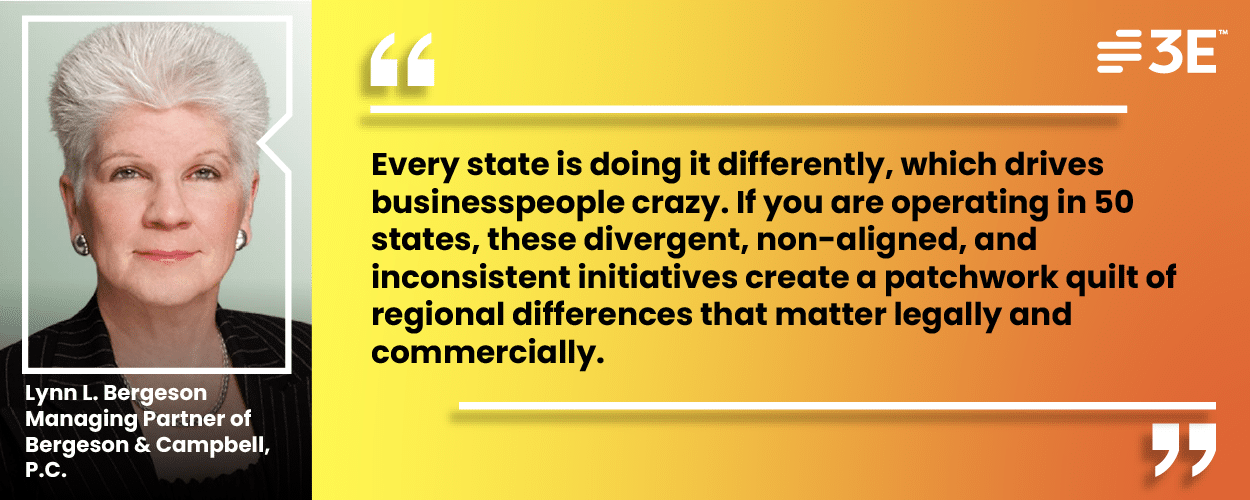
You are dealing with an enormous class of substances, many of which undergo biological transformation that alters their risk, toxicity, and environmental profiles. It is enormously complicated. That area of law is still in its infancy, but it will play out over the next several decades. Every state is doing it differently, which drives businesspeople crazy. If you are operating in 50 states, these divergent, non-aligned, and inconsistent initiatives create a patchwork quilt of regional differences that matter legally and commercially.
Q: Have you seen any attempts by states to harmonize those efforts?
No. It is reminiscent of the state-level chemical regulation efforts that led to the 2016 TSCA amendments. The idea then was that with a strong federal program, the temptation for state-level differences would be reduced. But at the end of the day, states must protect their citizens. And depending on who is in charge and how they view regulation, there is not much room for coordinated regional agreements or state alignment.
Even with a federal standard, states have wildly different interpretations of what the law requires, what levels are safe, and whether a substance even poses a risk. So no, I do not see much effort to harmonize regulations at the state level.
About the contributor: Adnan Malik is a Production Specialist and Graphic Designer on 3E's News team. With nearly a decade of experience, he specializes in various design solutions. He holds a Diploma in Information Technology, which complements his extensive expertise in various fields and Industries.


Insights straight to your inbox
Sign Up NowReporter
Christopher Bornmann
Christopher Bornmann is the State Regulatory and Legal Action Reporter for 3E based in Washington, D.C. He covers the latest legal developments and updates in environmental, health, and safety (EHS) that impact the U.S. at the state level. He has experience working for the U.S. House of Representatives and national advocacy groups.

Related Resources
News
EU Omnibus Packages Part 5: Omnibus V – Simplifying EU Defense Regulation
News
EU Omnibus Packages Part 4: Omnibus IV — Product Regulation, Simplification, and Compliance
News
Athletes Disqualified at 2026 Winter Olympics Over PFAS
News
EU Omnibus Packages Part 3: Simplifying EU Agricultural Regulation