
Related

EU Omnibus Packages Part 5: Omnibus V – Simplifying EU Defense Regulation
EU Omnibus Packages Part 4: Omnibus IV — Product Regulation, Simplification, and Compliance

Athletes Disqualified at 2026 Winter Olympics Over PFAS

EU Omnibus Packages Part 3: Simplifying EU Agricultural Regulation
The purpose of the Restriction of Hazardous Substances in Electrical and Electronic Equipment (RoHS) is to address the growth of waste generated by electronics. When electronic waste is disposed of there are varied risks to the environment and in turn nearby populations. Requirements regarding electronic waste will present ongoing challenges for a variety of operations in the European Union (RoHS is a EU Directive, specific to the EU).
RoHS focuses on ten hazardous substances in EEE:
- Mercury
- Dibutyl phthalate (DBP)
- Diisobutlyl phthalate (DIBP)
- Butyl Benzyl Phthalate (BBP)
- Polybrominated diphenyl ethers (PBDE)
- Cadmium
- Hexavalent chromium
- Bis(2-ethylhexyl) phthalate (DEHP)
- Polybrominated biphenyls (PBB)
- Lead
Examples of electrical and electronic equipment (EEE) are mobile phones, PC's, Laptops, TV's, kitchen equipment.
Companies that want to ensure RoHS compliance and reduce non-compliance risks, should be aware of the multi-dimensional aspects of the directive, given the focus on reducing exposure to hazardous substances as well as promoting safe disposal and even recycling of EEE.
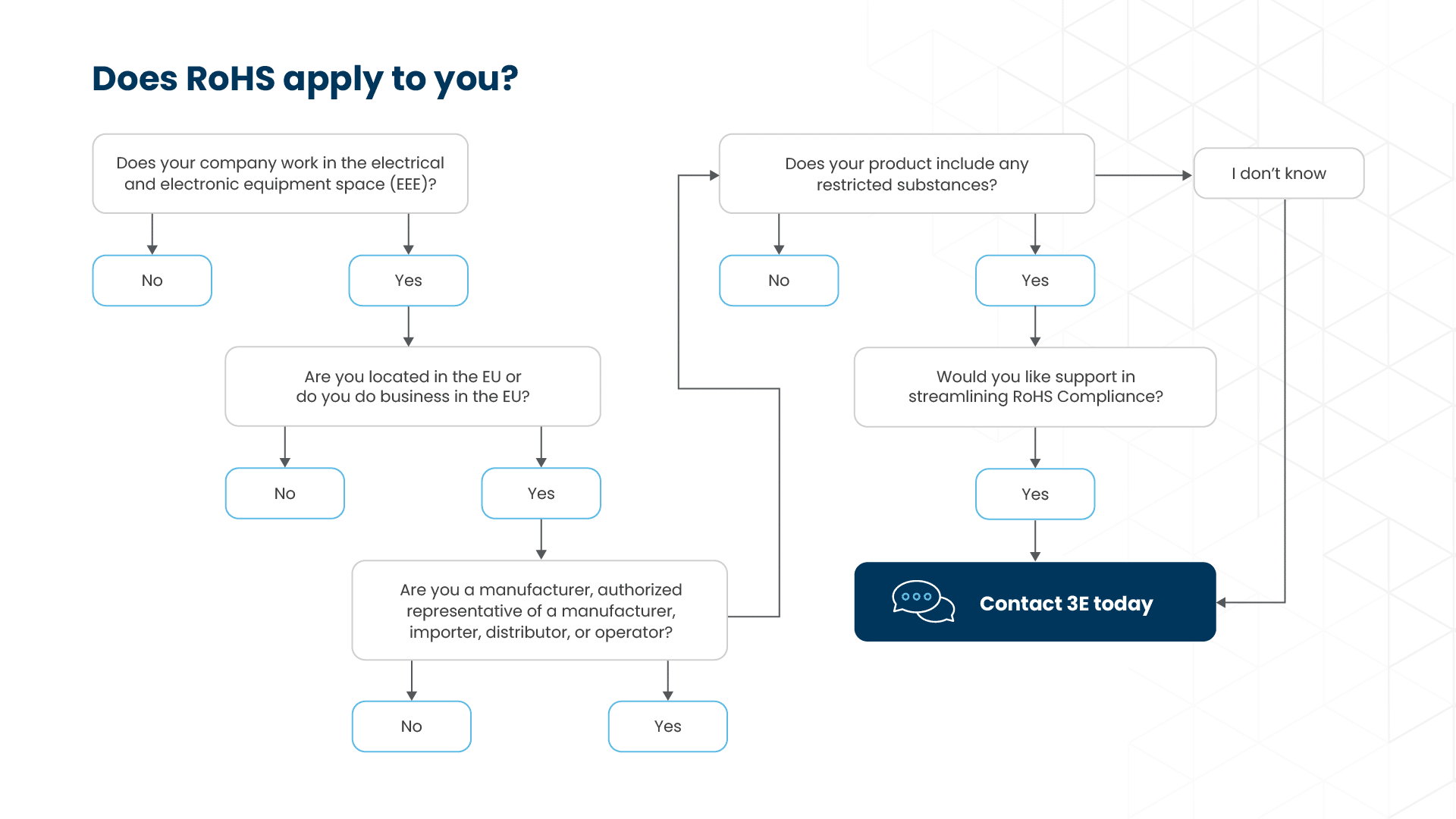
Because RoHS is a EU Directive, individual member states are obligated to transpose the Directive into national law. RoHS applies to a variety of operators.
There are obligations on:
- Manufacturers of products and their authorized representatives
- Importers
- Distributors
- Economic Operators
In Annex II, the Directive mandates certain maximum concentrations by weight in homogeneous materials for certain substances. It is important for companies that fall into the categories above pay attention to the specific percentages tolerated (Annex II) and the exemptions provided (Annex III).
In addition, companies need to stay up-to-date on any changes, such as those encompassed within the “2025 RoHS Compliance Guide“.
Impact of RoHS non-compliance in the EU
One challenge regards consequences of violating transposed RoHS regulations in member states. Under Article 23, the directive provides flexibility to Member States to set penalty amounts. In particular, the language states that penalties must be “effective, proportionate and dissuasive.”
Thus, Member States can have a wide range of penalty values for infringements, and this can provide uncertainty for the regulated community, particularly where a manufacturer may be held liable for actions taken in multiple member states. For instance, if a manufacturer has multiple locations within the EU (e.g., France, Germany, Italy), then penalties might be different if an infringement occurs in all three locations. In addition, if a manufacturer relies upon suppliers and is ultimately responsible for supplier compliance, those suppliers may be subject to varying penalties, based on location.
Achieving RoHS Compliance
There are a number of steps that manufacturers, distributors, importers, and economic operators must take in order to successfully overcome challenges in RoHS compliance.
- Track National Requirements: Different Member States will transpose the RoHS Directive into national law. Because Member States are granted flexibility in how they meet the goals of directives, there are likely to be different requirements in different jurisdictions. Having software that helps track what the regulatory requirements are and when/how they are updated expedites compliance processes.
- Manage Data: Sometimes there is great difficulty in compiling accurate compliance data. This is particularly challenging when dealing with a complex supply chain. Having a software solution that assists in keeping data organized and accurate, is vital to compliance as well.
- Mitigating Risk: It can also be difficult to receive timely responses from suppliers regarding compliance information and workflows. Tools that can help streamline responses assist in mitigating risk of non-compliance and product recalls. Automation also helps to reduce errors in calculation and provide opportunities for internal resources to be allocated elsewhere (such as research & development into suitable “green” alternatives less likely to face regulatory burdens.)
Questions about RoHS and other regulations impacting the electronics industry? Request a consultation.
See related: CONFERENCE CHATTER: Calls for Regulatory Reform Complicate India’s Evolving Supply Chain Role


Insights straight to your inbox
Sign Up NowRelated Resources
News
EU Omnibus Packages Part 5: Omnibus V – Simplifying EU Defense Regulation
News
EU Omnibus Packages Part 4: Omnibus IV — Product Regulation, Simplification, and Compliance
News
Athletes Disqualified at 2026 Winter Olympics Over PFAS
News
EU Omnibus Packages Part 3: Simplifying EU Agricultural Regulation